
The car was stopped at about 9.55 one evening in late September, five minutes before a rapper was due on stage at a music venue north of Copenhagen. Inside, according to Danish prosecutors, were two loaded pistols and two knives. One of the men had bought a ticket to the show. The concert was cancelled, the arrests stayed quiet, and for almost two months the public knew little about why.
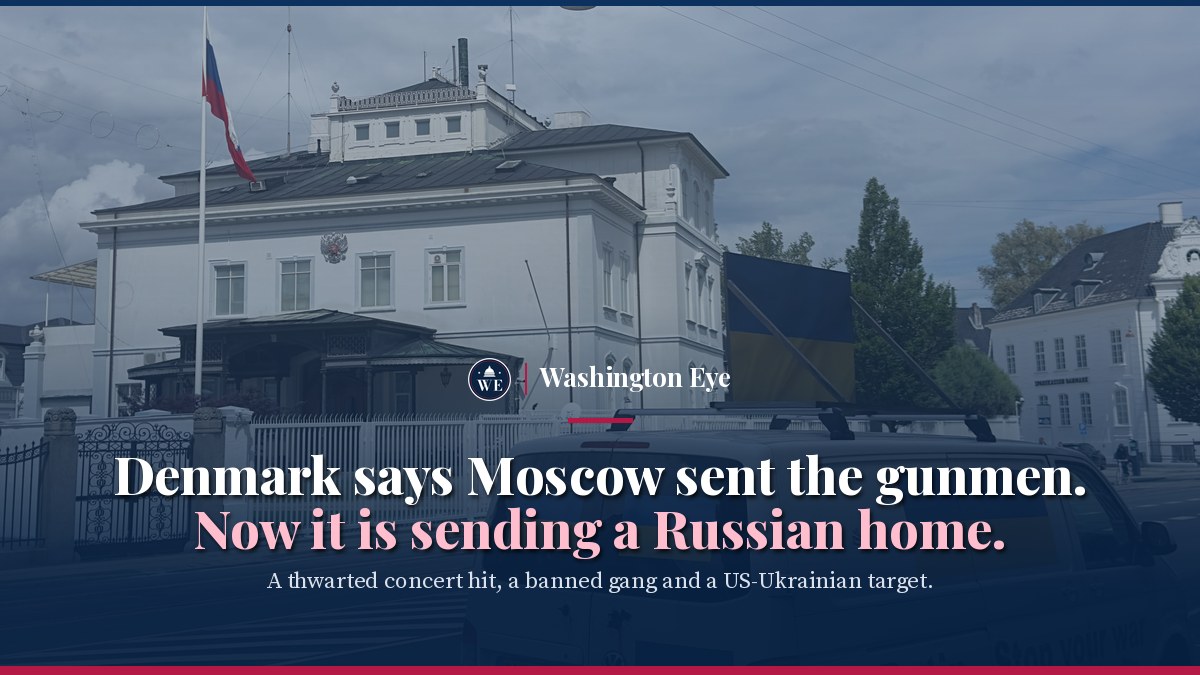
On Friday Denmark said why. Its domestic Security and Intelligence Service, known by its Danish initials PET, announced that the thwarted attack of 25 September was an assassination attempt that had been "planned and initiated by Russian intelligence services", and that the people meant to carry it out were linked to Loyal to Familia, a violent criminal gang that Denmark's Supreme Court banned in 2021. Within hours the foreign minister, Lars Lokke Rasmussen, summoned Russia's ambassador and told him that Moscow's defence attache had seven days to leave the country.
The target, named by Danish media as the performer Kyivstoner, whose real name is Albert Vasiliev, holds both Ukrainian and American citizenship. That detail turns a Nordic security scare into something larger: an alleged Russian state plot to kill a US citizen at a crowded public event inside a NATO country.
What Denmark says happened
PET's account is precise about what it knows and careful about what it does not. The agency says it worked with North Zealand Police to stop an attack that was "already underway and imminent". Three people travelling in a car near the venue were stopped, and firearms and knives were found in the vehicle. A fourth suspect was arrested later that night, police said. The car was intercepted in Hellerup, an affluent residential district on the coast just north of the capital.
Two men have been charged with attempted murder and with assisting a foreign intelligence service to operate in Denmark, an offence under Section 108 of the Danish Criminal Code. They have been held in pre-trial detention since September, and on Friday a court extended the legal grounds for that detention to cover the intelligence charge. Both have denied wrongdoing and pleaded not guilty, according to local reports. PET stressed that the criminal case is separate from its intelligence assessment: the courts, not the agency, will decide what each man did and what he knew about who was behind the operation.
The agency's director general, Rasmus Kieffer-Kristensen, did not hedge on the bigger picture. "A Russian assassination attempt is not something we've seen in Denmark before," he told reporters, "and that gives me an impression of an increasingly aggressive and risk-taking Russia." In PET's written statement he said the case shows Russian services are "both willing and capable of initiating an assassination attempt on Danish soil", using "individuals from Danish criminal gangs". He also said the agency does not see a general threat of assassination against Danish citizens or other residents. The target, in PET's view, was singled out.
Why this rapper
Kyivstoner was on a European tour when the Danish date was cancelled. Danish media reported that he wrote online, in a post later taken down, that Danish intelligence officers had warned him of a threat to his life. European media have also reported that he was the target of an earlier plot in Poland this year, though Danish officials did not discuss that case on Friday.
Moscow had already marked him publicly. In July, Russia's FSB security service accused Vasiliev and the Ukrainian authorities of organising a "terrorist attack" on military facilities and personnel inside Russia. He denied the accusation on social media. Whatever the truth of that charge, it shows that a Ukrainian artist with an American passport had been named as an enemy by Russia's main security agency two months before armed men allegedly drove toward his concert.
The gang as a weapon
The most unsettling part of PET's finding may be the method rather than the target. Loyal to Familia is one of Denmark's best known criminal networks. Danish police say they have brought more than 5,000 criminal charges against its members in the past five years, for violence, drug trafficking, weapons offences, fraud and money laundering, and estimate that around a third of its members are currently behind bars. The ban has not ended its activity.
PET argues that by working through such networks, a foreign intelligence service "gains access to capabilities and networks that can carry out violent operations in Denmark" without sending its own officers. It is a model European security services have warned about for several years: deniable proxies recruited for money, with little or no ideological link to the state that pays them. Kieffer-Kristensen said the possibility that gang members were motivated by financial gain "does not change our responsibility".
The national police commissioner, Lasse Boje, announced intensified nationwide operations against the gang on Friday, aimed at its violence, its sources of income and key figures, including those based abroad. That is a domestic policing response to what Denmark now describes as a foreign security threat.
Copenhagen's answer
Rasmussen chose a pointed but limited diplomatic response. Expelling a defence attache, the military officer at an embassy, sends a message about who Denmark believes was responsible without severing ties. He said Denmark would not expel all Russian diplomats because it still needs to communicate with Moscow. "We are saying this very clearly: we have exposed you," he said.
The sharper proposal is about travel. Denmark already issues few visas to Russians, but Rasmussen noted that a Russian with a Schengen visa from another member state can still enter Denmark. Copenhagen wants the European Union to move toward a halt to all non-essential visas for Russian citizens and, failing that, to make any remaining visas valid only in the country that issued them. That would require agreement from partners that have kept more open policies, and Rasmussen said he would raise it at the European level.
Prime Minister Mette Frederiksen framed the plot as part of a pattern. "We are facing a cornered Russia, acting more aggressively and with a greater propensity to take risks," she said. She listed "drones with explosives near critical infrastructure, sabotage, and destructive cyber attacks across Europe", adding: "The methods may vary, but the overall pattern is clear." Her government promised more resources for police and intelligence. Both she and Rasmussen said the strongest answer was to keep supporting Ukraine. "The strongest response Denmark can give is not to waver," Rasmussen said.
Brussels lined up behind Copenhagen. European Council President Antonio Costa called the plot "unacceptable" and said such actions "will not go unanswered", adding that Russia's tactics would not weaken the bloc's support for Ukraine.
Moscow's denial
Russia rejected the accusation outright. Its embassy in Copenhagen called the expulsion "vengeful" and said Denmark had not presented evidence of Russian involvement. In a statement on social media, the embassy accused Danish authorities of discovering a "Russian trace" to stage "a propaganda spectacle" and of trying to frighten the public to justify a long confrontation with Russia. Foreign ministry spokeswoman Maria Zakharova said Moscow would give "an appropriate response", according to Russian state media.
Denmark has not published the intelligence behind its attribution, and it may never do so in full. What it has made public is the physical evidence of the arrest, the charges, and a formal judgment from its security service. Any trial will test how much of the link to Russian intelligence can be shown in court.
Why it matters beyond Denmark
For Europe, the case sharpens a debate that has been building since drone sightings shut Copenhagen's airport for hours in September 2025: how to respond to hostile acts that fall short of war but now, if Denmark is right, include attempted killings. Denmark's military intelligence service warned in September that Russia was increasingly willing to take risks and carry out physical attacks in Europe. PET's finding is the most concrete example yet offered by Danish authorities.
For Washington, the case lands at an awkward moment. Denmark's parliament has just voted for a permanent defence pact giving the United States expanded access in Greenland, and the two governments are closer on Arctic security than they have been in years. At the same time, the Trump administration is pressing for a settlement of the war in Ukraine. An alleged Russian plot against an American citizen on allied soil raises a question the administration will eventually have to answer: whether it treats this as a Danish criminal case, or as an attack on one of its own.
For now, two men sit in a Danish jail denying the charges, a Russian officer is packing, and a rapper's cancelled concert has become one of the clearest public accusations a European government has made about Moscow's methods. Denmark's message, in its foreign minister's words, is that it has exposed them. The next move belongs to Moscow, and to Denmark's allies.