
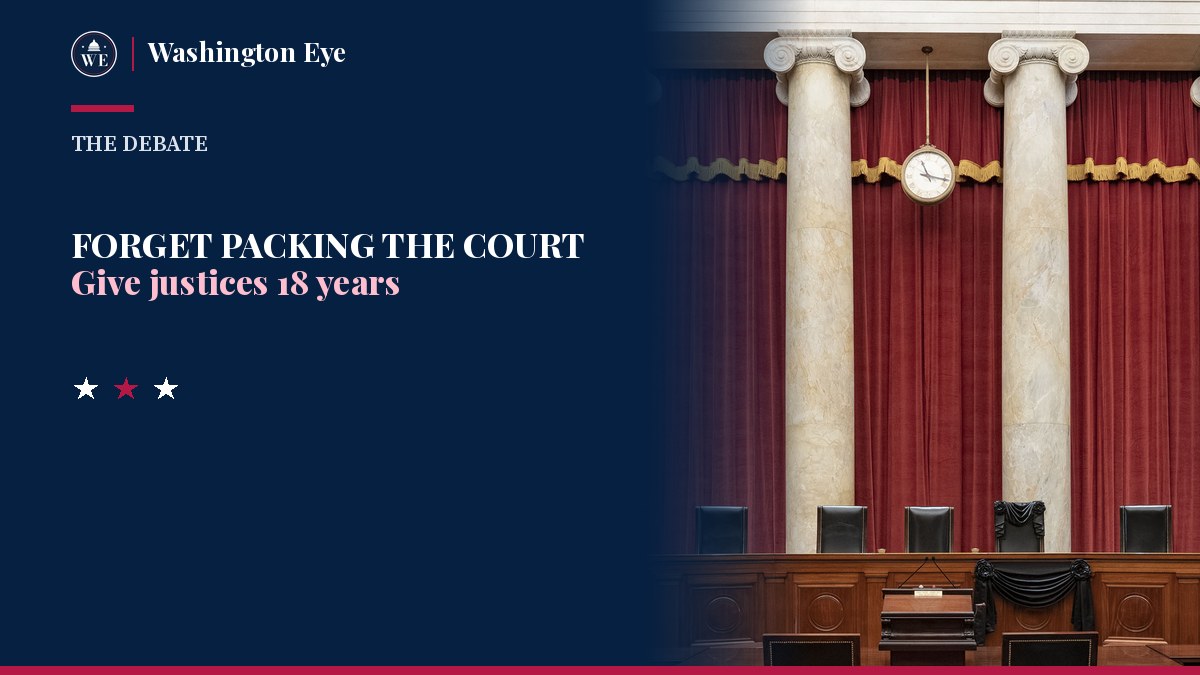
Somewhere in the Supreme Court chamber, above the nine black leather chairs, hangs a clock. For most of American history nobody thought of it as a political instrument. It is one now. When a justice leaves the bench, it is usually because of a decision about timing that the justice alone controls, or because of a death that nobody controls. Either way, the most powerful court in the democratic world is restocked by accident.
Democrats have a rare chance to change that. They will control the House and at least 54 seats in the Senate when the new Congress meets in January, and reports over the weekend said House Democrats are preparing to introduce a plan to cap a justice's active service at 18 years. The incoming Speaker, Hakeem Jeffries, has already told colleagues in a letter that the party must "clean up the mess at the Supreme Court," and has said Jamie Raskin, the likely chair of the Judiciary Committee, will lead the work.
Our view is simple. Of everything on the Democratic shelf, term limits are the idea worth spending political capital on. Not adding seats. Not a fresh round of hearings designed to embarrass individual justices. A fixed, predictable, 18 year term, with a new appointment every two years, is the one reform that would cool the court down rather than heat it up, and it is the one most Americans already want.
A justice just made the case, carefully
The argument got an unexpected nudge on Friday evening in Philadelphia. Speaking at an American Philosophical Society event, Justice Sonia Sotomayor was asked whether her colleagues had counted on elections as a check on presidential power when they granted former presidents broad immunity for official acts. "Absolutely," she replied. "My colleagues today would probably applaud the last election, because they believe that if the people don't like what's happening, they can speak with their vote. And they did speak."
Then an audience member raised term limits. Sotomayor did not endorse them, and she was right to say the decision belongs to elected officials. But she pointed out that other democracies manage without lifetime appointments. "They either have age limits or they have term limits," she said. "So, they have not needed it to keep politics out of influencing their judges in the way our founders worried. So, that's something that should give you pause."
When a sitting justice tells a public audience that the rest of the world's experience "should give you pause," Congress should take the hint.
Life tenure has quietly become something else
The Constitution says judges "shall hold their Offices during good Behaviour." It says nothing about how long that should be, and for most of the Republic's history the answer was not very long. In a study published in a law journal two decades ago, the scholars Steven Calabresi and James Lindgren calculated that justices who left the court between 1789 and 1970 served an average of 14.9 years. Those who left after 1970 served an average of 26.1 years.
Their numbers drew a fair challenge. Other scholars argued that the jump looked sharper because of how the time periods were sliced, and that tenure has crept up more gradually than the headline figure suggests. That is a reasonable quarrel about the slope of the line. Nobody seriously disputes its direction. Clarence Thomas has now served 35 years. Chief Justice John Roberts and Justice Samuel Alito are both past 18. Justices are staying longer, and critics across the spectrum say many now time their departures for a friendly president.
It is worth remembering who made that argument. Professor Calabresi is one of the best known conservative legal thinkers in the country. Term limits are not a progressive invention. A Republican congressman from Michigan, Tom Barrett, has proposed a constitutional amendment to cap service on the Supreme Court and the lower federal courts at 20 years. He lost his seat this month, but the idea did not lose its logic.
The lottery nobody voted for
Consider how the current court was built. In February 2016 Justice Antonin Scalia died, and the Senate refused for the rest of that year even to hold a hearing on President Barack Obama's nominee. In September 2020 Justice Ruth Bader Ginsburg died, and the Senate confirmed her successor days before a presidential election. Those were not the same principle applied twice. They were power applied twice, by whoever held the Senate at the moment fate intervened.
Under that system, one president can fill three seats in a single term and another can fill none. Every vacancy becomes an emergency, every confirmation a war, and every justice's health a subject of partisan speculation. A justice's choice to stay or go becomes a political act whether the justice wants it to be or not. That is bad for the country, and it is bad for the court's own standing, which is why it ought to appeal to people who like the court's recent rulings as much as to people who loathe them.
An 18 year term with appointments in the first and third years of every presidential term ends the lottery. Each president gets two justices per four year term, no more and no fewer. A single term president shapes the court modestly. A two term president shapes it more. Voters, not actuarial tables, decide the balance.
Three bills, one good idea
The legislative groundwork is already done. In July, Senator Sheldon Whitehouse reintroduced the Supreme Court Biennial Appointments and Term Limits Act with Senators Cory Booker, Richard Blumenthal and Alex Padilla. It sets 18 year terms, requires an appointment in the first and third year of each presidential term, and leaves the nine most recently appointed justices to hear the cases on the court's appellate docket, which is almost everything it decides. Older justices keep their title and salary and can still be called on to sit.
In the House, Representative Ro Khanna has offered a similar bill since early 2025, and a broader package from Representative Greg Landsman, introduced in June, would rotate sitting justices into senior status one by one, starting with the longest serving, as each new justice is commissioned. Representative Johnny Olszewski of Maryland has gone further with a constitutional amendment that would force justices who have already served more than 18 years to retire.
Democrats should choose the gentlest of these designs and say so out loud. The statutory route avoids the near impossible arithmetic of an amendment, which needs two thirds of both chambers and 38 states. A gradual transition that applies to future appointments, and moves current justices to senior status only as new ones arrive, blunts the charge that this is a purge. It also helps the bill survive the obvious constitutional challenge, because no justice would lose the office, only a seat on the merits panel.
Why not just add seats?
Some Democrats would rather skip the subtlety. A bill from Representative Al Green of Texas would grow the court from nine justices to 13. Congress has the power to do that; the number has changed six times and has stood at nine since 1869. But expansion answers a political problem with a bigger version of the same problem. The next Republican majority would simply add its own seats, and the one after that would add more. Term limits, by contrast, are symmetrical. They bind both parties in the same way, on the same calendar, forever.
That symmetry is also the best political argument. Polling has been consistent for a decade. A 2016 survey found two thirds of voters favoured term limits for justices, and Trump voters backed the idea by 72 percent to 12. A 2025 survey by the Public Religion Research Institute put support at about three quarters, including 67 percent of Republicans. Few proposals in American politics command that kind of agreement across party lines.
The honest objections
The case against is serious and deserves an answer. Life tenure was meant to protect judges from exactly the pressures that elected officials face, and critics fear that a justice with a known end date would spend the last years of a term auditioning for the next job. That risk is real, and the answer is in the design: a term limited justice would remain a judge for life, on full salary, with no need to court a future employer. Others argue that only an amendment can change how long justices serve. Reasonable lawyers disagree, which is exactly why Congress should write the bill with the most cautious transition it can, and let the courts test it.
There is also the plain question of whether any of this can pass. The 60 vote threshold in the Senate still stands, and the President would be unlikely to sign a bill he sees as aimed at a court that has ruled for him on immunity and other major questions. Democrats should push anyway. A House vote puts every member on record. A Senate debate forces opponents to explain why they prefer a lottery to a schedule. And a bill that starts with the next president, rather than this one, invites Republicans who have backed the idea before to prove they meant it.
What we would like to see in January
We would like the new House to pass a clean term limits bill early, separate from the more partisan pieces of the Democratic court agenda, and pair it with an enforceable ethics code, the other reform that draws broad support. We would like it to apply prospectively, so no one can call it revenge. And we would like Senate Democrats to hold a real debate on it, in daylight, rather than letting it die quietly in committee as earlier versions did.
The clock above the bench will keep ticking whatever Congress does. The only question is whether the country keeps letting chance and calculation decide when it matters, or finally sets the time itself.