
Strip away the tabloid details and the Nvidia scandal comes down to one sentence spoken on Friday morning by the Treasury Secretary of the United States. "Commerce has the pen," Scott Bessent said in a television interview, "and you will have to ask them about their internal processes." Cabinet members do not usually say things like that about each other in public. When one does, it is because the private route has been tried and has failed.
The facts that Mr. Bessent laid out on the record are simple. The Treasury Department, the State Department, the Pentagon and the Office of the US Trade Representative all "were in favor of putting Megaspeed on the entity list for months," he said. "My deputy has been pushing this for months." Megaspeed is the Singapore-based cloud company, one of Nvidia's big customers, that US authorities have investigated on suspicion of helping move advanced American AI chips into China. It is also the company where Alice Huang worked, the businesswoman whom US intelligence reportedly assessed to be a Chinese asset and with whom Jensen Huang has admitted an affair. Mr. Huang resigned as Nvidia's chief executive on Thursday.
Megaspeed is still not on the Entity List, the Commerce Department's trade blacklist. That is not a matter of interpretation. It is the central fact of this story, and it is the one that every conservative who cares about the contest with Beijing should keep in front of them.
Washington's favourite way to digest a scandal like this is to turn it into a morality play about one man. Mr. Huang's affair is a personal failing and a serious governance question for Nvidia's board, which is still investigating. But as Mr. Bessent put it, "The story has been thus far on Jensen Huang's personal foibles. The real story here should be: Did Nvidia know their client?" He is right, and there is a second real story beside that one: why the agency responsible for keeping America's most sensitive technology out of the hands of its main rival did not act when the rest of the government told it to.
The president's policy is not the problem. Here it is worth being precise, because critics on the left will try to make this a referendum on President Donald Trump's whole approach to China. Mr. Trump made a defensible, if debatable, call last December when he allowed Nvidia to sell its H200 chips to approved Chinese customers in exchange for 25 percent of the proceeds going to the US government. Reasonable conservatives disagreed with that decision. Representative John Moolenaar of Michigan, the Republican who chairs the House China committee, warned at the time that the H200 offered "32% more processing power and 50% more memory bandwidth than China's best chip" and that Beijing would use such chips "to strengthen its military capabilities and totalitarian surveillance." That argument deserves a hearing on its merits.
But the H200 decision came with a line, and the line was clear. "President Trump made it very clear that China should not receive any Nvidia chips above H100s," Mr. Bessent said on Friday. "And so any leakage is very frustrating" because it "hurts our great companies in the AI race" and "gives the Chinese an advantage." A policy that sells a capped product through vetted channels only works if somebody polices the channels. Shell companies and pass-through buyers are exactly how a cap becomes meaningless. The Entity List is the tool built for that job.
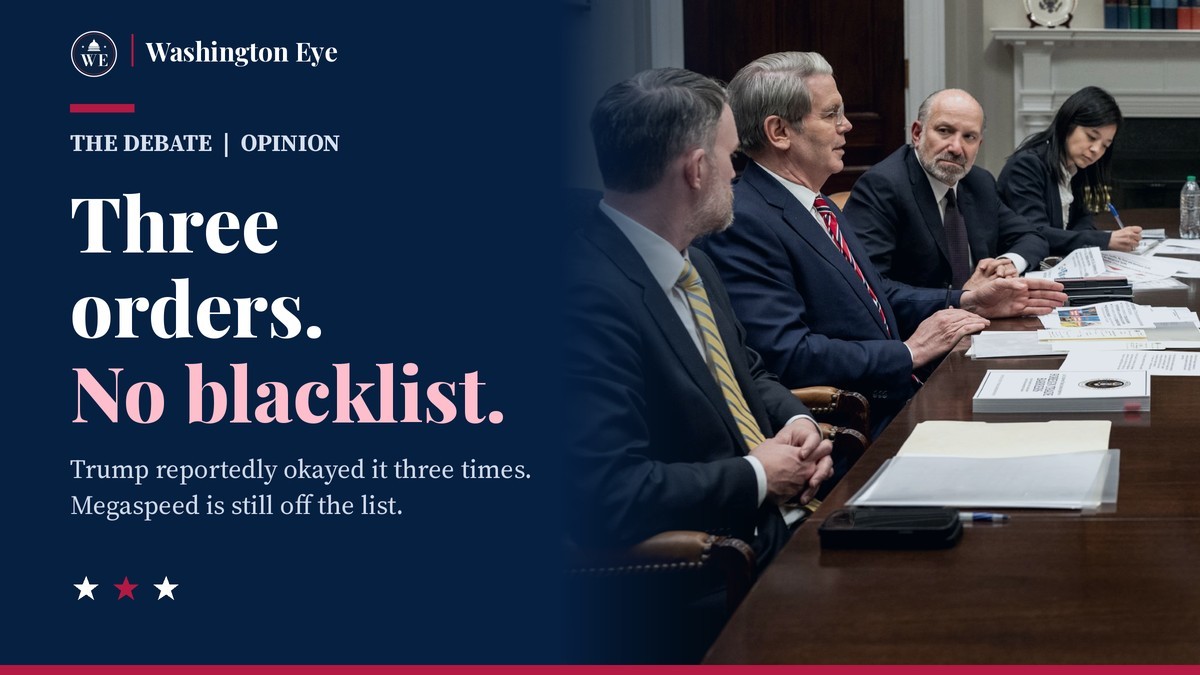
According to reporting by a US news site this week, citing people familiar with the discussions, Mr. Trump approved action against suspected diverters of Nvidia chips on at least three occasions this year: in May, in August and on November 5. On that last date, the same reporting says, Mr. Bessent pressed Commerce Secretary Howard Lutnick in the White House Situation Room on why Megaspeed had not been listed, with the defense secretary, the trade representative and Secretary of State Marco Rubio present. Mr. Lutnick is quoted as replying, "I don't know. I'll look into it," and later, after the president again gave the go-ahead in the Oval Office with the words "Let's get it done," saying he would "develop some options and come back."
Commerce disputes that account. "This is false. Secretary Bessent and Secretary Lutnick had no such conversation," a department spokeswoman, Kristen Eichamer, said this week. Asked about it on Friday, Mr. Bessent said only, "We don't repeat conversations in the Situation Room." Readers should weigh the anonymous version accordingly. Yet the on-the-record version, from the Treasury Secretary himself, is damaging enough: four agencies agreed, the decision sat with Commerce, and nothing happened.
A pattern, not a slip. If Megaspeed were an isolated case, there might be an innocent explanation: a slow interagency process, legal caution, a case that needed more evidence. The wider record makes that harder to accept. A major American newspaper reported this week, after reviewing the Federal Register, that Commerce has not added a single company to the Entity List in more than a year. The same newspaper reported that the department's Bureau of Industry and Security paused its own export-control investigation of Megaspeed at the request of the Justice Department, which has since turned the matter into a criminal inquiry.
There is also the matter of access. According to that reporting, Nvidia's general counsel emailed the agents working the Megaspeed case in August 2025 to say that Jeffrey Kessler, the under secretary who runs the bureau and reports to Mr. Lutnick, had given the company permission to reach out. The agents declined to meet. A department official said Mr. Kessler told staff to handle the case "strictly by the book" and did not direct anyone to share information with Nvidia. A bureau spokesman repeated the line: "BIS conducts all enforcement strictly by the book." Perhaps so. But a regulated company invoking a political appointee's name to the investigators examining its customer is precisely the kind of thing that erodes confidence in an enforcement agency, whatever happened next.
In fairness to Megaspeed, the company has said it was inspected by the Commerce bureau, by Malaysia's trade ministry and by Nvidia, and that none found signs of illegal activity. Singapore police said on October 30 that their investigation was ongoing. No one has been charged. But the Entity List is not a criminal verdict. It is a licensing requirement, a way of saying that American technology may not flow to a given buyer without the government's permission. It exists for cases where the evidence of risk is strong but a courtroom standard has not yet been met. If four departments thought that bar was cleared, the burden is on Commerce to explain why it disagreed.
Why conservatives should own this. There is a temptation on the right to circle the wagons. Mr. Lutnick is a loyal Trump appointee; the people attacking him loudest include Democrats such as Senator Richard Blumenthal of Connecticut, who said on Friday that "Lutnick must go." From January, Senator Elizabeth Warren of Massachusetts will chair the Senate Banking Committee, and she has already demanded that the administration preserve every document on Nvidia's exports to China. Defending a Cabinet member against that onslaught can look like defending the president.
It is not. The case against inaction on Megaspeed is, first of all, the president's own case. Mr. Trump set the line on chips; Mr. Bessent and Mr. Rubio, two of his most senior officials, tried to enforce it. Republicans who have spent years warning about Chinese espionage and technology theft cannot credibly go quiet when the alleged failure sits inside a Republican administration. And they increasingly are not going quiet. "If that's true, then clearly, it seems that those questions need to be answered," Mr. Moolenaar said this week of the reports that Mr. Trump directed the blacklisting three times. Senator Jim Banks of Indiana said Mr. Lutnick "used loopholes to allow some of these chip sales to occur even though President Trump has directed" otherwise. Senator John Kennedy of Louisiana said the secretary "needs to answer that in front of God and country." Senator John Curtis of Utah said the reported stalling "raises the question of whether the Commerce Department is acting in the best interests of the American people."
That is the right instinct. Better that Republicans ask the hard questions in November than that Democrats get to ask them alone, with subpoenas, from January. The oversight calendar already gives them the chance. Mr. Huang has been asked to give a closed-door briefing on December 1 to the House committees on China, intelligence and foreign affairs. Nvidia's general counsel has been asked to sit for an interview on December 2. Representative Brian Mast of Florida, the Foreign Affairs chairman, has asked Mr. Kessler to testify on December 3 about chip smuggling and "reported interference by private companies into export control policy and enforcement investigations." And Mr. Lutnick, according to his department, has agreed to appear before the Senate Banking Committee on December 10.
What should happen now. The fix does not require new law. Asked whether Congress needed to step in, Mr. Bessent said, "We have all the authorities that we need. They just need to be implemented." That points to three steps, none of them radical.
First, list Megaspeed, or explain in writing to the relevant committees why the department believes four other agencies were wrong. Second, publish a clear account of the department's contacts with Nvidia about the Megaspeed case, including what Mr. Kessler authorised in August 2025 and why. Third, resume normal use of the Entity List, so that a tool Congress built for national security is not quietly shelved to keep a trade détente smooth. If the administration has decided that calm with Beijing matters more than closing leaks, it should say so openly and defend that choice, rather than let an export ban exist on paper while the shipments continue.
Mr. Lutnick's defenders argue that he has been a tireless advocate for American industry and that the stories against him rest on anonymous accounts from rivals inside the administration. Some of that may prove true. One report this week said senior White House officials had discussed whether he should be pushed out; another said the president is standing by him for now. His department insists that "the Department of Commerce and the Department of the Treasury have a great working relationship and are committed to advancing President Trump's agenda." The quickest way to prove it is to carry out that agenda on Megaspeed.
The contest with China over artificial intelligence will be decided by chips, power and talent. America leads on chips because of companies like Nvidia and because, for years, both parties agreed that the most advanced hardware should not be handed to a rival that intends to use it against us. That consensus survives only if the rules are enforced. Four agencies said blacklist it. The one agency that could, did not. On December 10, Mr. Lutnick will have the chance to explain why. Conservatives should be the first to ask.