
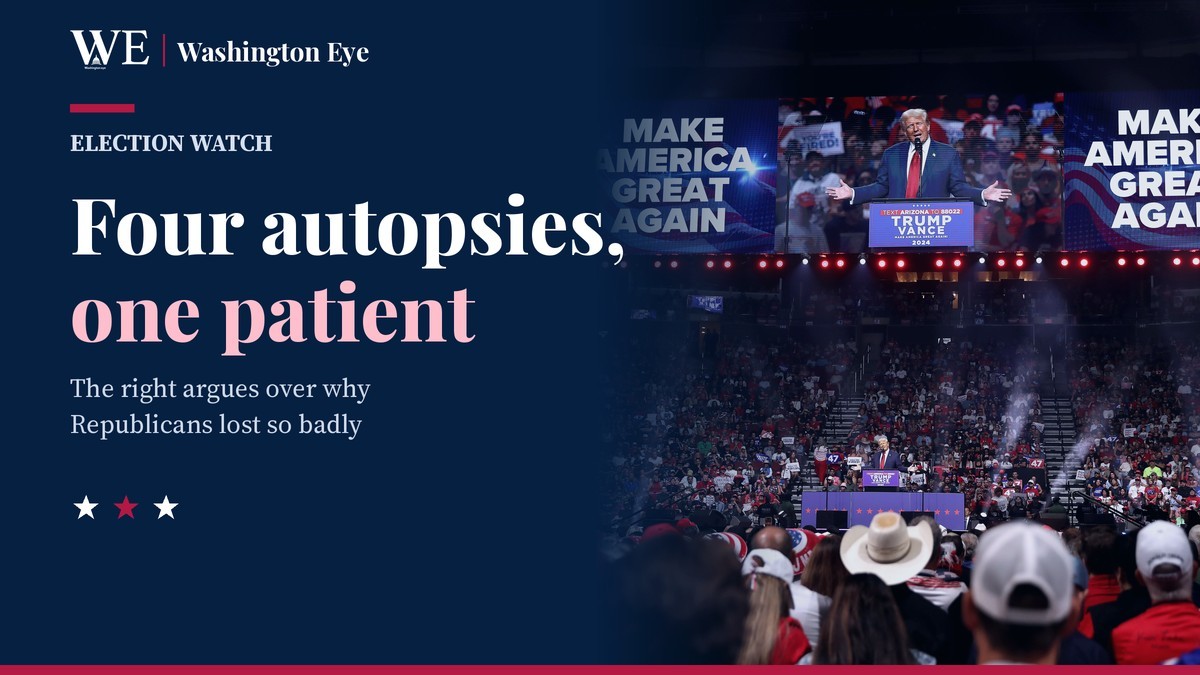
A week after the worst night for Republicans in a generation, the party has not yet agreed on what killed it. Democrats will take control of the Senate in January, and election analysts project they will hold about 259 House seats, their largest majority since the 1990s. A handful of races are still being counted or recounted, from a machine recount in Miami to a requested recount in southern Minnesota, but none of them will change the basic picture. The question on the right is no longer how bad it was. It is why, and whose fault.
So far there are four main answers, each with its own champions, and each conveniently pointing away from the people offering it. Sorting through them is not an academic exercise. The explanation Republicans settle on in the next few months will decide what kind of party walks into the 2028 primaries.
The first autopsy says it was the war. Vice President JD Vance made the case within a day of the results. "The reason we lost is the war," he wrote in a post online. "If you'd like to argue it was worth it, that losing the Senate for the next 6 years was worth it, then do so. Argue it was a worthwhile cost to pay. But everyone knows why we lost." Asked about the comments, President Trump told reporters it was "largely true" that the war, through higher energy prices, had cost Republicans Congress, while insisting the conflict was still worthwhile. "If I had to do it again, I'd have to do it again," he said.
The numbers give this camp real ammunition. In voter surveys, about six in ten said the United States made the wrong decision in taking military action against Iran, and roughly three quarters said the conflict was a crucial or major factor in their vote for Congress. One conservative writer argued on election night that anyone who privileged any other explanation was "selling you a just-so story," and pointed to rural Republicans, whose long commutes, farm equipment and trucks make them acutely sensitive to the price of fuel. The war, in this telling, broke the core promise of the 2024 campaign: no new wars, and lower costs.
Yet even the war argument splits in two. Former Vice President Mike Pence agrees the conflict sank the party, but from the opposite direction. The "unfinished war against Iran," he wrote, "became an albatross around the necks of Republicans because Washington stopped short and pursued appeasement rather than allowing our troops to finish off the threat." One side says the mistake was going in. The other says it was not finishing. Both cannot be the lesson.
The second autopsy says it was the tariffs. This is the view of the party's free-market wing, and it has the advantage of pointing to a problem that began long before the first strike on Iran. Senator Ted Cruz of Texas, who called the midterms a "Watergate-level repudiation," said the war "has dragged on too long" but went further: "Tariffs have made everything too expensive." Senator John Cornyn, who lost his own primary this year, wrote in an op-ed that the president "misread his mandate." Voters, he argued, "wanted to retool our trading relationships, but got arbitrary 'Liberation Day' tariffs that raised prices without creating incentives for long-term reshoring." His sharpest line summed up the disappointment of many 2024 Trump voters: "Americans elected the Donald Trump who put on the apron of the Golden Arches and got a plan for a Triumphal Arch instead."
Here, too, the data are hard to dismiss. Prices rose 3.7 percent in the year to September, driven by fuel and energy. Diesel hit a record of about $6.52 a gallon in September. Nearly eight in ten voters said inflation had caused their family moderate or severe hardship over the past year, and more than six in ten blamed the president's policies for higher prices. One writer at a leading conservative magazine asked why the party was treating it as a choice at all, comparing the debate to arguing over which of two body blows did more damage. "The punch to the face, then the gut?" he wrote. That seems right. The tariffs and the war arrive at the same place: the household budget.
The third autopsy says it was the culture war, or rather the party's misplaced faith in it. Outgoing Florida Governor Ron DeSantis, no moderate on social issues, said he knew Republicans were in trouble when he saw how much they were spending on advertising about transgender issues. By late October, more than $180 million had been spent on such ads. "That was not the issue motivating voters," DeSantis said. Republicans, he added, "really were fighting yesterday's battles." Democrats, for their part, mostly declined the fight and returned at every turn to grocery bills, power bills and health costs.
This explanation matters less for what it says about any single issue than for what it says about the party's habits. The ads were a substitute for an economic message the party did not have. DeSantis also made a point that should sting congressional Republicans: the result, he said, was a "rejection of Republicans in Washington," aimed at a Congress that had produced too little as well as at the White House. "So it's really both sides of Pennsylvania Avenue," he said.
The fourth autopsy is the bluntest, and the one most Republicans in office will not say aloud: it was Donald Trump. Andrew McCarthy, writing for the same conservative magazine, dismissed the war versus tariffs argument as "blame-shifting, not serious self-examination." The real problem, he argued, was the president's second-term conduct, which reminded voters why they had disliked him the first time, "but this time without the perception of rising prosperity." Republicans, he wrote, "made Trump the center of their universe, as if Congress did not exist other than as a presidential pom-pom squad."
Another contributor, Gregory Slayton, listed the evidence: presidential approval of about 31 percent in one mid-October poll, a September promise of $5,000 checks to every adult if Republicans held Congress, a steady drip of corruption stories, and the president's endorsement of Ken Paxton over Cornyn in the Texas Senate primary, which turned a safe seat into a blowout loss. Voters seem to agree that conduct mattered. Roughly nine in ten said government corruption was a major factor in their vote. Cornyn's own prescription was pointed: "Voters won't trust Republicans to cut fraud and scams out of government programs until we cut them out of our own ranks."
Strip away the factional loyalties, and the four autopsies describe one patient. A party that won in 2024 on a promise to lower costs and avoid foreign entanglements delivered higher costs and a long war. It then tried to win the midterms by putting the president at the centre of the campaign and turning to cultural fights that no longer moved voters. The war camp, the tariff camp and the culture war critics are each describing one symptom. McCarthy's camp is describing the decision-making that produced all three.
That is the uncomfortable conclusion conservatives need to face, and it is not the same as saying conservatism lost. Republicans had a real record to run on: a border they could credibly call more secure, a tax law that locked in the 2017 cuts, and a lighter regulatory hand. Those achievements went largely unheard because the national conversation was about the war, the tariffs and the president himself. As Slayton put it, limited government, secure borders, a strong defence and economic growth "are not losing ideas in general. They are losing right now because of who is carrying them."
The scale of the coalition damage makes the point. Two years ago, gains among Hispanic and Black voters helped deliver Trump a clear win. This time, according to one newspaper analysis, majority-Hispanic counties swung more than 22 points against Republican Senate candidates compared with 2024, the largest shift of any major group. A majority of Americans, 56 percent, now view the federal immigration enforcement agency unfavourably, according to the Pew Research Center. Even a popular goal, a secure border, can become a liability when the means look reckless.
There is also a structural lesson for the House. Speaker Mike Johnson has said he will not seek to lead the new minority, setting up a contest between Steve Scalise and Jim Jordan. Representative Jason Smith of Missouri, chairman of the tax-writing committee, argued online that the conference must first understand "how and why we lost the trust of the American people," and fix rules that "have empowered members to vote against rules, bills, and even the Speaker." A party that could not pass its own agenda with a majority has little claim to a governing reputation, whoever leads it next.
So what should Republicans do with the next two years? The answer that follows from an honest autopsy is not complicated. First, end the war on terms the country can accept, and stop pretending the cost at the pump is a foreign policy detail. Second, abandon tariffs as a permanent tax on American consumers and return to trade policy that lowers prices. Third, rebuild Congress as a co-equal branch, with members who legislate and oversee rather than cheer. Fourth, treat corruption inside the party as a problem to fix, not a story to dismiss as media bias.
None of that requires Republicans to repudiate the voters who came to them in 2016 and 2024. It requires taking those voters at their word. They asked for lower prices, a secure border and peace through strength. They did not ask for higher prices, an open-ended war and a party that existed to defend one man.
The midterms were not an endorsement of Democrats. Voters rated the Democratic Party only 47 percent favourably, against 40 percent for Republicans. That gap leaves room for a comeback. But the comeback starts with an autopsy that names the cause rather than just the symptoms. Republicans who keep arguing about war versus tariffs are debating which wound was fatal. The more useful question is who kept inflicting them, and whether the party is willing to say so before 2028.