
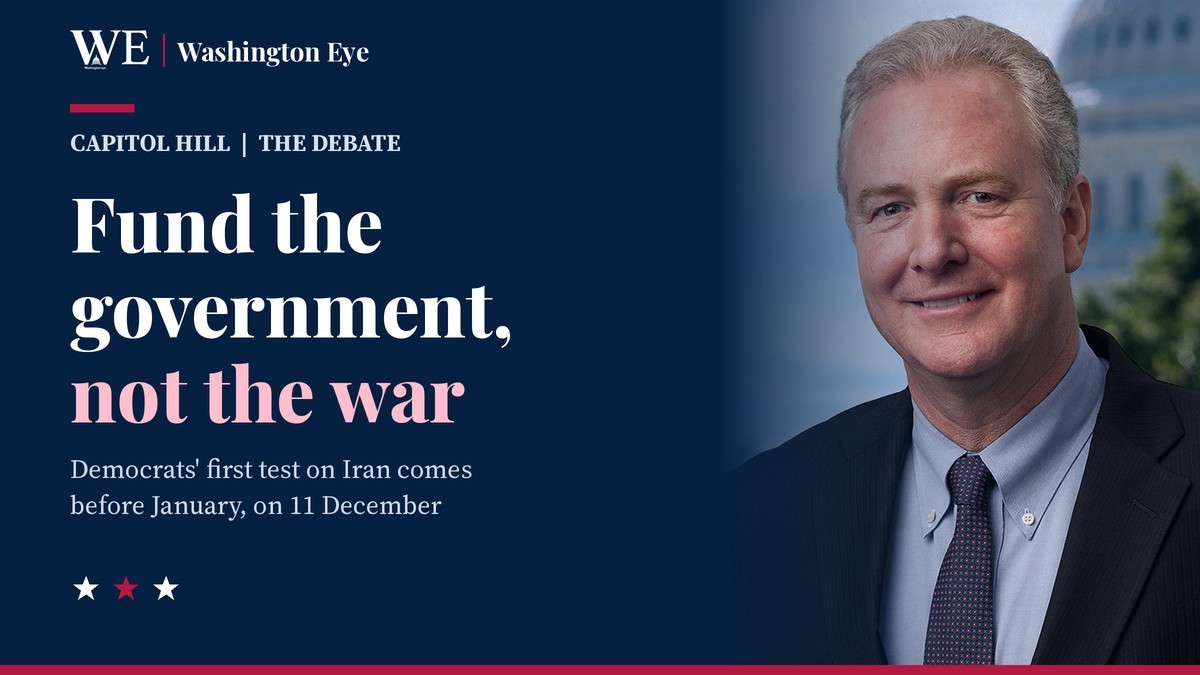
Congress comes back to Washington on Monday for a lame-duck session that most voters have already mentally skipped. They should not. Republicans still hold the House and the Senate until January, but the calendar has handed Democrats a choice that will define their new majorities before a single gavel changes hands. Federal funding runs out on 11 December. Whatever bill keeps the government open past that date will either keep paying for the war in Iran or it will not. Democrats should insist that it does not.
The facts of the deadline are simple. The current stopgap, the Continuing Appropriations and Extensions Act, became law on 2 September after the House accepted the Senate's version by 370 votes to 48 and the Senate had passed it 90 to 6. It funds agencies at last year's rates until 11 December, and it also carries the expiry date for highway and transit programmes, the Defense Production Act and a set of veterans' programmes, including housing and services for homeless veterans. The House calendar shows 16 session days between now and then. Only three of the twelve full-year spending bills have passed the House, and the Senate has passed none. Nobody seriously expects a $1.9 trillion package to be negotiated in five weeks. Another stopgap, running into early next year, is the likeliest outcome.
That is exactly why the stopgap matters. A clean extension is not neutral. It would carry the war's funding into the new year at full speed, on autopilot, at the precise moment the administration is weighing whether to escalate.
Consider where the conflict stands. The war is in its ninth month. The Pentagon puts its cost at more than $47 billion, and independent estimates run higher. Both chambers have already adopted a concurrent resolution, H. Con. Res. 86, directing the removal of American forces, and the administration has carried on regardless. On Thursday the president told reporters in the Oval Office: "I would rather not destroy the rest of the country if possible, but maybe I'll have to. You'll know soon enough." Reports since the election describe military planners preparing to restart major combat operations even as regional mediators float a deal on the naval blockade and frozen Iranian funds.
Voters, meanwhile, have spoken about as clearly as voters ever do. In a national exit poll conducted for a major television network, 63 per cent said launching the war was the wrong decision, and among those voters roughly eight in ten backed Democrats. Even the vice president, JD Vance, has said plainly that "the reason we lost is the war." Democratic candidates in close races tied the conflict to higher prices for petrol, diesel and groceries, and they won.
Democratic leaders have absorbed the message in their rhetoric. Hakeem Jeffries, who is running for Speaker, told a television interviewer on Saturday that his caucus would move early bills to "end this reckless and costly war of choice in Iran, which has skyrocketed gas prices on the American people." Rosa DeLauro, the senior Democrat on the House Appropriations Committee, went further in a statement this week: "Democrats will absolutely not fund Trump's war of choice with Iran that has increased costs on American families and made us less safe." Patty Murray, her Senate counterpart, said Democrats would "look at every tool we have available to us to bring this disastrous war to an end."
Every tool includes the one in front of them now. Senator Chris Van Hollen of Maryland has said he will not vote for any bill that keeps the money flowing. "I'm not planning to vote for anything that provides any funding to fuel the war in Iran," he said this week. "If the president wants to tell the country that he's prepared to shut down the United States government in order to conduct an illegal and senseless war in Iran, that will be his choice." Representative Ro Khanna of California has made the same call in the House, and more than two dozen advocacy groups have signed a letter arguing that "the most appropriate and immediate opportunity comes when current government funding expires on December 11, 2026."
The model Van Hollen has in mind is not new. In 1973 Congress attached language to must-pass legislation barring the use of funds, including money already appropriated, for combat in and over Cambodia and the rest of Southeast Asia. Richard Nixon signed it, and American bombing in Cambodia ended roughly six weeks later. The provision Van Hollen describes would be just as short: no funds may be expended to conduct the war in Iran. It is the cleanest expression of the power the Constitution gives Congress, and it is the one power a president cannot simply ignore, because the Treasury cannot pay for what the law forbids.
The case for waiting until January deserves a fair hearing, because it is not cowardice. Democrats will hold the gavels in both chambers in a few weeks. Adam Smith, the Washington Democrat in line to chair the House Armed Services Committee, has said a bill cutting off funding will be "one of the first things we do, and strongest things that we should do" in the new Congress. Moderates worry that a December shutdown would be fought on Republican turf, while Republicans still control the floor schedule, with federal workers' pay at risk weeks before Christmas. The country lived through a 43-day shutdown in this Congress already. A second one, some Democrats fear, would bury the affordability agenda on which they just won, from restoring the enhanced Affordable Care Act tax credits to reversing cuts to Medicaid and food assistance.
Those are real costs. But the waiting strategy has a flaw that its advocates rarely admit. A funding ban passed in January still has to become law, and the president holds the veto pen. Smith himself expects a stand-alone bill would be vetoed. The new majorities will be large enough to pass bills, not to override vetoes without substantial Republican help. A free-standing war funding ban is therefore a statement, not a policy. The only proven way to force a president to accept such a restriction is to attach it to legislation he cannot afford to veto. That means a spending bill. And the first spending bill on the calendar is the one due on 11 December.
There is also the matter of timing on the battlefield. If the administration is preparing a renewed bombing campaign, a restriction that arrives in February or March may arrive after the decisive escalation has already happened. Waiting is not a cost-free option for the people living under the bombs, nor for the American service members asked to carry out an operation that Congress has formally voted to end.
Nor is the shutdown risk as one-sided as it looks. The traditional fear is that the party demanding a policy concession gets blamed when the lights go off. But in December the Republicans will control the House, the Senate and the White House. If they choose to close the government rather than accept a limit on a war that most voters oppose and that their own vice president blames for their defeat, they will have to explain that choice. Van Hollen's framing is the right one: the decision to shut down the government to keep a war going would belong to the president.
Democrats can also make the demand easier to accept. They do not need to load the December bill with every grievance from the past two years. A short stopgap, running perhaps to the end of January, that funds every agency and every veterans' programme at current levels and adds a single sentence barring funds for offensive operations against Iran would be hard to caricature. It would leave money for force protection and for bringing troops home. It would hand the new majorities a clean start on the full-year bills. And it would put Republicans, some of whom privately share the voters' verdict on this war, to a recorded vote.
Those Republicans are not hypothetical. Representative Thomas Massie of Kentucky, who lost his primary to a candidate backed by the president, has said he will force a vote this week on articles of impeachment against Defense Secretary Pete Hegseth, built largely on the charge that the war violates the War Powers Resolution. Massie has put the odds of the resolution passing at "better than a 50 percent chance." Whatever happens to that effort, it shows there is a bloc of members in the outgoing majority who no longer feel bound to defend the war. The December bill is where their votes can do more than send a message.
The defence policy bill offers a second vehicle, and some senators prefer it. But the House passed its version in July by just 216 votes to 212, and the Senate version stalled at 50 votes to 46 on a procedural motion the same month. Its future in the lame duck is uncertain. A funding bill has the one quality the authorisation bill lacks: it must pass, on a known date.
Leaders in both chambers have so far kept their options open, and that is understandable for a few more days. But open options have a way of becoming a clean extension by default when the clock runs short. Democrats spent the campaign telling voters that this was a war of choice that made their lives more expensive and their country less safe. They won on that argument. If the first bill they help pass after the election quietly keeps the war funded into the new year, voters will notice, and they will be right to ask what the victory was for.
Fund the government. Fund the troops' safe return. Do not fund the next phase of the war. It is a simple position, it matches what the voters said a week ago, and it is available now, not in January.