
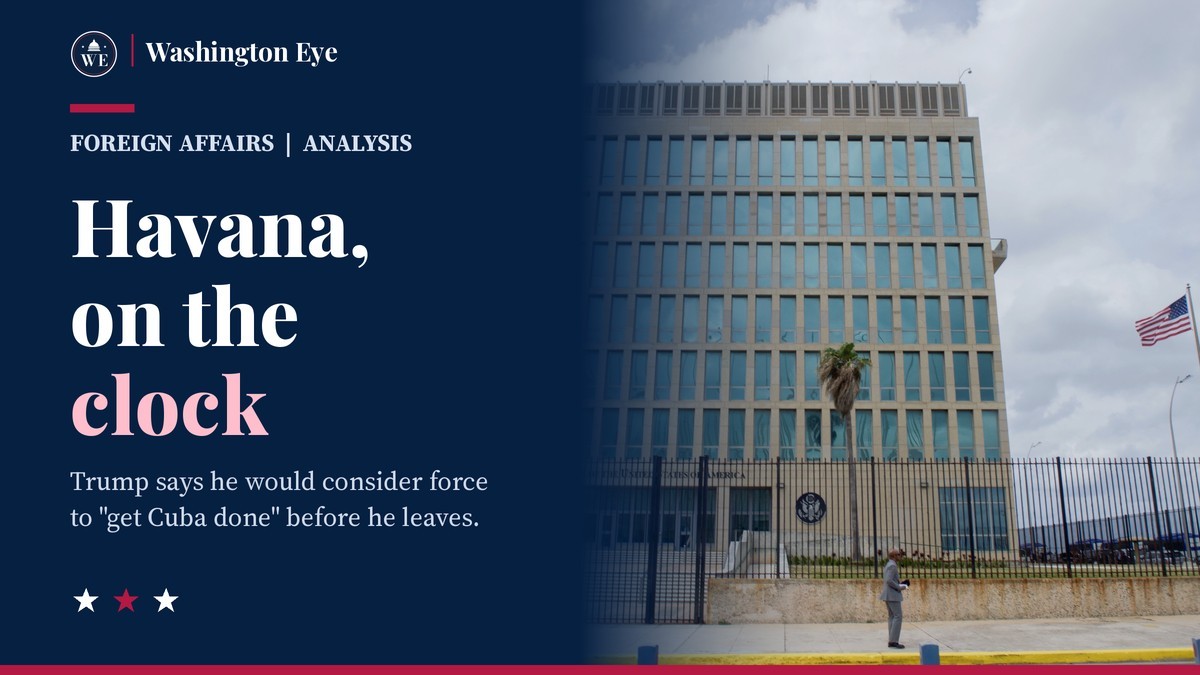
For most of this year, President Donald Trump has talked about Cuba the way he talks about a building he expects to buy: as something already on its way to him. On Thursday he went a step further. In a telephone interview with the conservative radio host Hugh Hewitt, he was asked whether he was considering "freeing Cuba" through military intervention. "I want to get Cuba done before I leave," he said.
Mr Hewitt pressed the point. "So, if it took a little bit of military force, a week campaign, you'd be okay with that?" he asked. "I would certainly consider that, yes," the president replied.
According to a US political news site, it was the first time Mr Trump had attached a timeline to a possible military operation against the island. He has spent months predicting that Cuba's government will collapse. He had never before said, in effect, that he intends to see it happen on his watch, which runs until January 2029, and that force is among the tools he is willing to weigh.
What the president said
The full answer mixed geopolitics, personal grievance and electoral arithmetic. "We have a very good, talented guy for Cuba named Marco," Mr Trump said, referring to Secretary of State Marco Rubio, whose parents emigrated from Cuba. "He would love to do that." The administration was "watching it very closely," he went on, describing the island as "essentially a failed, you know, place, nation, whatever you wanna call it."
He then turned to the Cuban-American community in Florida. "I'd love to be able to do it for the people, for the Cubans that came and were treated really badly, and they came to America," he said, adding that he had won the Cuban vote in the state by a wide margin.
The remarks did not come out of nowhere. At an impromptu White House news conference on Monday, Mr Trump said of the Cuban government, "I would imagine it will fall fairly soon," and called the country "a failing nation" with "an ideology very similar to what the Democrat ideology is." He added that the United States would help Cuba "on a humanitarian basis." At a conservative gathering at Mar-a-Lago last week, he said Mr Rubio was "going to work on Cuba" and joked that "we're going to drop him by parachute into Cuba." At a rally in Texas in late October, he offered a similar line: "We'll drop him in the middle of Cuba, he'll solve that problem in about two minutes."
Mr Rubio has been blunter still in his own way. In a recent post on a social media platform, he urged people who "seek to create positive change in Cuba" to "seize this opportunity to create the change you desire through a discrete partnership with the CIA."
A year of escalating pressure
To understand why a throwaway question on a radio show matters, it helps to recall how far Cuba policy has already moved in 2026. In January, American forces removed Venezuela's Nicolás Maduro from power, cutting off the Venezuelan oil that had long kept Cuba's power plants running. On 29 January, Mr Trump signed an executive order declaring a national emergency over Cuba and creating a system to impose tariffs on goods from any country that "directly or indirectly" supplies the island with oil.
The White House justified the order in sweeping terms. Its fact sheet said Cuba hosts "Russia's largest overseas signals intelligence facility," provides "safe haven" to groups such as Hezbollah and Hamas, and persecutes political opponents, together amounting to "an unusual and extraordinary threat" to American security. The same document pointed to the Venezuela operation as proof that "dictators and state sponsors of terrorism will be held to account."
Since then the president's language has drifted further from sanctions and closer to ownership. In February he said talks with Havana could lead to a "friendly takeover." In March, as the island's power grid failed, he said he expected to have the "honor" of taking Cuba. "I think I can do anything I want with it," he told reporters at the time. "Whether I free it, take it, I think I can do anything I want with it." At the United Nations General Assembly in September, he said Washington was seeking "fundamental change" on the island.
The economic squeeze has continued this month. The Treasury Department imposed new sanctions on Cuban oil tankers and shipping companies and warned that it could target any foreign person or company doing business in Cuba's maritime industries, as part of an effort "to end the Cuban regime's malign activities, both in Cuba and across our hemisphere." The State Department separately announced sanctions on 10 individuals and entities tied to the Cuban government, military and oil industry.
The effect on ordinary Cubans has been severe. The island of roughly 10 million people has endured repeated nationwide blackouts and shortages of fuel and food. In May, Cuba's energy minister, Vicente de la O Levy, said the country had run out of fuel oil and diesel and described the situation as "extremely tense." Cuba's embassy in Washington estimated this week that American measures cost the country $8 billion between March 2025 and February 2026, and said the latest steps "deepen an energy siege that already leaves hospitals without reliable power." The blockade, it said, "is collective punishment that hits ordinary people every day."
What the military has said
Against the president's words stands the most direct public statement from the uniformed side. On 19 March, General Francis L. Donovan, the Marine officer who leads United States Southern Command, told the Senate Armed Services Committee that his command was not rehearsing or preparing to seize, occupy or take control of Cuba. He said its planning was focused on protecting the American embassy in Havana and the naval base at Guantánamo Bay, and on being ready for a mass migration or humanitarian emergency.
That testimony is now eight months old, and a great deal has changed since. But nothing announced publicly since then suggests an operation is imminent, and analysts quoted in financial and political coverage this week said further economic pressure remained far more likely than an attack. Mr Trump's own phrasing was conditional. He said he would "consider" a short campaign if one were proposed; he did not say he had ordered planning for one.
Why the timing is awkward
The interview came at an unusual moment for a president to float a new military venture. Nine days earlier, Democrats swept both chambers of Congress in midterm elections shaped in large part by the war with Iran, which began in late February with American and Israeli strikes. Mr Trump has acknowledged that the conflict was partly to blame for Republican losses. Vice President JD Vance went further, calling it the "real reason" for the rout, and on Thursday the president moved Mr Vance off the Iran file altogether.
That war has not ended, and the incoming Democratic majorities have made oversight of it a priority. Any new operation in the Caribbean would collide with the War Powers Resolution, the 1973 law that requires a president to notify Congress within 48 hours of sending forces into hostilities and to withdraw them within 60 days unless lawmakers authorise the action. The question "a week campaign" seems designed to sidestep is exactly the one a Democratic Congress, sworn in this January, would be keen to ask.
There is also a credibility question running the other way. Mr Trump has predicted Cuba's imminent fall many times this year, and the government in Havana is still standing. Havana, for its part, has not treated the threat as idle: a senior Cuban diplomat said earlier this year that the country's military was "preparing for the possibility of military aggression." Each new prediction without a result risks making the threat sound less like policy and more like talk, which may be part of why the president now speaks of a deadline.
The case each side will make
Supporters of a harder line argue that the island's government is weaker than it has been in decades, that Russia's intelligence presence on the island is a genuine security concern, and that a regime under this much pressure may yet bargain if it believes force is a real option. On that view, saying force is on the table is itself a tool, and the removal of Mr Maduro shows that the administration's threats are not empty.
Critics answer that the pressure campaign is already falling hardest on civilians rather than on the leadership, that a military operation 90 miles from Florida could set off the very migration crisis Southern Command has planned for, and that a president who has just been punished at the polls for one war should not be hinting at another. They also note that the island's government has survived six decades of American hostility, and that collapse predicted from Washington has repeatedly failed to arrive.
What to watch
Three things will show whether Thursday's answer was a signal or a riff. The first is whether Mr Rubio, the official the president named, moves from encouragement of internal change to talk of external action. The second is whether any change in force posture in the Caribbean becomes public, given that Southern Command's last stated planning assumptions were defensive. The third is how the new Congress responds in January, when Democrats will control the committees that can demand briefings, hold hearings and force votes on war powers.
For now, the president has done something he had not done before: he has put Cuba on his own clock. Whether he means economic strangulation, a negotiated surrender of power, or the "week campaign" he said he would consider, he has told voters, and Havana, that he expects the question settled within the next two years and two months.