
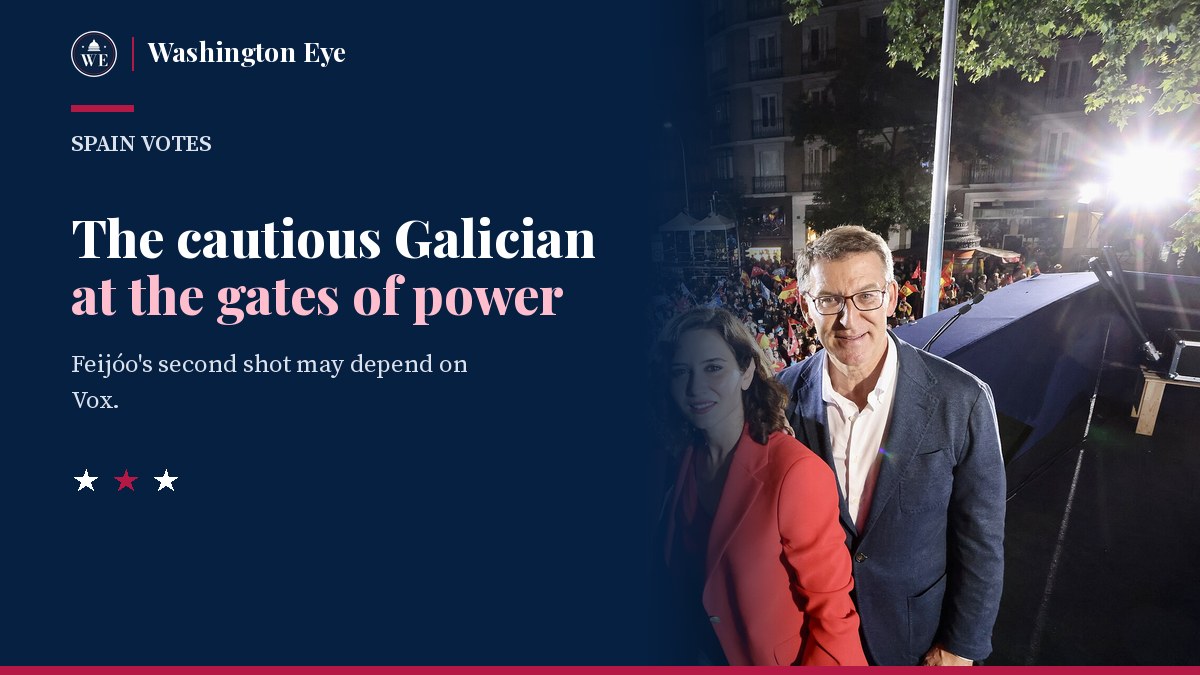
In 2018, Alberto Núñez Feijoó had the leadership of Spain's main conservative party within reach and turned it down. The People's Party needed a successor to Mariano Rajoy, and the long-serving president of Galicia was the obvious choice. Instead he stood before the cameras, close to tears, and said that leading his home region was the highest ambition he had.
Eight years later, the man who once cried to stay in Galicia is the favourite to run Spain. On Sunday, almost 39 million Spaniards are eligible to vote in a snap general election that polls suggest will end eight years of Socialist-led government under Pedro Sánchez. If they are right, Feijoó, now 65, will finally get the job he was denied three years ago. The question that hangs over him is the one that has followed him since he moved to Madrid: is he the cautious centrist manager his supporters describe, or a leader who will owe his premiership to the far right?
The civil servant from Os Peares
Feijoó was born on September 10, 1961, in Os Peares, a village in the inland province of Ourense, where his father worked as a construction foreman. He studied law at the University of Santiago de Compostela and wanted to become a judge. When his father lost his job, he took a post in the civil service instead to help support the family.
It is an unusual origin story for a conservative leader in another respect too. Feijoó has said he voted for the Socialists under Felipe González in 1982 and 1986. He did not join the People's Party until 1991, when he became a senior official in Galicia's agriculture department under the politician José Manuel Romay Beccária. He followed his mentor to the regional health department and then to the national Health Ministry in Madrid under Prime Minister José María Aznar. From 2000 to 2003 he ran Correos, the state postal company, before returning to Galicia as the regional minister for public works and housing.
That career shaped the image he still projects. He is a manager first and a tribune second. "Governing is about managing, and I have spent my whole life preparing for this moment," he told supporters in Seville on Friday, at the last rally of the campaign.
Four majorities in a row
Feijoó took over the Galician party in 2006, succeeding Manuel Fraga, the founder of Spain's modern right. Three years later he won back the regional government with an absolute majority of a single seat. He then did what few politicians in Europe manage: he won again in 2012, in 2016 and in 2020, the last time increasing his majority to 42 seats. In a fragmented country where national governments now depend on small regional parties, four straight majorities made him a political curiosity and gave him a reputation, in the region and beyond, as a moderate and pragmatic administrator.
Galicia also produced the episode his opponents never let him forget. In 2013, a Spanish newspaper published photographs from the mid-1990s showing him with Marcial Dorado, a Galician businessman later convicted of drug trafficking and money laundering. Feijoó confirmed the photographs were genuine, said he had no knowledge of Dorado's criminal activities at the time, and said their friendship ended in 1997. The pictures resurfaced in the 2023 campaign and remain part of the left's case against him.
Madrid, and the vote that went wrong
He finally moved to national politics in 2022, when the People's Party ousted its leader, Pablo Casado, after a bitter feud with the Madrid regional president, Isabel Díaz Ayuso. Feijoó ran unopposed with the backing of the party's regional barons. At the time, his party had just formed its first regional coalition with the far-right Vox in Castilla y León. He accepted it, but said he would not repeat it nationally, adding: "sometimes it's better to lose government than win it through populism."
The following year brought the defining setback of his career. In the July 2023 general election, the People's Party came first with 137 seats, but that was far short of the 176 needed for a majority in the 350-seat Congress. King Felipe VI asked him to try to form a government anyway. In September, his investiture failed by 172 votes to 178. Sánchez then stitched together a majority with left-wing allies and Basque and Catalan nationalist parties, and stayed in power.
Feijoó spent the next three years as leader of the opposition, attacking Sánchez over corruption cases that reached into the prime minister's inner circle and family, and over his reliance on separatist parties. He was re-elected party leader in June 2025 with 99.24 percent of the vote, promising to move the party to a "reformist centre." A month later he said he was willing to reach agreements with Vox in exchange for its support for a minority government. In November 2025 he led tens of thousands of protesters through Madrid demanding Sánchez's resignation.
The campaign of a man who has been here before
Sánchez called this election eight months early after parliament rejected his decrees on rents and evictions on October 2. He had proposed them after nationwide protests over the eviction and later death of Maricarmen Abascal, an 87-year-old Madrid woman whose monthly rent was raised from 570 euros to 1,650 euros. When the Catalan party Junts refused to back the housing reform, Sánchez dissolved parliament.
Feijoó has treated the vote as a second chance and a national turning point. He has called this probably "the most significant moment in our country for the past 50 years" and has promised to repair the state and regenerate democracy. "This time, yes, we're going to do it," he told supporters this week, a nod to 2023. In his final rallies, first in Barcelona and then in Seville, he promised a new political era of "truth, decency and good governance," and accused Sánchez of dodging questions on corruption, rail disasters, immigration and the national debt. He has called the Socialists "the most corrupt party" Spain has ever seen. Sánchez denies wrongdoing and says voters should distinguish between real and "fictitious" corruption allegations.
On housing, the issue that triggered the election, the two men offer opposite answers. Property prices and rents rose by more than 80 percent between 2015 and 2025, and the Bank of Spain estimates the country needs 700,000 more homes. Sánchez wants rent caps and limits on short leases and says housing should be a right, not an object of speculation. Feijoó promises deregulation, tax breaks for buyers and a million new homes over four years.
The campaign has not been flawless. In a four-way television debate on Thursday, Feijoó accused the left-wing leader Ada Colau of staying silent during the Valencia flood disaster and briefly raised a finger to his lips, using the word "calladita," a diminutive that can also be a condescending way to tell a woman to keep quiet. Sánchez accused him of sexism and told him to show "a little respect." Feijoó said on Friday that he had meant Colau had stayed silent during "these years of corruption."
The Vox question
Everything about a Feijoó government depends on Vox. Polling averages put his party at about 31.5 percent, the Socialists at 29 percent and Vox at about 18 percent. The gap between the two big parties has narrowed from about six points when the election was called to under 2.5 points, and one forecasting model gives the Socialists at least a 25 percent chance of finishing first. But almost every published poll shows the People's Party and Vox together above the 176 seats needed for a majority, and Vox hoping to nearly double the 33 seats it won in 2023.
Feijoó says he wants to govern with "parliamentary support agreements" with Vox rather than a coalition, and that the Vox leader, Santiago Abascal, has never discussed cabinet posts with him. He has also drawn a line at Vox's signature "national priority" policy, which would put Spanish citizens first for welfare and subsidies, saying it would breach the constitution and European Union treaties. "No-one can sign illegal agreements," he said. Yet his party already governs with Vox in four regions: Extremadura, Aragón, Castilla y León and Andalusia. A national coalition would give a far-right party a cabinet role for the first time since the death of Francisco Franco in 1975.
Some analysts think that prospect is overstated. Camino Mortera-Martinez of the Centre for European Reform, a former European affairs adviser to a Spanish prime minister, argues Vox would be kept away from real power even inside a coalition. "They're not going to get any of the core ministries. They're not going to get defence or home affairs or foreign policy or economy," she said. Others see the shift as structural. "What is changing that shift of majorities is the rise of Vox," said Jacobo Ramos Folch, a policy analyst and visiting professor at the University of Navarra.
Why it matters beyond Spain
Sánchez leads one of Europe's last left-wing governments. He has presided over years of economic outperformance, defied pressure from President Donald Trump for higher military spending and denied the United States the use of Spanish airspace in the war on Iran. A Feijoó government would almost certainly seek a warmer relationship with Washington and a tougher line on migration, after a summer in which more than 70,000 migrants crossed into the Spanish enclave of Ceuta from Morocco. With France holding a presidential election in five months, two of Europe's biggest economies could move right in quick succession.
If no one wins outright on Sunday, the process will be slow. The new Congress meets on December 23, the king then nominates a candidate, and a prime minister needs 176 votes in a first investiture ballot or a simple majority in a second. If no government is formed within two months of that first vote, Spain goes back to the polls.
Feijoó has spent his life rising by patience, from civil servant to regional baron to national leader. He has also learned that winning the most seats is not the same as winning power. On Sunday night he will find out whether the voters, and Vox, are ready to give him both.