
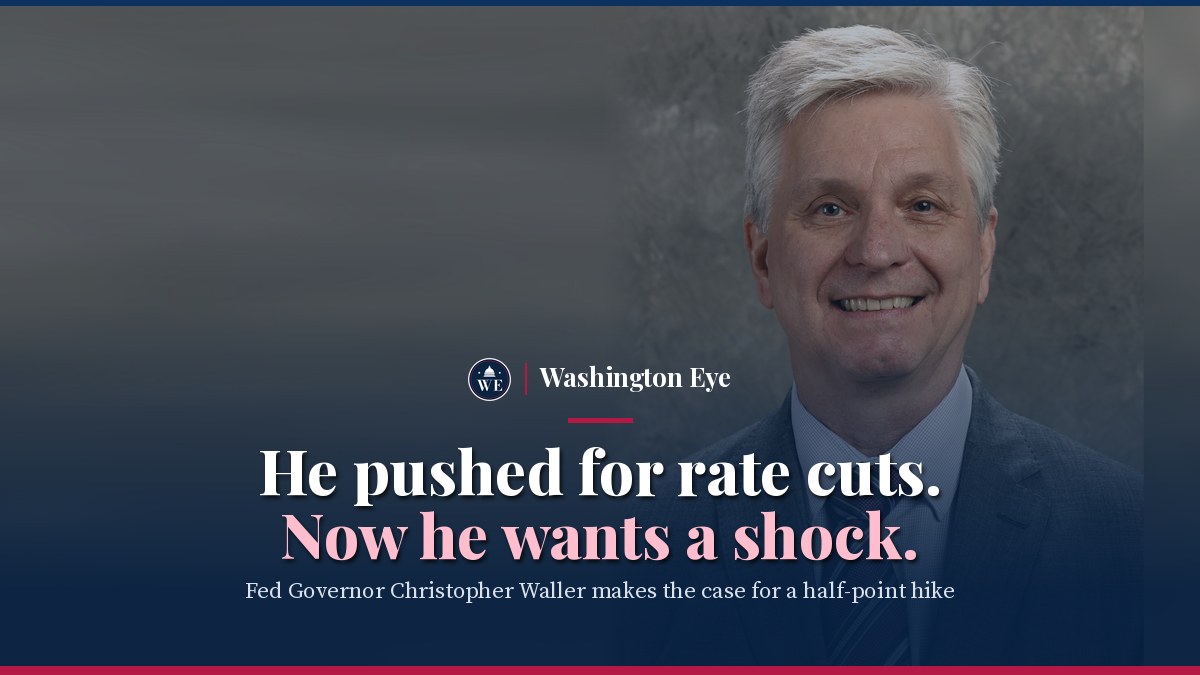
Sixteen months ago, Christopher Waller was the Federal Reserve governor arguing loudest that interest rates were too high. On Wednesday, he went on live television and said the central bank might need to "shock people" with a half-point rate increase next month. That journey, from dissenting in favour of a cut in July 2025 to pressing for the Fed's most aggressive move in years, makes the former economics professor the most interesting man at the central bank right now.
It also makes him a test case for a question that matters to every American with a mortgage, a car loan or a credit card balance: is the Fed finally getting serious about inflation, or is it about to overreact?
What Waller said on Wednesday
Speaking in a live interview on a business television channel, Waller said a half-percentage-point increase in the Fed's benchmark rate is probably necessary at the December 8-9 meeting of the Federal Open Market Committee, the panel that sets rates. "I'm very, very concerned about inflation," he said. "It's kind of headed in the wrong direction, and it's spreading out. If you really want to get it down, you've got to start taking more aggressive actions."
Then came the line that moved markets. "You might need to, like, shock people," he said.
Waller went further than December. He said the Fed needs to reverse the three quarter-point cuts it made in 2025, and might have to go beyond that. "First of all, you've got to take back the three insurance cuts we put in last year," he said. "If the policy rate last summer in 2025 wasn't bringing inflation down, getting back to that isn't going to bring it down. So we may have to go above ... three hikes plus maybe some more to get it to start actually coming back down."
Traders listened. The yield on the two-year Treasury note, the bond most sensitive to expectations about Fed policy, rose more than four basis points to 4.83 percent, and the 10-year yield edged up to about 5.12 percent. The dollar held near its strongest level since April 2025. Futures markets already fully expect a quarter-point hike in December, with a smaller chance of a half-point move.
The quiet economist from Minnesota
Waller is not a household name, and by Washington standards he has never tried to be one. He earned his bachelor's degree in economics at Bemidji State University in Minnesota and his master's and doctorate at Washington State University. He spent most of his career in academia, teaching at Indiana University, holding an endowed chair in macroeconomics at the University of Kentucky, and later the Gilbert F. Schaefer Chair of Economics at the University of Notre Dame.
In 2009 he moved to the Federal Reserve Bank of St. Louis as executive vice president and director of research, a post that made him one of the system's leading in-house thinkers. He joined the Board of Governors in Washington on December 18, 2020, nominated by President Donald Trump during his first term, to fill a term that runs until January 31, 2030.
He still talks like a teacher. In a speech in London on November 10, explaining why he worries about a labour market where both hiring and firing are unusually low, he reached for a hospital analogy. "If your mom was in the hospital and the doctor told you her condition was stable, you would be relieved but you wouldn't say she is healthy," he said. A stable jobs market, in other words, is not necessarily a healthy one.
The dove of 2025
To understand why Wednesday's comments landed so hard, go back to July 30, 2025. That day the Fed held rates at 4.25 to 4.50 percent, and two governors voted no: Waller and Michelle Bowman, both Trump appointees, each wanted a quarter-point cut. It was the first time two members of the Board of Governors had formally dissented on a rate decision since December 1993.
Waller's reasoning then was clear and, in hindsight, revealing. "Tariffs are one-off increases in the price level and do not cause inflation beyond a temporary increase," he wrote in a statement explaining his vote. Standard central banking practice, he argued, is to "look through" such effects as long as inflation expectations stay anchored. He warned that private-sector job growth was near "stall speed" and that the Fed should not wait for the labour market to crack before acting.
That stance put him squarely in line with what the White House wanted. Trump was demanding lower rates at the time, and in September 2025 he named Waller as one of his three finalists to succeed Jerome Powell as Fed chair, alongside Kevin Hassett and Kevin Warsh. On January 30, 2026, Trump chose Warsh. Waller stayed on as a governor.
The Fed went on to cut rates three times in 2025. Those are the cuts Waller now says must be reversed.
What changed
The short answer is that the world did. Inflation picked up again this year after the United States and Israel launched strikes on Iran in late February. Energy prices spiked while the effects of tariffs lingered, keeping most inflation readings above 3 percent. Bowman, the Fed's vice chair for supervision, said in a speech this month that tariffs, energy and price pressures linked to the artificial intelligence building boom each accounted for roughly a quarter of above-target core inflation over the year to September, with the rest reflecting the lingering effects of earlier shocks.
The Fed raised rates in September for the first time in more than three years, then held steady in October in a 10-2 vote, with Governor Lisa Cook and Cleveland Fed President Beth Hammack dissenting in favour of another increase. Waller voted with the majority. His explanation was technical but telling: the Fed's signals had already led markets to price in tighter policy, so the exact timing of the next hike mattered less than making sure the promised hikes actually happened.
Then the data kept running hot. In his London speech on November 10, Waller laid out a strong economy: growth estimated at 3.4 percent in the third quarter, unemployment at 4.1 percent, and 165,000 jobs added in October. He also noted that higher insurance costs and ship-to-ship transfers for tankers passing through the Strait of Hormuz were reportedly adding $20 to $30 a barrel to oil prices. His plan, he said, was a quarter-point hike in December. But if that day's consumer price report showed core inflation "around 0.3 percent or even higher," he said, a half-point move should be considered. "Hiking only 25 basis points would put our credibility at risk, a risk I am not eager to take," he said.
Hours later, the Bureau of Labor Statistics reported that consumer prices rose 0.4 percent in October and that core prices, which strip out food and energy, rose 0.3 percent, both above forecasts. (The bureau did not publish a yearly rate because last year's government shutdown left it without comparable October 2025 data.) Wednesday's interview was Waller following through on his own warning.
The case that he is right
Waller's defenders would say there is no contradiction at all. In 2025 he argued the Fed could look through tariffs because they were a one-time jolt and expectations were anchored. Today the problem looks different: price pressures are spreading. A net 37 percent of small businesses in an October survey by the National Federation of Independent Business said they plan to raise prices in the next three months, the highest share since July 2022. Bowman said this month that core inflation on the Fed's preferred gauge likely rose to 3.3 percent in October. Inflation has now run above the Fed's 2 percent target for roughly five and a half years.
On that reading, Waller is doing exactly what a data-driven economist should do: changing his view when the facts change. And he is not alone in wanting to move faster. St. Louis Fed President Alberto Musalem suggested on Tuesday there could be as many as four hikes by the spring of 2027. Dallas Fed President Lorie Logan, after the October inflation report, said she sees a need for two more quarter-point increases and that "it may be possible to move more rapidly this winter than the [Federal Open Market Committee] has moved so far this fall."
The case for caution
Others at the Fed are much less eager. "I don't think the situation calls for dramatic action," New York Fed President John Williams said on Tuesday. "I think what we've been doing over the last past few months is ... working well." Philadelphia Fed President Anna Paulson said on November 10 that "further gradual tightening seems appropriate," and pointed to research suggesting tariff effects are beginning to fade.
The cautious camp has a real argument. Bowman herself expects several of the forces pushing up inflation to fade next year: tariff effects should wane, and energy prices should ease when the Middle East conflict ends. If that happens, a big December move could leave the Fed tightening into a slowdown. And Waller's own speech supplies the worry: a "low hire, low fire" labour market may look steady, but it can turn quickly, and people who lose jobs in such a market struggle to find new ones.
The Warsh wrinkle
There is also a quieter institutional tension. Waller said on Wednesday that the Fed would not necessarily need a half-point hike if it raised rates by a quarter point and clearly signalled another move in January. But Chairman Warsh has resisted that kind of forward guidance, arguing it ties policymakers' hands. "If you're not going to signal this very clearly to markets, you're going in January, my view is then you have to go 50 [basis points] in December to put it in place and get it done," Waller said.
Read one way, that is a governor working within the chair's framework. Read another, it is a public nudge: either tell markets what is coming, or act bigger now. Either way, the man Trump passed over for the top job is now one of the clearest voices shaping what the chair's Fed does next.
What to watch
The next clue arrives later on Wednesday in Washington, when the Fed releases the minutes of its October meeting, which should show how widely concern about sticky inflation was shared in the room. After that come the remaining data before December 8-9, including the Fed's preferred inflation gauge later this month. If those numbers run hot again, Waller's "shock" may stop sounding like an outlier and start sounding like the plan.
For borrowers, the stakes are simple. A quarter point or a half point in December will flow into credit card rates, car loans and the cost of new mortgages within weeks. The economist who argued for cheaper money in 2025 now says the cure for inflation has to hurt a little. Whether his colleagues agree will be one of the defining economic stories of the winter.