
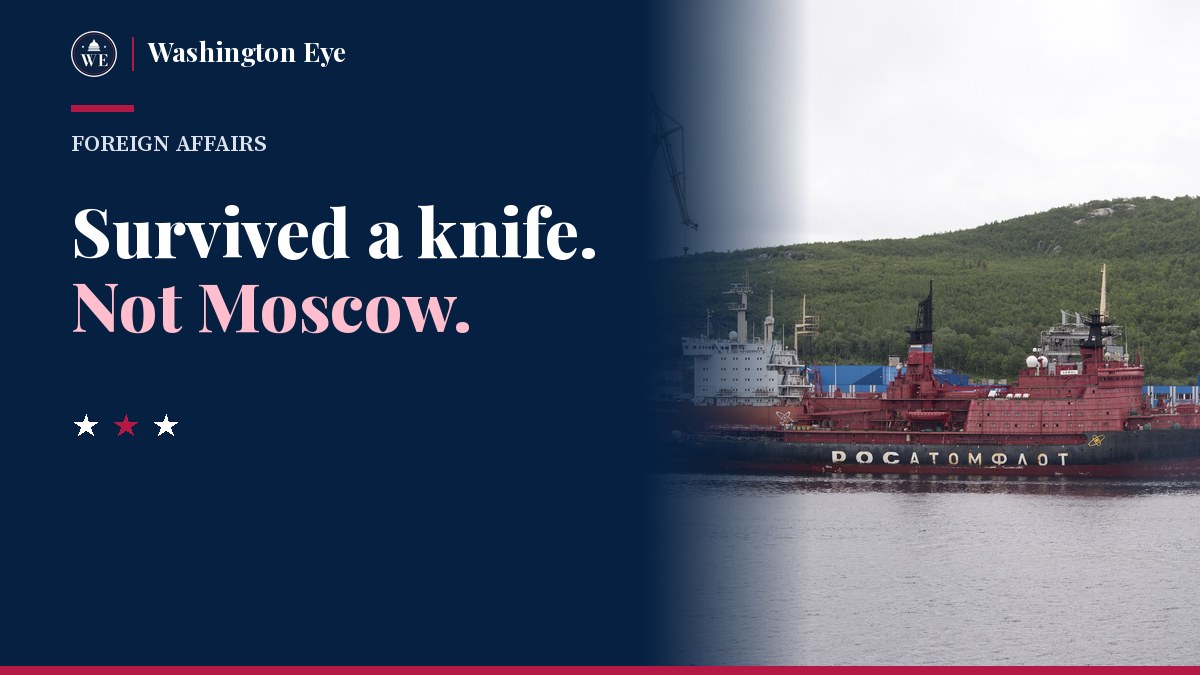
On Monday morning Andrei Chibis chaired a cabinet meeting in Murmansk, then boarded a flight to Moscow for what his press office called a scheduled work trip. When the plane landed at Sheremetyevo, police were waiting. By Wednesday evening the governor of Russia's most strategically important Arctic region was in a Moscow detention centre, ordered held until 23 January, and Vladimir Putin had signed a decree removing him from office.
Russia arrests officials all the time. What makes this case different is the rank and the timing. Mr Chibis is the first sitting regional governor to be arrested since Russia launched its full-scale invasion of Ukraine in February 2022. The last serving governor taken into custody was Ivan Belozertsev of the Penza region in March 2021, who was later sentenced to 12 years in prison for taking bribes. For almost five years, through a war that has rewarded loyalty above almost everything else, the Kremlin left its governors alone. Now it has jailed one of the most loyal of them.
The Kremlin wants everyone to understand that this was not an accident. Asked whether Mr Putin had known in advance, his spokesman Dmitry Peskov told a Russian business newspaper: "Of course. Naturally, such detentions are not carried out without the president's knowledge."
What he is accused of
The case, run by the central investigations department of the Interior Ministry, began with a Monday statement from ministry spokeswoman Irina Volk. She said investigators suspected Mr Chibis and others of stealing more than 39 million roubles from the regional construction budget and embezzling more than 1 billion roubles, roughly $12 million, that had been set aside to rebuild a highway between the Arctic towns of Apatity and Kirovsk, where the fertiliser giant PhosAgro has a major base. She also mentioned suspected transfers to foreign bank accounts using falsified documents.
By the time he stood in the glass defendant's box at Moscow's Meshchansky District Court on Wednesday, the charge sheet had shifted. His lawyer, Ruslan Zakalyuzhny, said he now faces two counts of embezzlement on a particularly large scale and one count of taking a bribe on a particularly large scale. The fraud and currency allegations announced on Monday had been reclassified or set aside, according to the lawyer and Russian press accounts of the closed hearing.
The details reported from the case file read like a guide to how regional money moves in Russia. According to investigators, Mr Chibis and Ashot Bablumyan, the former head of the Murmansk government's office in Moscow, formed an organised group no later than 2022 to siphon off public funds. The vehicle, investigators say, was Severstroy, a construction firm controlled by the businessman Oganes Shankoyan, which had won 83 publicly disclosed state contracts worth a combined 8.3 billion roubles.
In February 2022 the region signed a 132.7 million rouble contract with Severstroy to build a centre for gifted children and young people in Murmansk. The company took an advance of about 39 million roubles. Construction never started, and the region cancelled the contract in January 2026. Road contracts followed the same pattern, investigators allege: large advances, unfinished work, and money moved through companies in Kyrgyzstan that, according to the case materials, delivered nothing in return.
The bribery count is stranger still. Mr Shankoyan, who has struck a cooperation deal with prosecutors, is reported to have told investigators that he gave the governor gifts worth about 20 million roubles through Mr Bablumyan. They include an airboat, a hovercraft-style vessel built for ice and shallow water, valued at 8.5 million roubles, and 11 million roubles to pay for the slick presentation the governor used for his annual report to the regional legislature. Mr Chibis denies owning the boat, which was reportedly registered to a company, and told investigators he could not see how a slideshow had made him rich.
He denies everything. In a statement his lawyer read to reporters after the hearing, Mr Chibis said: "I do not agree with the charges. I worked honestly and sincerely in the interests of the North." He said he was confident he would prove his innocence. His wife, Yevgenia Chibis, called the accusations "absurd" in a post online. His defence asked for house arrest instead of a cell, citing medical treatment he still needs after being stabbed in 2024. The court refused. Images from the courtroom showed him making a heart sign with his hands to his daughter.
The technocrat who liked the spotlight
Mr Chibis was never meant to be a political animal. He came out of a generation that the Kremlin's domestic policy team promoted in the late 2010s as "technocrat governors": career officials without political ambitions of their own, sent out to run regions on Moscow's behalf.
His path was a classic bureaucratic climb. After a law degree in the early 2000s he worked as a lawyer on a governor's election campaign in the Ryazan region, then took posts in regional government there and in his native Chuvashia. In 2006 he moved to the federal Regional Development Ministry, where from 2007 his boss was Dmitry Kozak, one of Mr Putin's longest serving associates. He spent several years running a utilities company inside the business empire of the billionaire Viktor Vekselberg, returned to government in 2013 as deputy construction minister and chief housing inspector, and passed through the presidential academy's training programme for future governors. In 2019 he was sent north to Murmansk. He was re-elected in 2024.
Unlike many of his classmates, he seemed to enjoy the job itself. He coined the regional slogan "Live in the North!" and wore it on his clothes. He decorated city streets for the long polar winter, backed a festival in the coastal village of Teriberka, and was a keen motorcyclist who once, as a deputy minister, stopped at a roadside house in full biking gear to quiz startled residents about their repairs. Critics saw a showman. Locals, according to one regional official quoted in the Russian press, nicknamed him the "chattering bird" for his love of promises and publicity.
He was also a reliable supporter of the war. He visited occupied parts of Ukraine several times, worked closely with commanders of the Northern Fleet, and put former military men into municipal posts. In August 2024 he survived a knife attack in Apatity; the attacker was later sentenced to 13 years in prison. Three days before his arrest he was re-elected as secretary of the regional branch of United Russia, the ruling party, whose regional list he had led in this autumn's parliamentary campaign.
Why loyalty was not enough
That last detail may be the most telling. A source in the presidential envoy's office for northwestern Russia told an independent Russian news site that the arrest was "no surprise" to officials there. "They'd been closing in on him for a while," the source said, adding that investigators held off during the parliamentary campaign because he headed the party list. "Once the voting was over, they could go after him."
The net had indeed been tightening for months. Mr Bablumyan and Mr Shankoyan were arrested in the spring. In July investigators detained Dmitry Ignatov, the former head of the regional road agency. On 30 October they detained Andranik Musatyan, the director of Murmansk's state water utility and a close associate of the governor, who reportedly reached a cooperation agreement and gave evidence against him. On the day Mr Chibis was arrested, officers searched the offices of four deputy governors, and First Deputy Governor Oksana Demchenko was also detained and taken to Moscow.
Analysts disagree about the real reason. The same envoy's office source called Mr Chibis a "convenient target" who had lost his protection: his longtime patron Mr Kozak was no longer in the Kremlin administration, and other powerful figures had never treated him as one of their own. Ivan Preobrazhensky, a Russian political analyst, went further, arguing that corruption was a pretext and that the governor had fallen out with the regional branch of the Federal Security Service, which wields unusual power in a territory packed with military bases and closed towns. "If he had not been involved in corruption, he would have been jailed much earlier," he told a Norwegian news site that covers the Arctic. He pointed to a fight over control of Murmansk's ports, and to the fact that no successor had been lined up, as a sign that not every faction in the Kremlin had agreed to the arrest. For now, Deputy Governor Nadezhda Aksyonova is reported to be serving as acting governor.
Why the rest of the world should care
Murmansk is not just another region. It is Russia's largest Arctic port and home to the Northern Fleet, the core of the country's nuclear armed submarine force. It is the base for the icebreaker fleet that makes the Northern Sea Route possible, the Arctic shipping corridor to Asia that Mr Putin has championed as sea ice retreats. With fighting disrupting the Black Sea and tensions rising in the Baltic, the port has also taken on a growing role in Russian grain exports. Mr Chibis was closely involved in the Arctic route. Whoever replaces him inherits a region that matters to Moscow's military planning, its trade ambitions and its competition with the West at the top of the world.
The arrest also says something about how power works in wartime Russia. Since 2024 the Kremlin has jailed a string of senior figures, most prominently the former deputy defence minister Timur Ivanov, sentenced in 2025 to 13 years. Until this week, sitting governors seemed to be exempt. A political strategist close to the presidential administration told the same independent news site that Mr Chibis had been loyal to Moscow and had tried to meet all its demands, which is exactly why his situation is "very alarming" for other regional officials.
That is the lesson the case sends to Russia's 89 regions. Loyalty to the war, a strong election result and a well branded region did not protect a governor once his patrons faded and the security services had a file. Mr Chibis may yet fight the charges in court, and his lawyer has said he will appeal the detention. But in a system where Mr Putin's own spokesman says no such arrest happens without the president's blessing, the verdict that matters most may already have been delivered.