
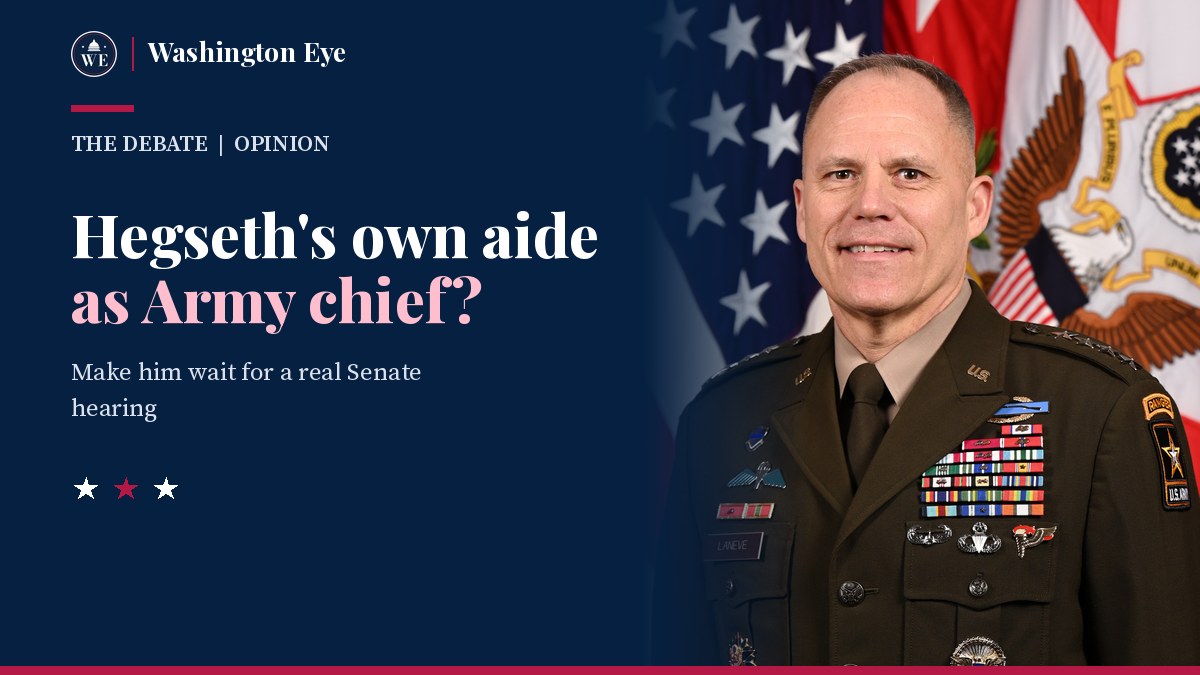
On Monday the Senate received a nomination that should not be waved through in the final weeks of a dying majority. President Trump has asked senators to confirm Gen. Christopher LaNeve as chief of staff of the Army, the service's highest uniformed officer. LaNeve has done the job on an acting basis since April, when Defense Secretary Pete Hegseth pushed out his predecessor, Gen. Randy George. Before that, LaNeve was Hegseth's senior military assistant, the officer who sits closest to the secretary every working day.
We do not argue that LaNeve is unqualified. His record is long and real. We argue something narrower and, we think, harder to dismiss: the Senate should not confirm Hegseth's own former aide to the Army's top job until it has finally been told why the man before him was fired. That answer has been withheld for seven months. A lame-duck Senate in a hurry is the wrong body to stop asking for it. The new Senate that is sworn in on 3 January should hold a full, public hearing, and LaNeve should wait for it.
A résumé worth respecting
Start with what is not in dispute. LaNeve has served 36 years in the Army as an infantry officer. As a general he has commanded the 7th Army Training Command in Germany, the 82nd Airborne Division at Fort Bragg and the Eighth Army in South Korea. Since taking over in April he has issued a new strategic framework for the service and, last month, updated operational guidance on how the Army intends to fight a technologically equal adversary such as Russia or China.
At the Army's annual convention in Washington in October, he made the case in plain terms. "Every day we ask American soldiers to be prepared to hold terrain, secure populations, disarm militias, protect humanitarian corridors and create the conditions for whatever comes next," he said. "That should never ever be a fair fight." The acting Army secretary, Adam Telle, called him "the right leader at the right time to modernize the Army" in a statement online after the nomination went in.
None of that is trivial, and a fair process should give LaNeve every chance to make his case. But a résumé is not the only thing the Senate is asked to judge when it confirms a service chief. It is also asked to judge whether the chain of command is working the way the law intends, with civilian control that is firm but accountable, and uniformed leaders who give honest military advice rather than loyal agreement. On that second question the record of the past two years gives senators every reason to slow down.
The question nobody has answered
Gen. George, a 1988 West Point graduate, had led the Army since September 2023. In early April, a little over a month into the war with Iran, Hegseth ordered him to retire immediately. Reporting at the time by a major American newspaper tied the firing to a dispute over promotions: Hegseth had reached into a list of colonels selected for their first star and removed four of them, two Black men and two women. George and then Army Secretary Dan Driscoll objected, citing the officers' records. Soon after, George was gone.
When members of the Senate Armed Services Committee pressed Hegseth at a hearing on 1 May to explain the decision, he declined to give specifics. "We needed new leadership," he told senators, several times. Sen. Joni Ernst, an Army veteran from Iowa whose vote helped confirm Hegseth himself, was among the Republicans who said they were disappointed.
That is where the matter has rested. Senators were never told whether a sitting Army chief was removed for failing in his job or for objecting to the secretary's handling of a promotion list. That is not gossip. It goes to the heart of what the Senate's advice and consent is for. If the previous chief was fired for doing what the law expects of a senior officer, then confirming the secretary's former aide in his place without asking the question sends a message to every general in the building about what kind of advice is safe to give.
A pattern, not an exception
George was not an isolated case. By one network tally, at least 20 generals, admirals and senior civilian defense leaders have been fired or have left their posts since Hegseth took over the Pentagon. The chairman of the Joint Chiefs, Gen. Charles Q. Brown, was dismissed in February 2025, along with the chief of naval operations, Adm. Lisa Franchetti, and the Air Force vice chief of staff, Gen. James Slife. The head of the Defense Intelligence Agency, Lt. Gen. Jeffrey Kruse, was removed in August 2025 after an early agency assessment found that the strikes on Iran's nuclear sites that summer had set the program back only by a matter of months.
LaNeve's own rise runs through that pattern. He became vice chief of staff after Gen. James Mingus retired a year early with no public explanation. About three months after LaNeve's confirmation to that post, George was gone and LaNeve was running the Army. One source quoted by a Capitol Hill news site this summer called the circumstances of Mingus's departure "questionable". The Army secretary who defended George, Driscoll, resigned at the start of September after months of reported tension with Hegseth. The Army, with close to a million people in uniform and about 200,000 civilian employees, has since had no Senate-confirmed leader in either its top uniformed or its top civilian job. The White House has not yet nominated anyone to replace Driscoll.
A Senate that confirms a chief in those circumstances without a serious hearing is not exercising oversight. It is ratifying a purge after the fact.
The objections are bipartisan
This is not only a Democratic complaint. When word spread in August that LaNeve was Hegseth's choice, objections came from Republicans on the Armed Services Committee as well. Ernst was reported to oppose him. Sen. Tommy Tuberville of Alabama said colleagues had told him LaNeve "doesn't have enough four-star experience". The committee chairman, Sen. Roger Wicker of Mississippi, acknowledged at least some bipartisan opposition. Lawmakers and former defense officials pointed out that Army chiefs have usually spent at least 18 months in a four-star post before reaching the top job; at that point LaNeve had held four stars for about half a year.
Members of Congress were also angered when LaNeve eliminated a 600-member unmanned assault battalion created inside the 173rd Airborne Brigade, a strange choice for an Army that says it is racing to field drones. He has since tried to reassure industry by renaming the command that shapes the future force to put autonomous systems in its title. Those are fair subjects for a hearing. They are exactly the kind of questions a rushed vote in December would skip.
The Pentagon says it stands behind him. Its chief spokesman, Sean Parnell, said this summer that the department would keep working with the White House and the Senate "to nominate and ultimately confirm President Trump's pick to lead the United States Army". That is the department's right. Advice and consent is the Senate's.
Why waiting is the honest choice
The strongest argument for moving fast is obvious, and we take it seriously. The country is at war with Iran. An Army without a confirmed chief for five months is not a healthy Army, and a vacancy at the top can weaken a service's voice inside the Pentagon and at the White House. If the job matters this much, the argument goes, fill it now.
But the vacancy was not an accident of the calendar. It was created by the secretary's own decision, made without explanation, in the middle of the same war. And LaNeve is already in the job. He will keep running the Army whether the Senate votes in December or in February. Waiting six or eight weeks for a full hearing in front of the new Senate would cost the service very little in practice. Confirming him in a lame-duck rush, with the outgoing majority eager to clear its desk, would cost the Senate a great deal of its authority.
There is also a fairness point for LaNeve himself. A general confirmed in the dark carries a question mark for the rest of his tenure. A general confirmed after answering hard questions in public, including what he knew about the decision that put him in charge, carries a mandate. If he is the officer his supporters describe, a real hearing is the best thing that could happen to him.
The voters have just handed both chambers of Congress to Democrats, in an election many Republicans themselves blame partly on the war and the rise in gas prices that followed. Last week the outgoing House majority voted 211 to 204 to send articles of impeachment against Hegseth to committee rather than vote on them. That vote may only delay the fight, because the new majorities arrive in January. The decent and orderly way to respect that result is to let the new Senate do the confirming.
What the Senate should ask
When the hearing comes, the questions are not complicated. Why was Gen. George removed, and did the dispute over the promotion list play any part? What role did LaNeve, then the secretary's closest military aide, play in the decisions that led to Mingus's early retirement and George's firing, if any? Will he tell the secretary and the president things they do not want to hear, and how will senators know if he does? And why did the Army disband a drone unit while promising to lead on drones?
Hegseth has just ordered the military's war colleges to teach officers about constitutional principles and civil-military relations, with case studies of ethical successes and failures. It is a good idea. The Senate can offer the first lesson itself. Civilian control of the military does not mean the secretary of defense answers to no one. It means he answers, in the end, to the people's elected representatives. Before Hegseth's former aide takes the Army's top job, those representatives deserve an answer to a seven-month-old question. Make him wait until they get one.