
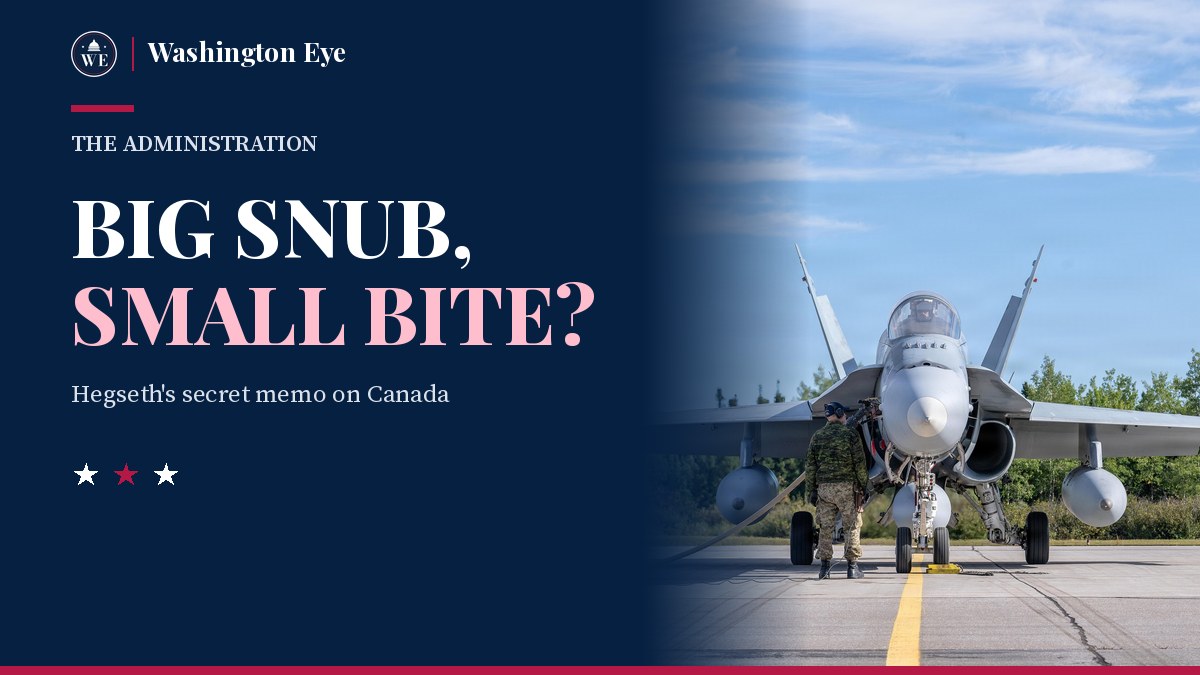
Every November, the defence establishment of the Western alliance gathers in Halifax, Nova Scotia, for a weekend of panels, side meetings and long dinners. This year the Americans arrived carrying a document their Canadian hosts had never seen. Defense Secretary Pete Hegseth, it emerged on Friday night, had circulated a classified memo the week before that places new restrictions on how the United States military deals with Canada. By Saturday morning the forum's corridors were full of people trying to work out what, exactly, it restricts.
The answer that came into focus over the weekend is both smaller and stranger than the first reports suggested. The memo does not touch the machinery that actually defends North America. It does, however, tell American generals and officials that their ordinary professional contact with the country's closest military partner now needs a reason, and in some cases a permission slip. That combination of a big symbolic snub and a modest practical bite says a great deal about how the administration now treats its northern neighbour.
The first account of the directive, published by a major American newspaper and based on officials who spoke anonymously, described it as escalating a broad clash between Washington and Ottawa. One official was quoted as saying the Canadians were sure to see it as a "slap in the face". The newspaper said it had not seen the memo itself, and the Pentagon has not released it.
The clearest description so far came from Senator Mike Rounds, a South Dakota Republican on the Senate Armed Services Committee, who was in Halifax and confirmed the memo exists. "It does limit general flag officer meetings to those that advance [Department of War] objectives," he told reporters. American defence officials, uniformed and civilian, must now request permission before attending Canadian think tank events or social engagements. Mr Rounds said he had checked with the administration and been told the directive has no operational effect on American personnel serving in Canada, and no effect on the North American Aerospace Defense Command, on NATO operations or on the Five Eyes intelligence partnership.
He also offered something rarer in these stories: a motive, stated plainly. The measures were drafted months ago and signed only recently, he said, and their purpose was pressure. "Look, we really want you to bring up your defence spending," Mr Rounds said, adding that the Canadians had just walked the American delegation through their plan to increase it significantly. He called the leak unfortunate.
The Pentagon's own statement drew the same boundary from the other side. Sean Parnell, its chief spokesman, said the department is "taking steps to ensure its engagements with Canada advance tangible U.S. defence objectives and ultimately support a reinvigorated defence relationship." He said the guidance "does not impact defence intelligence co-operation, our binational NORAD command or our co-operation through NATO." What he did not say is just as telling. Bilateral exercises, training exchanges, personnel swaps and joint planning were left out of his list of protected areas, and Canadian military sources have pointed to exchange programmes as one place where the directive might eventually be felt.
Ottawa's reaction was a study in deliberate calm. Defence Minister David McGuinty said he had first heard of the memo the day before. "It's clear there's some sort of document we haven't seen," he said. "I'm not aware of the contents of it." Senior Canadian commanders learned of it from the news report, according to Canadian military sources, and the government says it received no formal or informal notice. Mr McGuinty insisted the two forces still work "hand-in-glove", pointing to joint efforts to stop drug shipments in the Caribbean and to new work on integrated air and missile defence. "There have been curveballs of this kind," he said. "We've learned to move forward."
Not every American in Halifax was relaxed about it. Senator Chris Coons, a Delaware Democrat on the Foreign Relations Committee, called the directive "a completely unnecessary insertion of a negative tone". He said he was relieved it had no significant operational impact, but argued that with Iran, North Korea, China and Russia drawing closer together, the United States "should be doing nothing to further aggravate" the distance between itself and Canada.
To understand why a memo about dinners and panels matters, it helps to see it as the latest step in a pattern rather than a one off. In May the administration suspended American participation in the Permanent Joint Board on Defense, a bilateral advisory body created in 1940 that once shaped continental security policy. Elbridge Colby, the Pentagon's policy chief, announced the decision in a post online and tied it to Prime Minister Mark Carney's January speech at the World Economic Forum in Davos, where Mr Carney urged middle powers to band together against mistreatment by global "hegemons". "Unfortunately, Canada has failed to make credible progress on its defence commitments," Mr Colby wrote, telling Ottawa to prioritise "hard power over rhetoric." The board met only sporadically, so the practical effect was small. The message was not.
The new memo follows the same template. It leaves the load bearing walls of the alliance standing, NORAD, NATO and intelligence sharing, while pulling away the social and professional scaffolding around them. That scaffolding is not trivial. Generals who have shared panels and dinners for years pick up the phone to each other in a crisis. Think tank conferences are where allies test ideas before they become policy. Making each of those contacts a matter for approval does not break the relationship, but it adds friction, and friction is the point.
The complaint at the heart of it, that Canada does not spend enough on defence, has become harder to sustain. Under Mr Carney, Canada has reached NATO's long standing benchmark of 2% of GDP and has signed up to the 5% by 2035 target that President Donald Trump demanded of allies. An American official at a Pentagon briefing for Canadian reporters earlier this year said Ottawa had not yet produced a concrete plan to reach 5%. Mr Rounds's own account suggests the Canadians spent part of this weekend showing exactly that kind of roadmap.
Which points to the more likely irritant: where the money goes. Mr Carney has said openly that it is unhealthy for more than 70 cents of every Canadian defence equipment dollar to flow to a single market, the United States. His government's first Defence Industrial Strategy, launched in February, aims to raise the share of defence purchases awarded to Canadian firms to 70% and frames procurement as build at home first, partner second, buy third. Mr McGuinty repeated that order in Halifax. "We'd like to procure less from the United States when it comes to military hardware and produce more of our own here in 10 core areas," he said. He also used the forum to announce that Canada will put about C$100 million into the NATO Innovation Fund, a venture fund backed by a couple of dozen allies.
The sharpest example is the fighter jet. Canada agreed in 2023 to buy 88 F-35s from Lockheed Martin. Soon after taking office, Mr Carney ordered a review of the purchase, and that review is still open. Ottawa is committed to 16 jets, has paid long lead costs on 14 more and has already received its first two aircraft, but the remaining 72 are in limbo. Sweden's Saab has lined up Canadian partners, including a final assembly site in Halifax itself, in case Ottawa opts for a mixed fleet with the Gripen E. American officials have openly criticised the review, and Canada's industry minister said in mid October that a decision on major procurements could come within a couple of weeks. More than a month later, it has not.
Seen in that light, a memo that rations generals' goodwill looks less like a security measure and more like leverage. There is an irony buried in it. One of the main worries about the Swedish jet is that its engine is American made and subject to United States export controls. Even a Canada that buys elsewhere stays tied to Washington's approval. Restricting the warm contacts that make a buyer feel like a partner is an odd way to win an order the administration plainly wants.
The memo also lands in the middle of a trade negotiation. Canada walked away from a tentative agreement in August and has retaliated against American tariffs more forcefully than most countries. Talks have resumed. On Friday Mr Trump said his team was "working on making a deal" and called Mr Carney "very nice" after the two met in China this week, while repeating his complaint that Canada is "ripping us off". Mr Carney, for his part, said in a newspaper interview that he has studied the risk of an American military attack on Canada, a sentence that would have been unthinkable from a Canadian leader a few years ago.
There is a reasonable case for the administration's approach. Allies that free rode for decades did start spending once Washington stopped being polite, and Canada's own move to the 2% line came under exactly that pressure. A directive that costs nothing operationally while signalling displeasure is, from the Pentagon's point of view, a cheap lever. The counter case is that the lever pulls in the wrong direction. Each public snub makes it easier for any Canadian government to justify buying European, and harder to argue at home for deeper integration with the United States.
What to watch next is concrete. The first test is whether the memo's reach stays where Mr Rounds described it or creeps into exercises, training slots and exchange postings that the Pentagon's statement conspicuously left out. The second is the F-35 decision, which will show whether pressure of this kind moves Ottawa or hardens it. The third is the trade deal, because if one is signed the defence frost may thaw quietly, and if talks collapse it may spread. For now, the planes on the runway at Goose Bay are still flying the same missions with the same partners. The question this weekend raised is how long the relationship around them can be run on permission slips before the planes start to notice too.