
There is a simple idea at the heart of the Department of Housing and Urban Development's newest rule, and most Americans would agree with it: scarce federal housing aid should go to citizens and lawful residents first. Waiting lists for subsidised housing in many cities stretch for years. Families who followed every rule sit on them while their rent eats half their pay. Asking that taxpayer-funded homes serve those families is not cruelty. It is common sense.
That is why it is so frustrating that HUD has chosen a way of making the point that is likely to lose in court, will burden millions of the very citizens it says it is protecting, and hands its opponents the moral high ground on a silver plate.
The rule, due to take effect on 14 December, would end what is known as proration. For nearly 30 years, a household in which some members are eligible for federal housing help and some are not has been allowed to stay in assisted housing, with the subsidy cut so that it covers only the eligible members. Under the new rule, a family can remain in HUD-assisted housing only if every member is a US citizen or an eligible immigrant. On 23 November, 22 state attorneys general and the governor of Pennsylvania sued in federal court in Massachusetts to stop it.
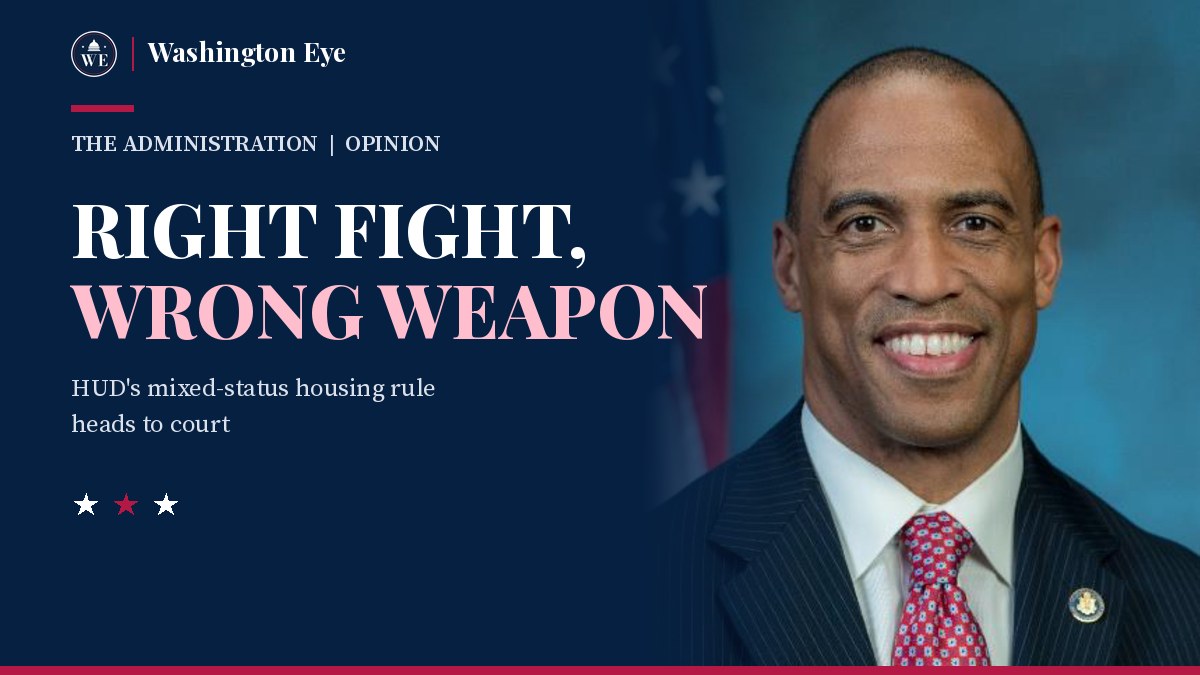
Housing Secretary Scott Turner has defended the rule with vigour. "This rule guarantees ONLY AMERICAN citizens and certain eligible noncitizens will reside in HUD-funded housing," he said, describing it as "a reallocation of up to $218 million which will now go to eligible Americans that are currently on a waitlist." He says it "ends the exploitation of taxpayer dollars."
On the principle, he has a point. Conservatives have argued for years that a program which lets people with no legal right to be in the country live in subsidised housing, even with a reduced subsidy, rewards illegal immigration and sends the wrong signal. Housing aid is not an entitlement that every poor family receives. It is rationed, and when something is rationed, the country is entitled to decide who goes to the front of the line. The first Trump administration tried a version of this policy in 2019. It was never finalised and was withdrawn in 2021. Returning to it now is consistent, and it fits the mandate the president won in 2024 on immigration.
But a good principle does not excuse a bad instrument, and this rule has three problems that should worry anyone on the right who cares about winning the argument rather than just making it.
The first problem is the law. Congress wrote proration into statute in 1997. According to the states' complaint, the law says families receiving prorated assistance "shall not" lose their benefits just because an ineligible family member lives with them. Conservatives spent decades criticising agencies that rewrote statutes by regulation when they did not like what Congress had passed. The Supreme Court's recent decisions curbing agency power were victories that the right fought hard for. An agency that tries to erase the words "shall not" through rulemaking is doing exactly what conservative lawyers told judges agencies must never do. If the rule falls, it will fall on grounds the right itself made stronger.
The second problem is the burden on citizens. The rule does not only affect mixed-status families. Every US citizen in a federal housing program would have to provide a Social Security number and consent to a check through the federal SAVE immigration database. Where that check fails to confirm citizenship automatically, the tenant would have to produce an original or certified birth certificate, a naturalisation certificate or a passport. The states cite estimates that 3.8 million adult US citizens lack a document proving their citizenship, and that a further 17.5 million face barriers to getting one. Many of them are elderly, disabled or poor, which is to say, many of them live in public housing.
A policy sold as putting Americans first should not threaten Americans with eviction because a computer system could not find their records. The country has seen what happens when well-meaning verification rules meet messy databases: eligible people are dropped, appeals pile up and the agency spends more on paperwork than it saves.
The third problem is who actually loses. By HUD's own estimates cited in the lawsuit, around 20,000 mixed-status families, totalling about 78,100 people, would lose their assistance. Of those, about 55,000 are themselves fully eligible for federal housing help. Federal figures in the complaint say 65 percent of the eligible people in these households are children, and that mixed-status families make up less than 1 percent of households receiving federal housing aid. HUD expects most of them to leave voluntarily, and nearly 1,000 households to face formal eviction.
That means the typical person hit by this rule is not an illegal immigrant. It is an American child whose parent lacks legal status. Conservatives who want to deter illegal immigration should aim the policy at the person who broke the law, not at the citizen child who did not. And by HUD's own estimate, sheltering people pushed out by the rule could cost governments between $20,000 and $50,000 per person each year. A rule designed to save taxpayers money could simply move the bill from the federal budget to city shelters.
There is also the politics. Republicans just lost both chambers of Congress in an election shaped by the cost of living. A rule whose most memorable image is a citizen child being moved out of a home is a gift to every Democratic campaign in 2028. It turns a debate the right should win, about fairness to the families on the waiting list, into one it will lose, about splitting up households.
So what should conservatives want instead? Start with Congress. If the 1997 law is wrong, change it. A bill that ends new prorated leases for households with members who are in the country illegally, while letting existing families transition over a fixed period, would be far harder to challenge in court and far easier to defend in public. It would also be durable, unlike a rule that the next administration can erase with the stroke of a pen, as the Biden administration did with the 2019 proposal.
Second, separate the citizen verification question from the immigration question. Making sure that only eligible people receive aid is reasonable. But the burden of proof should sit with the government's databases, not with an elderly tenant who was born at home decades ago and never had a birth certificate. Phase in verification at recertification, accept a wider range of documents and require HUD to fix its matching before anyone loses a home.
Third, follow the money that Secretary Turner says will be freed up. If up to $218 million truly goes to Americans on waiting lists, publish exactly where, to whom and how fast. A promise of reallocation is only persuasive if voters can see the families who benefit.
The courts will now decide whether HUD had the power to do this. The states argue that the rule exceeds HUD's authority and is arbitrary and capricious under the Administrative Procedure Act. Given the plain words of the statute, it would be a surprise if the department wins on the merits without help from Congress.
That is the real lesson. Putting citizens first in federal housing is a fight worth having. But it is a fight for Congress, not for a rulemaking, and it should be fought in a way that protects citizen children rather than putting them on the front line. HUD picked the right fight. It picked the wrong weapon.