
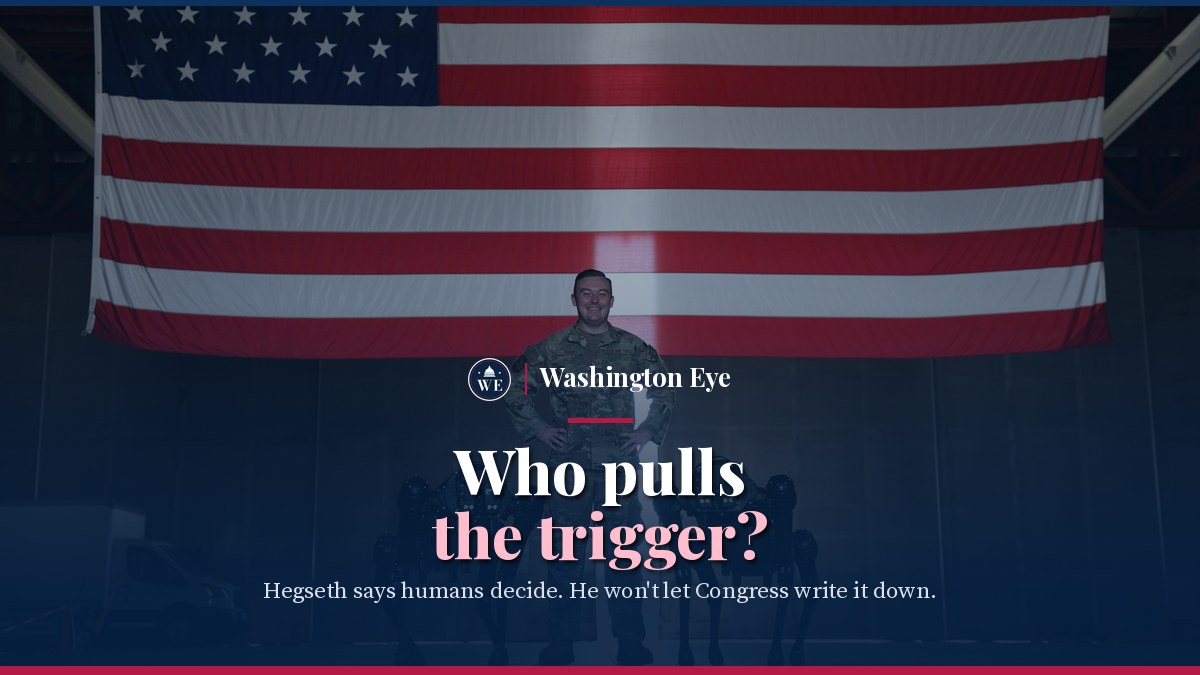
In April, sitting before the Senate Armed Services Committee, Defense Secretary Pete Hegseth was asked a question that sounded simple. Senator Jacky Rosen, a Nevada Democrat, wanted to know whether a human being would always be in the loop when artificial intelligence is used to pick lethal targets. Hegseth did not give a one word answer. "We follow the law, and humans make decisions," he said. A moment later he added: "AI is not making lethal decisions."
Seven months on, the Senate has offered to turn that promise into law, and Hegseth has said no. A report on Tuesday said the Pentagon chief is rejecting a provision in the Senate's version of the annual defense policy bill that would require the military's autonomous weapons and AI systems to be designed and used so that commanders exercise "ultimate human responsibility" over lethal force. It is the first time Congress has tried to write rules for military AI into statute, and it lands just as the Pentagon races to put more of it on the battlefield.
Washington Eye could not review the full text of the objection, so we will not put words in the secretary's mouth. But the administration has made its thinking on AI and war public many times this year, and the dispute now heads into the final weeks of a lame duck Congress with a December 11 funding deadline hanging over everything. So here is the question, argued both ways: should Congress write the human into the law?
What the Senate actually wrote
The language is less radical than the fight around it suggests. The Senate committee finished marking up its bill on June 10 and sent it to the floor on an 18 to 9 vote. Its AI sections came largely from a June 8 bill by Senators Jack Reed and Chris Coons, the committee's top Democrat and his colleague on defense appropriations, with pieces of a measure by Senator Mark Kelly, a former Navy combat pilot, folded in. The Republican majority accepted them into the base text.
The opening line is not a restriction at all. It says the department's policy is to "maximize uses of autonomy and artificial intelligence capabilities to the extent practicable," while keeping "appropriate human oversight." The rules follow. To the maximum extent practicable, covered systems would have to let operators supervise them, include a way to intervene in or stop the use of force, fall back to manual control, give operators enough information to oversee them, and keep records of target selection data and operator actions for later review. An incident database would track failures, unintended behaviour and near misses.
Three uses would be banned outright: using AI for "the decision to initiate the launch or detonation of a nuclear weapon," using it to monitor or target people in the United States outside existing law, and using lethal autonomous force "without incorporation of appropriate levels of human judgment." A second section would order regulations, within 180 days, ensuring that force "remains subject to a clear, accountable, and identifiable human chain of command and control" and that no weapon system "shall eliminate human responsibility for the use of force."
Much of this is not new. Pentagon Directive 3000.09, first issued in 2012 and last updated in January 2023, already requires that autonomous weapons let commanders and operators exercise "appropriate levels of human judgment over the use of force." The Senate text would lift that standard out of a document the Pentagon can rewrite and put it into a law it cannot.
That is exactly why it matters. On June 5, President Donald Trump signed a memorandum telling the department to "eliminate unnecessary barriers to rapid deployment" of AI and to deliver an updated version of 3000.09 within 90 days. As far as public reporting shows, no revised directive has been released. The House version of the defense bill takes a softer route: it gives the secretary a year to update the policy himself against a checklist, and states that nothing in it requires any programme to pause. One arms control group called the House approach "less specificity and more deference to the Pentagon."
The case for writing it into law
Start with the secretary's own words. If humans make the decisions, and AI does not, then a statute that says so costs the Pentagon nothing. Refusing it invites the obvious question of what the department wants to keep open.
Supporters point to a year in which the gap between promise and practice has looked wide. The United States has been at war with Iran. In February, a US strike hit an Iranian elementary school; Iranian state media said at least 168 children were killed, and congressional Democrats have pressed the Pentagon on whether AI targeting tools played any part. In September, Senators Reed, Mark Warner and Coons wrote to Hegseth citing public reports of an AI targeting platform that relied on outdated geospatial data in a strike in Minab, Iran. Senator Ruben Gallego warned in June that a compressed rewrite of the directive could raise the risk of friendly fire and civilian harm.
Then there is transparency. The Pentagon's main AI office was renamed this autumn the Super Intelligence Office, after a September executive order told agencies to call AI "super intelligence." Its public leadership page now lists only two officials, and spokespeople this week declined to confirm who runs the Maven Smart System, the flagship AI platform for targeting and battlefield awareness. "Who runs a program like Maven isn't a minor detail," said Savan Kong, the department's former chief experience officer. A law requiring an identifiable human chain of command is, in part, a demand to know who is accountable.
Finally, supporters argue that a directive is only as durable as the official who signs it. The administration has already shown it will fight a contractor that tries to set limits of its own. In February, on the eve of the Iran operation, Hegseth designated the AI company Anthropic a supply chain risk after it said its technology could not be used for fully autonomous weapons targeting or mass surveillance of Americans. "That would be like Boeing giving us airplanes and telling us who we can shoot at," he told senators. A federal appeals panel has since upheld the designation by two votes to one, and Anthropic has asked the full court to rehear the case. If companies cannot draw the line, the argument runs, Congress must, because Congress is the one body the Constitution gives that job.
The case against
The administration's side starts from speed. The President's memorandum framed AI as something to deploy fast, and the White House has presented its AI push as a drive to accelerate the technology to counter America's adversaries. On that view, a detailed statute is the wrong tool. A law passed in December 2026 would set engineering requirements for weapons that will look different by 2028, and changing a statute takes an act of Congress, not a memo.
The design rules carry real costs. Re-reviewing systems that were previously exempt, documenting decision logic, logging every operator action and building manual fallbacks into every covered system is slow, expensive work. The department's own testing office, which would police much of it, had its proposed budget cut by about two thirds in this year's request, according to an arms control group. A mandate the Pentagon cannot staff is a mandate that slows deployment without making anything safer.
There is also a command argument. The military already operates under the law of armed conflict and its own rules of engagement, and commanders are already accountable for what their units do. On this view, writing "ultimate human responsibility" into law invites lawyers and judges to define a battlefield term, and a phrase that sounds clear in a hearing room can become a weapon in litigation over every strike.
And the existing standard was built to be flexible on purpose. Directive 3000.09 does not require a human to pull every trigger, and the United States has argued for years at international talks in Geneva against binding rules on "meaningful human control." Locking a stricter standard into US law, the argument goes, ties American hands while rivals sign nothing.
Where the honest answer lies
Both sides have a point, and the bill already contains the outline of a deal. The prohibitions are the easy part. A ban on AI deciding to launch a nuclear weapon has had bipartisan support since 2023, and it is hard to imagine a serious argument for leaving it out. A requirement that every use of force trace back to a named human commander is close to what Hegseth told the Senate in April. Those belong in law.
The engineering list is harder. Here the House instinct to let the department write the detail, with reporting deadlines and public summaries, has merit, as long as Congress can see the result. The experts who study this are blunt that words alone settle little. Zaza Tsotniashvili, a professor in Tbilisi, has said human oversight must be "meaningful rather than ceremonial," warning that without accountability mechanisms a law "may succeed in preserving the appearance of human control while the substance of it continues to erode." Jovana Davidovic, who studies military ethics at the University of Iowa, put the other half of the problem simply: "The more autonomous the system is, the more the decisions that developers make ultimately drive outcomes."
What to watch
The four leaders of the House and Senate Armed Services Committees are expected to write the final text themselves rather than fight it out on the Senate floor. Congress returns from its Thanksgiving break next week with only a few working weeks left, and government funding runs out on December 11. If the defense bill slides into a year end package, the AI sections could be traded away quietly.
Watch, too, for the rewritten directive. If the Pentagon publishes a new 3000.09 before the bill is final, it will show how much of the Senate's language the department already accepts, and how much it does not.
And watch January. Democrats won both chambers on November 3. Whatever drops out of this bill becomes the starting point for new Democratic majorities on both committees, and Democrats who have pressed these questions all year will chair both committees. The secretary says humans make the decisions. Next year, Congress will ask him to prove it.