
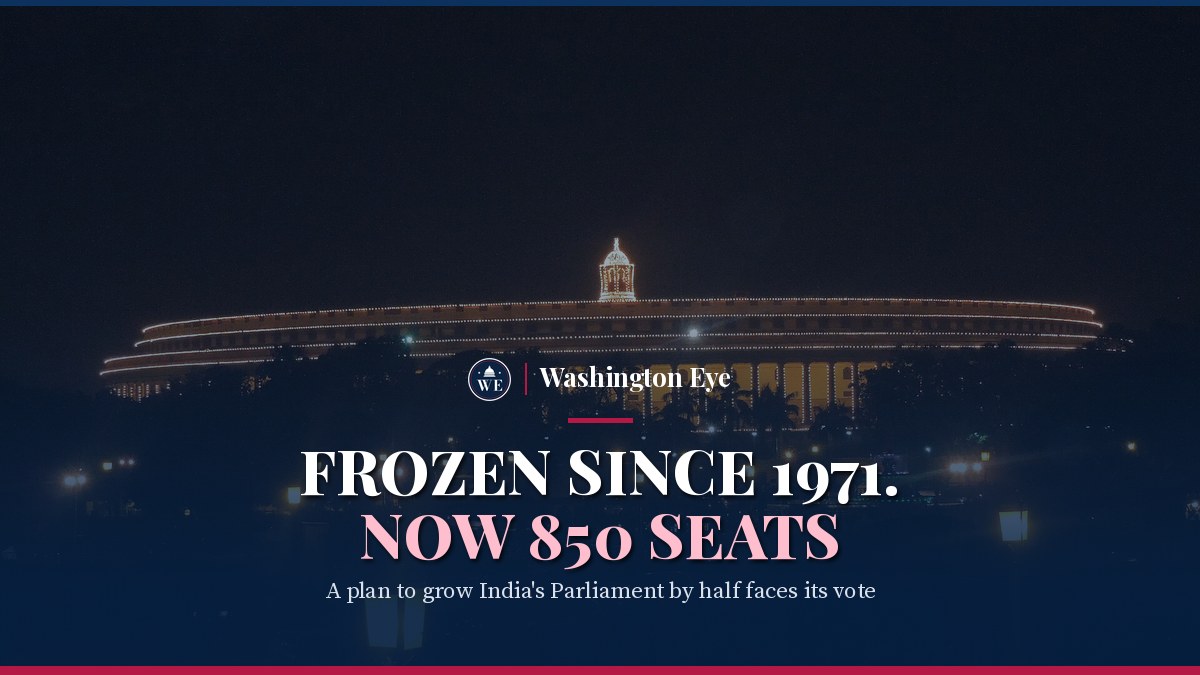
For half a century, India has run the world's largest election on a map drawn from the population count of 1971. Next week its government will ask Parliament to break that freeze in the most dramatic way available: by making the lower house half as large again, writing a one third quota for women into the new seats, and then locking the result in place until 2051.
The Union Cabinet chaired by Prime Minister Narendra Modi cleared the package on Friday, 27 November. It has two parts: the Constitution (132nd Amendment) Bill and a companion Delimitation (Second) Bill. On Saturday the plan picked up a supporter that changes the arithmetic. The Dravida Munnetra Kazhagam, the governing party of Tamil Nadu and for years one of the loudest critics of any redrawing of India's electoral map, said it would vote yes. Its leader, M.K. Stalin, called the revised bill a "major victory" for his state.
The Lok Sabha, the lower house, meets for a special sitting on Monday, 30 November, with the upper house, the Rajya Sabha, due to follow from 2 December. If the amendment passes both chambers with the two thirds majorities it needs, and is then ratified by at least half of India's states, it will be one of the biggest structural changes to the country's democracy since independence.
What the bills actually do
The core idea is simple. Every state and Union Territory keeps exactly the share of seats it has today, and every delegation grows by 50 per cent. Under the text described in Indian reporting, the constitutional ceiling on the Lok Sabha would rise to 815 members from the states and 35 from the Union Territories, a maximum of 850, up from today's limits of 530 and 20. Because half seats must be rounded, the real size of the chamber is expected to land somewhere between 816 and 824, against 543 elected seats now.
State legislatures would grow by the same proportion, and the ceiling on any single state assembly would rise from 500 to 650. That matters most for Uttar Pradesh, India's most populous state, whose assembly of 403 would pass 600 members. Under the old cap, a 50 per cent increase there would simply not have fitted.
The expansion is tied to women's representation. India passed a law in September 2023 reserving one third of seats in the Lok Sabha and state assemblies for women, but it was written to take effect only after a fresh delimitation, the formal redrawing of constituencies. The new amendment says its purpose is to give "immediate effect" to that reservation through a delimitation that adds 50 per cent more seats. If it passes and the exercise is completed, women would be guaranteed roughly 270 seats in the lower house, rotated across constituencies for 15 years.
In his statement of objects and reasons, Law Minister Arjun Ram Meghwal argued that "such a uniform increase would enhance the overall representation of the people while maintaining the existing relative distribution of seats among the states."
A delimitation commission headed by a sitting or retired Supreme Court judge, with the Chief Election Commissioner or a nominee and the relevant state election commissioner, would redraw the boundaries. According to the bill as reported, the work would rest on the latest census figures published when the act takes effect, which in practice appears to mean the 2011 count. Each state would add five members of Parliament and five state legislators as associate members.
Why the map froze in the first place
To see why this is a big deal, it helps to know why India stopped redrawing its map. The Constitution originally required seats to be reallocated after every census. By the 1970s that rule had become explosive. Southern states such as Tamil Nadu and Kerala had brought birth rates down sharply, while large northern states such as Uttar Pradesh and Bihar were still growing fast. A pure population formula would have moved seats, and power, from the south to the north.
The southern argument was that states should not be punished in Parliament for succeeding at a national goal. The solution was a freeze. Seat shares were pinned to the 1971 census, and the freeze was later extended until after the first census taken after 2026. That deadline is now arriving, which is why the question can no longer be postponed.
The new plan is a way to have delimitation without the redistribution everyone feared. No state loses ground. Tamil Nadu, which holds 39 seats and about 7.2 per cent of the chamber, would rise to 59 seats and keep the same share. The bill then extends the freeze on relative shares for another quarter century.
How the government lost once and may win now
This is the government's second attempt. In April it brought an earlier version, the 131st Amendment Bill, to the floor of the Lok Sabha. That version did not include the uniform 50 per cent increase, and a united opposition defeated it. It was the first time since 2011 that a constitutional amendment had failed to win the required majority in the lower house.
What has changed since then is the opposition. Indian reporting describes rebellion inside two opposition parties, the Trinamool Congress and the Uddhav Thackeray faction of the Shiv Sena, and a new willingness from the DMK and the Sharad Pawar faction of the Nationalist Congress Party to deal. The government has also made the concession the south asked for: protecting existing shares for 25 years.
The DMK's support is the clearest sign of that shift. The party holds 22 seats in the Lok Sabha and eight in the Rajya Sabha. "Since the Bill allows 50 per cent uniform increase in the number of seats for all states, the DMK has decided to support the Bill," said A. Raja, the party's deputy general secretary. "We have always batted for a fair delimitation. Our stance on this issue has not changed." Its resolution ended with a rallying cry: "We will protect Tamil Nadu's representation!"
Not everyone in Tamil Nadu agrees. K. Veeramani, leader of the Dravidar Kazhagam, a longstanding ally of the DMK, warned the party not to trust what he called sugar coated assurances, and said backing the bill would be a "historical mistake" and a "betrayal" of the state's people.
The case against
The Congress party, the largest opposition force, has promised to fight. Rahul Gandhi is reported to have told a party strategy meeting that "we will fight it tooth and nail to defeat it, just as we did last time." A senior Congress leader warned that "business cannot be as usual" inside the opposition alliance if partners break ranks.
Congress says it supports women's reservation but not this route to it. Its stated position is that the lower house should stay at its present strength, the women's quota should be applied to the existing seats from the 2029 election, and the current distribution among states should be frozen for 25 years without any expansion. Jairam Ramesh, the party's general secretary for communications, wrote in a social media post that the special sitting "is thus NOT for women's reservation," since that law already exists, and called it "a desperate move by a nervous and rattled PM."
The deeper worry is about who draws the lines. Gaurav Gogoi, a Congress member of Parliament, linked the bill to a disputed revision of voter rolls. "First, through SIR, Narendra Modi and Amit Shah decided who would vote and who would not," he said, referring to the special intensive revision. "Now, through delimitation, will they decide who votes where and who does not?" Congress also complained that the draft text had not been circulated to members days before the vote.
Those concerns are not trivial. Redrawing hundreds of constituencies at once hands enormous discretion to a commission, and boundary lines can shape results as surely as vote counts. Americans who follow fights over gerrymandering in Texas, California or North Carolina will recognise the stakes. The difference is scale: India would be drawing roughly 270 new national seats, and well over a thousand new state seats, in a single exercise.
Why it matters beyond India
India is the world's most populous country and a democracy of almost a billion voters. How it handles the tension between population and power will shape its politics for a generation, and the bargain on offer is unusual. Rather than choosing between fairness to fast growing states and fairness to states that slowed their growth, it tries to avoid the choice by making the pie bigger and postponing the reckoning until 2051.
The comparison with Washington is striking. The US House of Representatives has been fixed at 435 voting members for more than a century, so each American representative now speaks for more than 760,000 people. An Indian member of the Lok Sabha already represents well over two million people on average, and even a chamber of about 820 would leave each with a constituency several times larger than an American one.
For India's partners, including the United States, the result will also be read as a test of Mr Modi's political strength after the April defeat. A win would show that his coalition can still assemble the supermajorities needed to change the Constitution. A second loss would suggest the opposition has learned to hold together on the issues that matter most to it.
There is also an uncomfortable trade at the centre of the plan. The guarantee of seats for women is popular across party lines, and almost no one in Parliament argues against it in principle. By tying that guarantee to a vast expansion of the chamber, the government has made it costly for opponents to vote no. Critics call that a hostage tactic. Supporters call it the only way to make reservation real after decades of delay.
The votes next week will settle which description sticks. If the amendment clears both houses, the states will have their say, and then a commission will start redrawing the map of the world's largest democracy. If it fails, India will be back where it started: a map from 1971, a promise to women still waiting, and a deadline that has already arrived.