
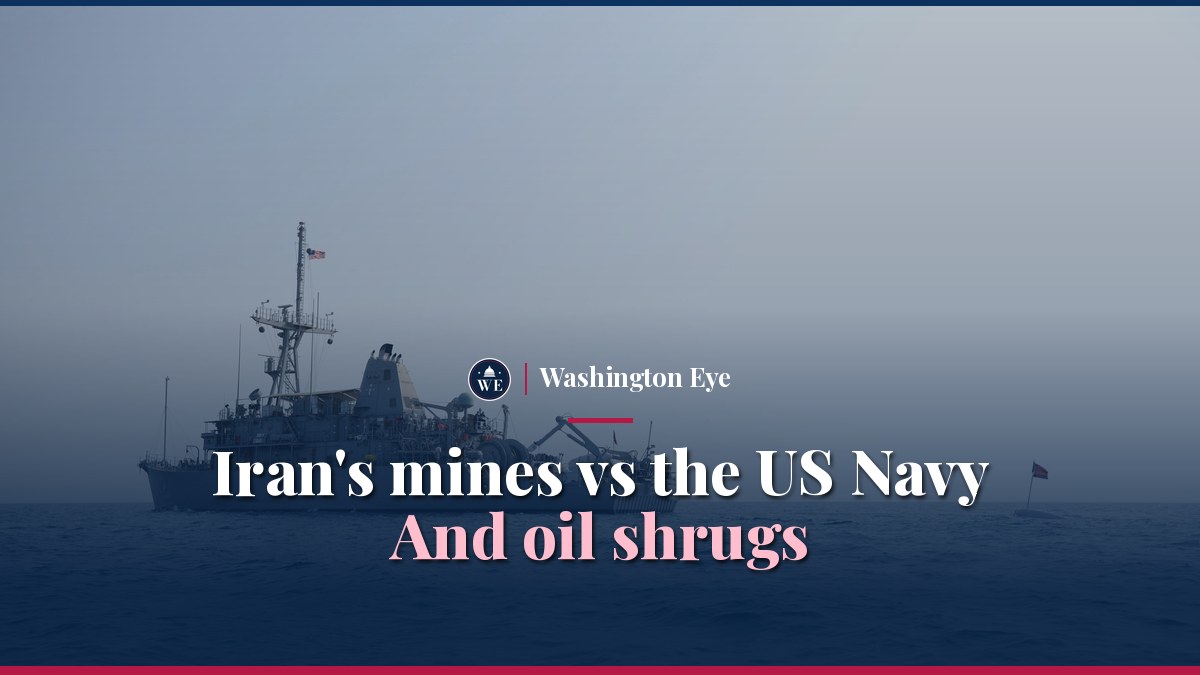
Late on Monday, Iran's Revolutionary Guards put out a statement that read like a dare. Three oil tankers, the Guards' navy said, had "suffered a severe explosion and fire after hitting naval mines" in the Strait of Hormuz within a few hours. One was hit near the southern coast of the strait and two in its eastern stretch. The punchline came at the end: all three, the Guards said, had been sailing under extensive American air cover and escort, and that protection had failed to stop the blasts.
Nobody outside Iran has yet confirmed the claim. The ships were not named, and US Central Command had not responded by Tuesday morning. Yet the statement matters whether every detail holds or not, because of who it was aimed at and when it landed. It came a day after President Donald Trump said Iranian ships trying to break the American blockade would go "to the bottom of the sea," and on the same day the Treasury announced another round of sanctions meant to choke what is left of Tehran's oil money. And then there is the strangest part of the story. When markets opened in Asia on Tuesday, oil prices fell.
What Iran is claiming
The Guards framed the three tankers as rule breakers. Iran has told commercial shipping for months that only the northern lane through the strait, the one that hugs its own coast, is approved for safe passage. Ships that use alternative routes closer to Oman have been threatened or attacked. "The Strait of Hormuz is not a place to test unauthorized routes or ignore maritime warnings," the statement said, warning that vessels disregarding its instructions would be treated as cooperating with "invading forces."
It added a line clearly written for shipowners rather than for Washington: "U.S. military cover and escort will not replace compliance with maritime regulations and instructions from the IRGC Navy Traffic Control Center." In other words, Tehran is telling insurers and captains that an American warship nearby is no guarantee of anything.
This is not the first time Iran has told this exact story. On 14 November, its navy said three tankers caught fire after hitting mines in the strait, one in the morning and two more that evening, describing them as "violating tankers" that were "attempting to slip through a prohibited route." That claim also could not be independently verified at the time. Two near identical announcements in ten days suggest that, at the very least, the mine is now Iran's preferred message.
Why mines, and why now
Mines are the oldest trick in the Gulf's playbook and still one of the most effective. They are cheap, hard to find and deniable, and they turn every crossing into a gamble. A fleet of destroyers can shoot down missiles and drones; it cannot easily see a mine sitting below the surface in a lane it has not swept. That is the gap the Guards are pointing at when they say escorts "failed."
The wider pattern supports the idea that Iran is turning up the pressure at sea. Reported attacks on shipping in and around the strait, the Gulf and the Gulf of Oman passed 30 in October, according to counts by the Royal Navy linked maritime trade office, the highest monthly figure since the war began in late February. At least 22 more had been reported in November by Sunday. Those are only incidents verified through primary sources, so the true number is probably higher.
The fight has also moved off the water. American officials are investigating Iran as a primary suspect behind cyberattacks on as many as 50 ships carrying oil, liquefied gas and chemicals, a major American newspaper reported on Monday, with some crews receiving warnings and bomb threats. Russia is also being examined as a possible culprit. Neither government had responded to requests for comment.
The blockade is the real target
To understand Monday's statement, read it next to what Iran said earlier the same day. At his weekly briefing, Foreign Ministry spokesman Esmaeil Baghaei called the US naval blockade of Iranian ports "military aggression" and an "act of crime" that breaks the UN Charter. "We will certainly not tolerate this situation and will use every means to counter US aggression," he said.
The blockade passed its 130th consecutive day on Saturday, according to Central Command, which says it is stopping the Guards from exporting billions of dollars of crude. Last week the Pentagon sent a third aircraft carrier, the USS Theodore Roosevelt, to join the two already in the region. For days, commentators and accounts close to the Guards have called for a convoy of Iranian tankers to run the blockade, with some threatening Gulf oil facilities if those ships were attacked. An agency close to the Guards said on Sunday that no official body had announced such a plan, but added that "Iran's plans to break the blockade are certainly being drawn up."
Mr Trump's answer was blunt. Asked about a convoy in a television interview, he said: "I hope they do it; they'll all go down to the bottom of the sea, just like the rest of their navy." Seen in that light, the mine announcement is Iran's reply in kind. You can stop our tankers, it says; we can make your escorted ships burn.
Washington tightens the money squeeze
The White House is fighting this as much with spreadsheets as with ships. On Monday the Treasury sanctioned more than two dozen Iranian exchange houses, front companies and key personnel, part of what it calls Operation Economic Outcast, launched on 24 August. The targets, it said, make up the shadow banking system that lets Iran turn its dwindling export earnings into usable foreign currency.
"Iran's economy is underwater, and its leaders are panicking," Treasury Secretary Scott Bessent said. He called the shadow banking system "the last financial lifeline of a bankrupt regime" and promised to keep going "until we have buried the head of the snake."
Here is the logic of the administration's strategy. Block the oil at sea, then block the money on land, and wait for Tehran to come to the table on American terms. Iran's logic is the mirror image. Make the strait dangerous enough, for long enough, that the cost lands on everyone else's fuel bills and Washington's allies push for a deal.
So why did oil fall?
If Iran's goal is to frighten markets, Tuesday morning was a disappointment for Tehran. Brent crude slipped 40 cents to $88.97 a barrel in early Asian trading, after its lowest close since 31 August on Monday. US crude fell to $79.94, having touched its lowest level since 26 August. In October, prices came close to $105.
The reason is supply. More crude and fuel is getting to market from elsewhere. Russian refined product exports have recovered this month, and Libya has reopened a major oil pipeline. Deutsche Bank estimated that global observed inventories rose by 52 million barrels in October, implying an oversupply of about 1.7 million barrels a day. Loadings of crude through the Gulf are down, but exports of refined products have partly made up the gap.
Analysts warn that calm prices are not the same as a safe market. Daniel Hynes, a senior commodity strategist at ANZ, wrote that the oil system appears to be "moving from acute scarcity towards persistent vulnerability, rather than returning to normal," with thin inventory buffers and tight logistics. Gregory Brew of Eurasia Group said "intensifying Iranian attacks in the Strait of Hormuz could reverse that trend," though he still expects Brent to stay in the lower half of an $80 to $100 range.
That is the quiet problem for Tehran. Roughly a fifth of the world's oil normally passes through Hormuz, which made it Iran's strongest card when the war started. Nine months later, the world has partly learned to route around it. Each new mine still raises insurance costs and frightens crews, but the market panic that would give Iran real leverage has not arrived.
What happens next
There are three things to watch. The first is verification. If Central Command, shipowners or the maritime trade office confirm the three incidents, and especially if any of the ships really were under American escort, the pressure on the Pentagon to show it can sweep and secure the lanes will grow quickly. If the claims fall apart, Tehran's credibility at sea takes a hit.
The second is the convoy. Reports of Iranian tankers gathering at Kharg Island have not been confirmed, and Iran's state broadcaster has dismissed them. But if a convoy does sail, the blockade stops being an economic weapon and becomes a direct naval confrontation, with Mr Trump on record promising to sink it.
The third is diplomacy, which has not died. Qatar's prime minister was due to meet Secretary of State Marco Rubio on Monday, with Doha acting as a key go between. Iran says the strait could reopen within two hours if Washington lifts sanctions, ends the blockade and honours commitments made under the Islamabad memorandum of understanding. Mr Trump has declared that memorandum null and void and called the talks "a load of nonsense." Even in Tehran, some voices want a way out. "We must remove the shadow of war from ourselves," parliament speaker Mohammad Bagher Ghalibaf said on Monday.
For now, both sides are betting the other blinks first. Washington believes money will break Iran before mines break the market. Iran believes fear at sea will outlast American patience. Monday's statement was Tehran's way of saying it is still in the game. The oil price was the market's way of saying it is not yet convinced.