
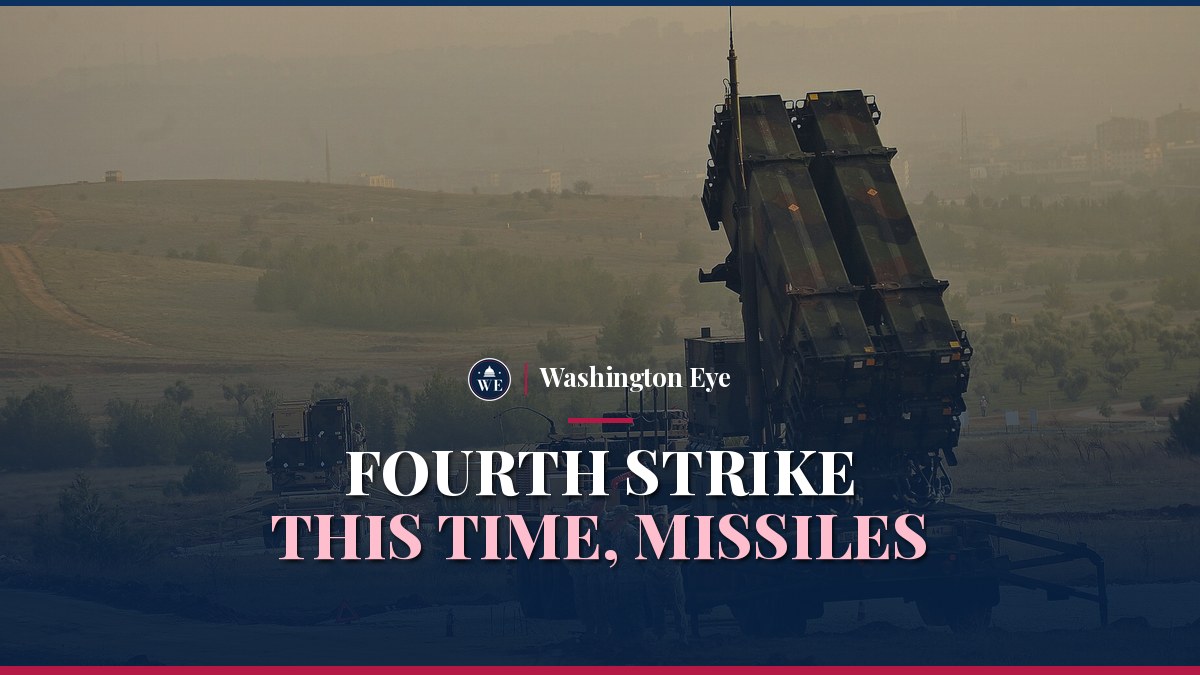
For a week, Iran's pressure on Bahrain came in small packages. Drones flew toward American radar sites on the island, Bahraini air defences shot them down, and the US military said nothing had been damaged. On Saturday night the package got bigger. Iran's Revolutionary Guards said they had launched missiles as well as drones at American military positions in the kingdom, and by Sunday Bahrain was counting two people injured and a burned out civilian industrial site.
It was the fourth Iranian attack on Bahrain since 13 November, after a roughly two month lull in direct fire, and the first in this run to include missiles. It comes at a moment when the wider standoff between Washington and Tehran looks closer to a breaking point than at any time since the summer: an American naval blockade squeezing Iran's oil trade, a convoy of Iranian tankers reportedly preparing to challenge it, tankers being struck near the Strait of Hormuz, and talks that both sides say could still produce a deal. Here is what happened, what is disputed, and why a small island with a large American footprint is where this is playing out.
What happened on Saturday night
Bahrain's Interior Ministry warned residents of a threat on Saturday evening and urged people to move to the nearest safe place. Sirens sounded. Bahrain's defence force then said its air defences had intercepted several Iranian aerial attacks, describing them as "heinous Iranian aggression." Soon afterwards the ministry reported that a fire had broken out at a civilian industrial facility, which images circulating on Saturday placed in Sitra, an industrial area on the island's east coast.
At first Bahrain reported material damage and no injuries. On Sunday the Interior Ministry revised that. Two people had been hurt in the attacks: a Bahraini citizen, who was in a stable condition, and a Pakistani resident, who was in a critical condition. Both were being treated in hospital.
Iran told a different story. Its Revolutionary Guards said the operation was a missile and drone strike on US military positions at two bases, and claimed that two radars belonging to American Patriot air defence batteries had been hit. Iranian state linked media went further, saying four US bases had been targeted in two waves, naming among them Sheikh Isa air base and Juffair, the district that hosts the US Navy's main support facility in the kingdom. The Guards said the attack was a response to American drones violating Iranian airspace, and warned that any further violation would meet "a harsh and decisive response."
Neither Bahrain nor the US military confirmed that any American equipment had been hit. That pattern has held all week. After Iran claimed a drone strike on a US radar at Sheikh Isa air base on 17 November, US Central Command said multiple Iranian one way attack drones had been "intercepted without any damage to US equipment or injury to American personnel."
A week of escalation
The Saturday strike did not come out of nowhere. On 13 November the Guards said they had attacked a US early warning radar in Bahrain in retaliation for an American strike on a communications tower at Sirik, on the Iranian coast overlooking the Strait of Hormuz. Two days later they claimed six drones against a US radar at a helicopter base at Riffa. On 17 November came the Sheikh Isa claim, justified this time not by any specific American strike but by alleged violations of Iranian airspace. The United States responded to that third attack by firing at Iranian targets along the shipping route.
Each step widened the justification Tehran gave itself. The first attack answered a particular strike. The later ones answered surveillance flights. Saturday's added a new weapon. Reports from southern Iran after the attack described explosions near Sirik again, suggesting the tit for tat cycle is now running in both directions within hours rather than days.
The surrounding sea has grown more dangerous at the same pace. On Saturday at least three tankers were reported attacked in or near the Strait of Hormuz. The British military's maritime security centre said two were struck by projectiles while leaving the Gulf, and Iran's navy said a third hit a naval mine east of the strait and caught fire. Iran also claimed that one of its missiles had damaged an American F-16 over the Gulf on Friday evening. Central Command denied it. On Sunday the Guards claimed to have shot down a US MQ-1 Predator drone east of the strait; there was no immediate American comment.
Why Bahrain
Bahrain is small, flat and close. It sits in the middle of the Gulf, a short flight from the Iranian coast, and it hosts the headquarters of the US Navy's Fifth Fleet. Its main military installations are packed into a limited area. "Bahrain is the most vulnerable because of its geographic exposure," Andreas Krieg of the risk consultancy MENA Analytica said last week, noting that the kingdom lacks strategic depth.
Radar sites are a logical target for a country that wants to impose costs without starting a full war. They are what lets American and Gulf forces see incoming drones and missiles. Hitting them, or even repeatedly trying to, signals that the shield is not invulnerable. Krieg has described the renewed confrontation as a deliberate effort by both capitals to test each other's limits without tipping into another full scale war. The problem with testing limits is that every test moves them.
There is also a political logic. A wire service report on Sunday noted that Gulf Arab states have been caught between Washington and Tehran since the United States and Israel attacked Iran in February. The Washington based Institute for the Study of War has argued that Iranian attempts to run the blockade force a choice on the United States: either let the blockade collapse, or return to a war "that imposes unideal political costs" by straining relationships with Gulf allies. Strikes on Bahrain, which put Gulf civilians and Gulf infrastructure in the line of fire, are a way of raising that cost.
The Gulf closes ranks
If that was part of Tehran's calculation, the first response was not encouraging for it. On Sunday Saudi Arabia, Qatar and Kuwait issued statements condemning the attack, and the United Arab Emirates joined them. Qatar's foreign ministry called it a "flagrant violation" of Bahrain's sovereignty and "a blatant breach of international law." Saudi Arabia called the attack "heinous" and said it held Iran responsible for the consequences of what it called continued flagrant attacks. Kuwait said Iranian attacks on Bahrain "threaten the region's security and stability."
Qatar's voice matters most here, because Qatar is also the main channel to Tehran. A Qatari delegation held about two hours of talks with Iranian officials in Tehran on Friday evening before returning to Doha, according to Iran's deputy foreign minister, Kazem Gharibabadi. Within roughly a day, Iranian missiles were falling on a Gulf neighbour and Doha was condemning them in some of the sharpest language available to it.
The pressure on the Gulf is coming from more than one direction. Saudi forces said on Sunday that they had intercepted a drone launched by the Houthis in Yemen toward Riyadh, part of an intensified fight between Saudi backed Yemeni forces and the Iran backed group that has seen repeated attacks on Saudi military, oil and transport sites.
The blockade question
Behind all of this sits the American blockade of Iran's ports, which has quietly strangled the country's oil exports for months. More than 14 Iranian tankers are reported to be gathered off Kharg Island, Iran's main export terminal, preparing to break out. Gharibabadi told Iranian media that the blockade "is an act of war" and that Iran would "take any necessary measures to break this economic siege." Tehran has warned of a fierce military response, including attacks on energy infrastructure across the Gulf, if the convoy is engaged.
Iran's leaders are framing the moment as one of endurance. President Masoud Pezeshkian has described the country as being subject to a "silent economic war" that is "tougher than a war with missiles." Its army spokesman, Brigadier General Mohammad Akraminia, warned on Saturday that "the defence of the country will not be limited to a specific geographical area," a line that reads differently after the night's events in Bahrain.
A deal still on the table
The odd feature of this crisis is that diplomacy has not stopped. The two sides signed a memorandum of understanding in June aimed at ending the war, even if talks have since stalled. Iran's foreign minister, Abbas Araghchi, said reopening the Strait of Hormuz would be "not difficult" if Washington accepted what he called Iran's reasonable conditions: ending the blockade, which he called completely illegal, lifting sanctions and acknowledging past mistakes.
President Donald Trump, speaking in a television interview on Saturday, said he wanted something more durable than a pause. "I intend to reach a permanent deal with Iran that prevents them from obtaining nuclear weapons, even if another president takes my place in the future and is unfit for the office," he said, adding that he had never been interested in regime change.
Those positions are far apart. Tehran wants the blockade lifted first. Washington wants permanent nuclear limits. In between, each side is trying to show the other that waiting is costly. For Iran, that means drones, missiles and mines. For the United States, it means warships: the arrival of the USS Theodore Roosevelt this month brought the number of American carrier strike groups in the region to three.
What to watch
Three things will show which way this goes. The first is whether Washington answers Saturday's attack in a way that is visibly larger than its earlier responses, which have been limited strikes along the Iranian coast. The second is the tanker convoy off Kharg Island: the moment it sails, the blockade stops being a policy and becomes a confrontation at sea. The third is Doha. If Qatar's mediation survives a week in which Iran fired on a fellow Gulf monarchy, the deal both sides keep describing is still alive. If Qatar steps back, the region is left with only the military track.
For now, the Pakistani resident lying in critical condition in a Bahraini hospital is the clearest measure of how far things have moved since the lull ended nine days ago. The earlier attacks were about radar dishes and press statements. This one reached a civilian worksite, and it drew in the whole neighbourhood.