
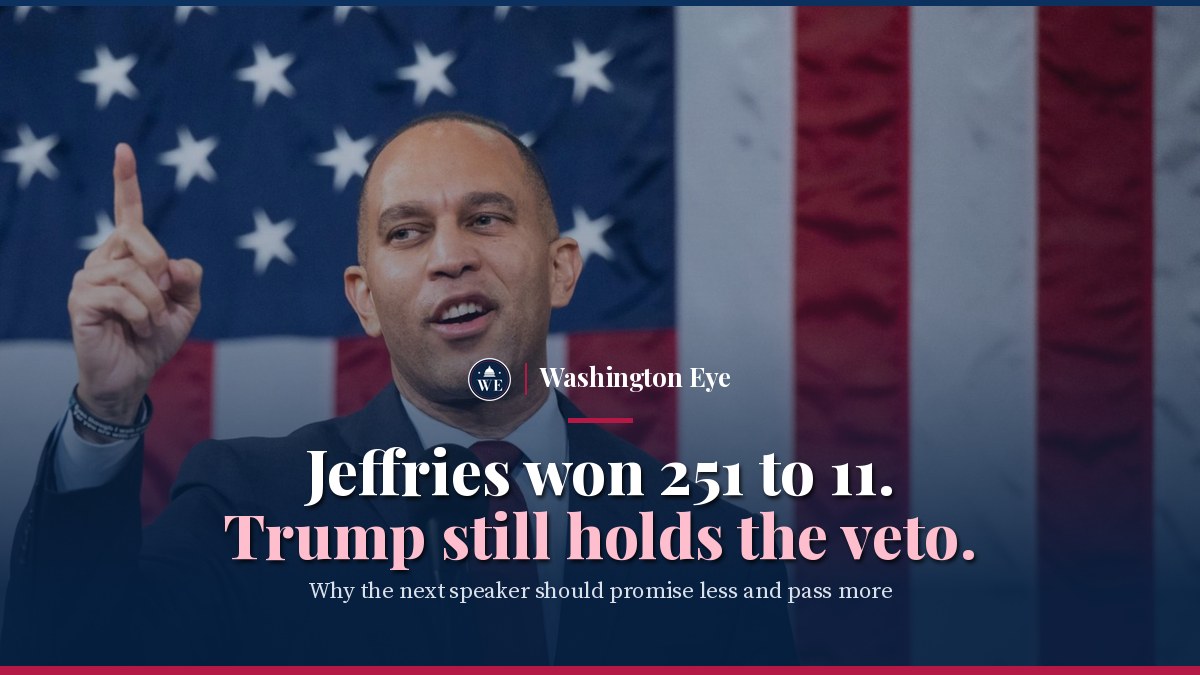
Hakeem Jeffries got the number he wanted on Wednesday. Behind closed doors, by secret ballot, House Democrats voted 251 to 11 to make him their nominee for speaker, with 262 ballots cast and no challenger on the paper. When the new Congress meets on January 3, the Brooklyn Democrat is all but certain to become the first Black speaker in American history. That is a genuine milestone, and he deserves the credit for it.
Here is the uncomfortable part. The vote that matters most to his speakership was not cast in that room, and Jeffries will not control it. It belongs to a president who, days before the election, said in a podcast interview, "I guess I'll become Mr. Veto," and who marked election night by posting a picture of a red cap with the word VETO printed across the front. Our argument is simple: a 251 to 11 caucus vote is a licence to govern, not a licence to perform. If Jeffries spends his first 100 days passing bills he knows will die on the president's desk, he will waste the largest House majority his party has held in a generation.
A big win, measured honestly
Start with what the new speaker-in-waiting actually has. One network projection puts House Democrats at 259 seats in the next Congress, the largest majority in 35 years, while other counts put them at no fewer than 257 with a handful of races still uncalled. Either way, he needs 218 votes on the floor in January, so he could lose roughly 40 of his own members and still take the gavel. Compare that with January 2023, when Kevin McCarthy, holding a 222 to 212 majority, needed 15 ballots to become speaker. Jeffries will not have that kind of week.
He also handled the internal politics well. Some of his allies wanted him chosen by acclamation, which would have produced no tally at all. Progressive members had signalled they might force a recorded vote to register dissent. Jeffries took the tactic away from them by asking for the recorded vote himself, pointing to the way Democrats returned Nancy Pelosi to the speaker's chair after the 2018 midterms. "It certainly seems to me to be appropriate that we take exactly the same approach," he told reporters on Tuesday. The result, 11 votes against him, is a rounding error in a caucus this size.
The rest of his team is set too. Katherine Clark of Massachusetts is expected to become majority leader, the first woman elected to that post in either chamber. Pete Aguilar of California is expected to be whip, and Ted Lieu of California was unanimously elected caucus chairman. Across the aisle, House Republicans last week chose Jim Jordan of Ohio over Steve Scalise as their next minority leader, which tells you the opposition will be loud, not accommodating.
The 100-day list is mostly veto bait
So what will Jeffries do with all this? His own words are the best guide. In a letter to colleagues on November 4 announcing his run for speaker, he wrote that during the first 100 days House Democrats "must act to reverse the Medicaid cuts, restore SNAP funding, extend the Affordable Care Act tax credits, eradicate the Trump tariffs and stop the reckless war of choice in Iran." He organised the rest of his pitch around three words, affordability, accountability and American values, and promised: "We are going to hold the crooks accountable."
Read that list next to the arithmetic of the Constitution. Overriding a veto takes two thirds of both chambers: 290 votes in the House and 67 in the Senate when every member votes. Mary Peltola's win in Alaska this week gave Democrats 56 Senate seats. On current counts, an override would need something like 35 House Republicans and 11 or 12 Republican senators to vote against a president of their own party. Before a bill even reaches the president, most legislation still needs 60 votes to clear a Senate filibuster, which means at least four Republicans.
Now ask which items on the Jeffries list could plausibly win those votes. Repealing the tariffs is the president's signature economic policy. Ending the war in Iran by statute would be a direct rebuke of him as commander in chief. Reversing the Medicaid cuts would undo the central bill of his second term. These are fine campaign promises and legitimate positions. As a 100-day legislative plan, they are a list of things the president has every reason to veto and Republicans have every reason to sustain. Passing them would make for good press releases in February and nothing on the statute books in May.
The case for promising less
There is a better path, and Jeffries himself has already pointed to it. In the same letter, he said Democrats "will try to find bipartisan common ground whenever and wherever possible." He set up five working groups on affordability: housing, health care, groceries and goods, gas and utilities, and caregiving. He called for a ban on members of Congress trading stocks. He claimed credit for what he called "the most meaningful housing affordability bill in 40 years" and for forcing a House vote on a three-year extension of the Affordable Care Act tax credits over the objection of Republican leadership. That last one matters. A bill that passed a Republican-run House against its own leaders' wishes is, by definition, a bill some Republicans will vote for.
That is the agenda that can become law: a stock-trading ban, housing supply, a health-cost package built on the tax-credit vote, and the kind of narrow, popular measures that analysts already name as plausible deals, from artificial intelligence rules to Social Security. None of it is as thrilling as "eradicate the Trump tariffs." All of it is more likely to reach a signing ceremony.
The president, oddly, has described how this ends. In a television interview he predicted the two sides would end up bargaining anyway: "Historically, you veto for a couple of months, and then they come and say, 'We've got to make a deal.'" Jeffries should take him at his word and skip the couple of months. Every week spent staging veto fights is a week the new majority is not spending on deals the president can sign and then has to own.
Accountability is a tool, not a programme
None of this means the new majority should go easy on oversight. Democrats will chair every committee, hold subpoena power and run hearings, and the Senate majority will decide which of the president's nominees are confirmed. That is real leverage, and the voters who handed Democrats this majority plainly wanted a check on the executive branch. But oversight works best as a lever for results, not as the results themselves. A majority that can be described a year from now only by its investigations will have given the president exactly the foil he wants for 2028.
Jeffries knows the pressure is coming from his left. Activists have pushed for scrapping the Senate filibuster on day one, and Senate Democratic leader Chuck Schumer is facing a formal challenge from Chris Van Hollen of Maryland ahead of leadership elections early next month. Even some newcomers who backed Jeffries are signalling independence. Brad Lander of New York voted for him but said he would "buck leadership" when necessary. A speaker who promises the moon to keep that wing happy will spend 2027 explaining why the moon never arrived.
The first test comes before he holds the gavel
The real test arrives sooner than January. The stopgap funding law passed in September runs out on December 11, and Republicans control both chambers until the new Congress is sworn in. Some Democrats have talked about using the funding bill to cut off money for the war in Iran. If the two sides cannot agree, a shutdown that begins in December could carry into the new Congress. That is what happened the last time Democrats won the House in a midterm: the shutdown that started on December 22, 2018 lasted 35 days and ended three weeks after the new majority took office.
Jeffries is not yet speaker, but his voice will shape how his members play that fight. A long shutdown would hand him a gavel and a crisis on the same day. A clean deal, with the Iran argument saved for votes the new majority controls, would let him start with a functioning government and an agenda instead of a hostage situation.
Schumer put the realistic version of the Democratic promise well this month: "Will everything pass? Will Trump sign all of it into law? Knowing Trump's and Republicans' intransigence, of course not." He then vowed to fight "bill by bill, brick by brick." That is the right spirit, and it applies even more to the House, where the bills start. The 251 votes Jeffries won on Wednesday prove he can count his own caucus. The next two years will test whether he can count the votes he does not control. Our advice to the next speaker is to promise less, pass more, and make the president decide whether he really wants to be remembered as Mr. Veto.