
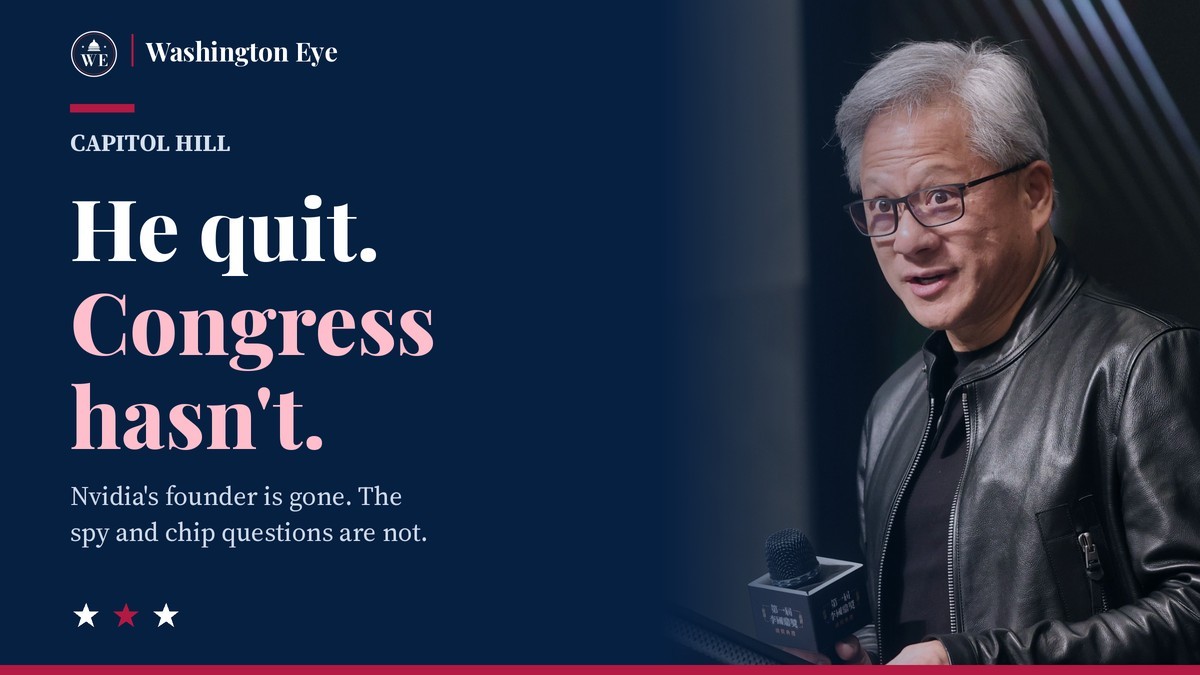
Jensen Huang spent 33 years building Nvidia into the company that sells the engines of the artificial intelligence boom. On Thursday he was gone from it entirely. In a regulatory filing, the chipmaker said its board had accepted his resignation as president, chief executive and director on Wednesday, effective immediately. The announcement came four days after Mr Huang told employees he had been unfaithful to his wife, and after a week of reporting that the woman involved is regarded by US authorities as a Chinese intelligence asset.
In most boardroom dramas, the story would end there: a founder steps aside, an interim leader steps in, investors reprice the shares. This one does not end there, because the questions that brought Mr Huang down were never only about Nvidia. They are about how a company at the centre of America's technology rivalry with China guarded its secrets, how its chips kept flowing to a buyer under federal scrutiny, and what senior officials in the administration knew and when. Those questions now pass from a corporate board to Congress, and in January to a Congress run by Democrats.
The company moved quickly to show continuity. Colette Kress, Nvidia's chief financial officer since 2013, will serve as interim chief executive while keeping her finance role. Before joining Nvidia she spent nearly 25 years in finance jobs at large technology companies. The board also named Harvey Jones, a former chief executive of the chip design software firm Synopsys who has sat on Nvidia's board since 1993, as its first ever chair. The board said it would look at internal and external candidates for a permanent successor.
"Jensen's contributions to NVIDIA are profound," the board said in its statement. "NVIDIA is one of the most consequential technology companies in the world. The Board and the company thank Jensen for his immeasurable contributions to the company and the industry." Ms Kress said she was "committed to building on the extraordinary foundation Jensen created over the last 33 years". In a note to staff, she called the past days "an extraordinarily difficult period" and said the company would hold an all hands meeting on 18 November.
The speed of the exit says something about how Nvidia was governed. Mr Huang was the largest individual shareholder, but he held only about 3.5 per cent of the stock and had none of the super voting shares that protect founders at many Silicon Valley giants. A technology news site noted that he ran an unusually flat company, with roughly 60 people reporting directly to him, and that there was no named heir. When the board decided it could not keep him, nothing in the company's structure stood in its way.
The sequence matters. Over the past few weeks a major American newspaper reported that US authorities had concluded that Alice Huang, a Chinese businesswoman who is no relation to the Nvidia founder, passed information to Beijing. She was an executive at Megaspeed, a Singapore cloud computing company that buys large volumes of Nvidia processors. On Sunday, Mr Huang wrote to employees: "I was unfaithful to my wife. My actions hurt her and our children. There is no excuse for what I did. I am deeply sorry." Nvidia's board opened an inquiry, saying at the time it had "no reason to believe that either national security or NVIDIA secrets were compromised".
Then the ground shifted again. Another major newspaper reported this week that Mr Huang had also had a relationship with a senior Nvidia executive who reported to him. That second report turned a national security story into a corporate governance story as well, and the board met to decide his future. Nothing in the public record so far shows that Mr Huang handed over sensitive information, and Megaspeed and Alice Huang have not publicly answered the central claims.
What makes the Megaspeed link so sensitive is the business itself. In a letter on Wednesday, Senators Elizabeth Warren of Massachusetts and Chris Coons of Delaware said the company has reportedly bought more than $4.8 billion in advanced Nvidia AI chips since June 2024. They cited reports that the Justice Department is investigating Megaspeed for possibly diverting chips to China in breach of export controls, and reports that a separate Commerce Department inquiry involving the company was altered after communications with Nvidia representatives.
Leaving Nvidia does not take Mr Huang out of the line of fire. John Moolenaar, the Michigan Republican who chairs the House select committee on China, told reporters on Thursday that he still wants the former chief executive to come to Capitol Hill. "We are in discussions with him right now on a date to come and meet with us," he said. He said that he, House Intelligence Committee chairman Rick Crawford and House Foreign Affairs Committee chairman Brian Mast are prepared to issue a subpoena if no date is agreed. The three had written to Mr Huang last week, and Mr Moolenaar said they received a reply on Wednesday, without describing it.
Mr Moolenaar's formal statement was blunter still, and notably did not use the word resignation. "Jensen Huang's firing from the company he founded is an unfortunate end that could have been avoided," he said. "It is in our national interest for NVIDIA and our other AI champions to succeed, but American companies should never jeopardize our nation's security by giving Chinese companies access to their most advanced chips." He called on Nvidia to "appoint leadership that makes national security its top priority" and urged Congress to pass bipartisan export control legislation in the year end defence bill.
That last line is the practical stake for the lame duck session. Republicans still hold both chambers until January, and the annual defence authorisation bill is one of the few pieces of must pass legislation left on the calendar. A China hawk chairman tying chip export rules to that bill, on the day the industry's most powerful lobbyist for looser rules lost his job, gives the idea fresh momentum.
Democrats are pressing from another direction. Ms Warren and Mr Coons wrote to Secretary of State and national security adviser Marco Rubio, White House chief of staff Stephen Miller and Commerce Secretary Howard Lutnick, asking them to preserve every record on Nvidia's chip exports to China and on the reported intelligence operation. "This incident raises significant concerns about the federal government's ability to effectively enforce our export controls and protect our national security," they wrote. They said reports suggest officials at the White House, the State Department and the Commerce Department knew of concerns about Nvidia, Megaspeed and the suspected operative "yet did not move to block the continued flow of advanced AI chips". They asked for written confirmation by 17 November and for a briefing.
Democrats on the House Foreign Affairs Committee have gone further, alleging in a social media post that Mr Rubio warned President Donald Trump about Mr Huang's relationship "but Trump brushed it off", and that licences for H200 chip sales to China kept being approved. The White House has not publicly confirmed that account. Ms Warren is expected to chair the Senate Banking Committee, which oversees export controls, from January. A records request that can be ignored today comes with subpoena power in eight weeks.
Mr Trump's response was in keeping with his long friendship with the chipmaker. He did not address the espionage questions. Instead he wrote on a social media platform that Mr Huang "has done a fantastic job" and that "there is only one man to take his place": Tim Cook, the former Apple chief executive who stepped down in September and remains the company's executive chairman. "A Legend replaces a Legend!" the president wrote. It was not clear whether he meant it seriously, and Apple did not immediately comment.
The post was a reminder of how close Mr Huang had become to this White House. He travelled with Mr Trump to China in May. In August, on stage at a technology conference, he took a call from the president and put him on speakerphone. "I'm with you all the way," Mr Trump told him in front of the audience. Mr Huang used that access to argue for chip sales to China and against tighter rules, positions that suited his company and that many China hawks in both parties opposed.
That closeness is now a political liability for the administration rather than an asset. Every question Democrats want answered about Mr Huang leads back to decisions made by Mr Trump's officials: which export licences were approved, which warnings were heard, and whether any investigation was softened. The president can praise a fallen ally, but he cannot stop the next Congress from asking what his aides did.
Investors reacted sharply. Nvidia shares fell more than 12 per cent at the opening bell on Thursday before recovering part of the loss, and were down about 5 per cent by mid morning in New York. The company's market value slipped below $4 trillion for the first time since 2025, and the week's turmoil had already erased roughly $515 billion in value. The stock set a record high last month after rising more than 1,700 per cent in four years, but has fallen more than 30 per cent since.
Not everyone ran. A research firm that tracks individual investors said retail traders bought a net $111 million of Nvidia shares in the first 30 minutes of trading, its largest opening bid for any stock on record and more than 40 times a normal open. Shares of companies Nvidia has invested in, including Intel and Marvell, fell more than 4 per cent.
Analysts at JPMorgan put the policy risk plainly before the resignation was announced. "All told, given the national security concerns, we think the risk of more restrictive guidelines on shipments directly or indirectly into China has risen," they wrote. That is the real hinge. A new chief executive can calm employees and customers. Only Washington decides how many chips can go where.
Three things will show whether this story is fading or growing. The first is whether Mr Huang agrees a date with the House committees, or whether Mr Moolenaar and his colleagues follow through on a subpoena. A former chief executive testifying about a suspected foreign intelligence operation would be one of the most closely watched hearings of the year.
The second is the defence bill. If export control language survives into the final text, Mr Huang's fall will have produced a concrete policy change before Democrats even take over. If it is stripped out, the fight moves to a Democratic Congress with more appetite for investigating the administration than for drafting chip rules alongside it.
The third is the administration's reply to the senators' records request, due by 17 November. A full preservation order would signal that officials expect scrutiny. Silence, or a narrow answer, would almost guarantee a subpoena in the new year.
For now, Nvidia has a new leader, a new chair and a share price that has lost a large slice of its value in a week. Washington has something else: a list of unanswered questions about chips, China and the people who decided where those chips could go. Jensen Huang has left the company he built. He has not left the investigation.