
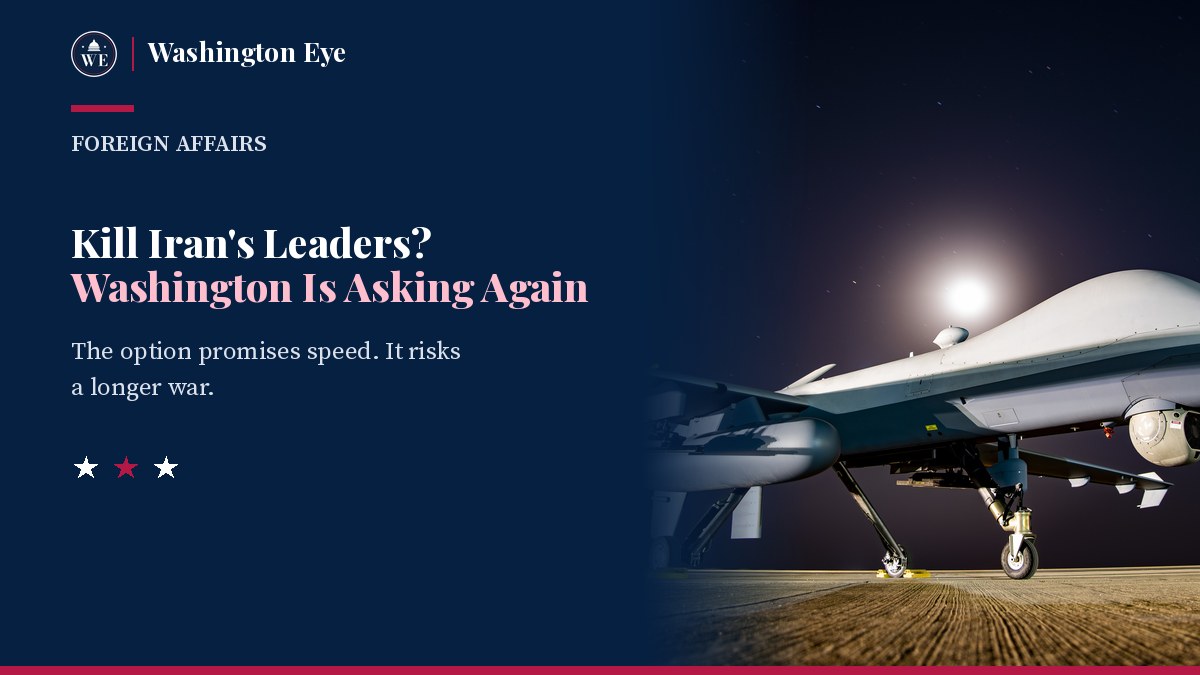
For most of this autumn, the question in Washington about Iran has been whether to talk or to bomb. This week a third, darker option moved back to the centre of the table. Trump administration officials are internally debating whether the US military should target Iran's top leaders, according to a US official and a person with knowledge of the discussions who spoke to an American television network. The idea, as described, is to remove the hardliners who are blocking an end to the war, or at least to prove to them that Washington can reach them whenever it chooses.
The two sources stressed that such an option has always been on the menu. What has changed is that it has been "under renewed discussion in recent weeks" while President Donald Trump weighs the next phase of a war that is now in its ninth month. No specific targets were named. Asked about the report, an administration official did not deny it and said only that the naval blockade of Iran would "continue with full effect" and that the president "has many options at his disposal." The Pentagon did not comment.
An internal debate is not a decision, and leaks of this kind are sometimes a message in their own right. But the timing matters. The report landed on the same day that Iran's chief negotiator ruled out any talks on Washington's terms, that Qatar's prime minister was in Washington trying to revive diplomacy, and that the president himself put a rough expiry date on his freedom to fight.
How the war reached this point
The conflict began on 28 February with US and Israeli strikes that killed Iran's supreme leader, Ayatollah Ali Khamenei, along with senior military and intelligence officials. A ceasefire followed in April and a memorandum of understanding in June, but that arrangement collapsed weeks later when Iran attacked commercial shipping. Since then the United States has enforced what the White House calls the largest naval blockade in history, and Iran has fought back at sea, most recently claiming that a fourth tanker struck a mine in the eastern Strait of Hormuz after taking what Iranian forces called an unauthorised route. That claim has not been independently confirmed.
Earlier this month Trump described the fighting as "effectively over" while keeping the embargo on Iranian ports in place to force a nuclear deal. The result is the stalemate that Iran's parliament speaker, Mohammad Bagher Ghalibaf, has labelled "no war, no peace" and which both sides now say cannot last.
Who is left in Tehran
The surviving leadership is the obvious subject of any targeting debate. At the top sits Mojtaba Khamenei, the late supreme leader's second son, who succeeded his father and was reportedly injured in the same strikes. He has not been seen in public since taking power. Around him are the men who run the war: the commander of the Islamic Revolutionary Guard Corps, Ahmad Vahidi; the armed forces chief of staff, Ali Abdollahi; the army chief, Amir Hatami; and Mohsen Rezaei, a former Guards commander reportedly named secretary of the Supreme National Security Council in August.
Tehran has already signalled how it would answer. A statement attributed to Khamenei warned that if Iran's enemies "once again launch military or terrorist attacks," it is Iran's armed forces and people "that will determine the time and conditions for ending them." On 31 October he reportedly told the military to prepare an "immediate, impactful and geographically unrestricted response" to future threats. This week Hatami ordered the Strait of Hormuz closed "further day by day" until Iran's demands are met.
The case for striking
Supporters of the option inside the administration make a simple argument. Iran's remaining leaders, in this view, believe they can outlast an American president who faces a hostile Congress from January. Showing that Washington can locate and hit the regime's top figures at any moment would, they argue, shatter that confidence and force a settlement faster than months more of blockade.
Trump has hinted at that capability in public. "We know who they are, where they are," he told reporters at the White House on 20 November. The debate also comes amid reports that Iran may be developing a radiological "dirty bomb" and US intelligence assessments of possible Iranian plots involving chemical weapons aimed at senior officials in Washington. If those assessments harden, the argument that leadership strikes are self defence rather than escalation becomes easier to make.
There is also precedent. In January 2020, during Trump's first term, a US drone strike near Baghdad airport killed Qasem Soleimani, the Guards' most powerful commander. Iran retaliated with a missile attack on bases housing American troops in Iraq, and the crisis then cooled. Advocates of a new strike tend to read that episode as proof that Tehran's threats outrun its willingness to escalate.
The case against
Officials opposed to the idea, according to the same sources, raise three objections. The first is retaliation: killing Iran's leaders could expose American officials to revenge attacks. The second is that it could backfire politically inside Iran, leaving whoever survives more entrenched and less willing to compromise. The third is diplomatic: once Washington has tried to kill the people it would have to negotiate with, the path back to talks narrows sharply.
History offers support for that caution too. The February strikes that killed the elder Khamenei were meant to destabilise the regime. Nine months later the Islamic Republic is still standing, its succession was handled inside the family, and its new leadership has dug in rather than folded. Decapitation removed a man; it did not change the system's answer.
There are legal questions as well. A long standing executive order bars anyone acting for the US government from engaging in assassination, although administrations of both parties have argued that striking enemy commanders during an armed conflict falls outside that ban. A strike on a supreme leader who holds both religious and political authority would test that argument further than the killing of a uniformed general did in 2020.
Tehran's seven conditions
On the diplomatic track, positions are hardening. Ghalibaf, who leads Iran's negotiating team, told parliament on Tuesday that there would be "no action or negotiation" before Iran's seven conditions are implemented, and warned that Tehran was ready to "change the geography of the battle" if Washington miscalculates. The demands include lifting the US blockade, guaranteed safe passage for shipping through Hormuz, an end to unilateral sanctions, an oil export waiver, the release of frozen assets, an end to fighting on all fronts and a formal declaration that the war is over.
He was answering Trump, who said this week he was inclined to resume strikes after the New Year if no deal is reached, and Treasury Secretary Scott Bessent, who promised after a fresh round of sanctions on Monday to keep going "until we have buried the head of the snake." Those sanctions hit more than two dozen Iranian exchange houses, front companies and individuals tied to what the Treasury called shadow banking networks.
Qatar is trying to keep a channel open. Its prime minister and foreign minister, Sheikh Mohammed bin Abdulrahman Al Thani, met Secretary of State Marco Rubio in Washington and held talks with Vice President JD Vance. Doha says the region cannot afford another round of escalation, that it remains in contact with both capitals and that it will announce any deal that is reached. So far there is no sign of one.
Israel is pulling in the other direction. Israel's public broadcaster reported, citing an unnamed source, that Prime Minister Benjamin Netanyahu is pressing Trump to strike Iran "as soon as possible," and that the president has not decided and is reluctant. Israeli military intelligence has reportedly warned that an Israeli attack could ignite a wider conflict involving Lebanon, Syria and Gaza. The US ambassador to Israel, Mike Huckabee, said on Tuesday that Trump is ready to use force again if diplomacy fails. "He's made it very clear he's willing to do it again," Huckabee said.
The January clock
The most revealing comment of the week came from Trump himself. In an Oval Office interview with a New York newspaper, he said the war effort is "funded" until "really the end of January, pretty much." That is when Democrats, who won at least 259 House seats in this month's midterms, take control of the chamber, and Trump acknowledged his options may then be constrained. If Democrats move to halt the war, he said, "they'll take a total win and make it a loss."
He also drew a line between his aims and Israel's. Ending the Islamic Republic is "probably doable," he said, but it is not his goal. "I just don't want them to have a nuclear weapon," he said, adding that regime change "was never a criteria for me."
Put those statements next to the targeting debate and the logic of the next two months becomes clearer. Washington has a narrow window in which the president can act without a Democratic House trying to cut off funds. Tehran knows that too, which is why its negotiators are betting on delay. A leadership strike is the kind of dramatic move that could break the deadlock before January, or the kind that could lock both sides into a longer war just as Congress gains the power to end it.
Why it matters
For the region, the stakes are immediate. Iran is already squeezing Hormuz, its Houthi allies in Yemen are striking deep into Saudi Arabia, and shippers and insurers are watching every new claim of a mined tanker. Any attempt to kill Iran's leaders would almost certainly be answered across that whole arc, not only against US forces.
For Washington, the debate is a test of what the administration actually wants. Trump says his goal is narrow: no Iranian bomb. Killing the men who would have to sign a nuclear deal is a strange route to a signature, unless the bet is that their successors will sign faster. That is the gamble officials are now weighing, and it is one the United States has tried before in this war without getting the answer it hoped for.