
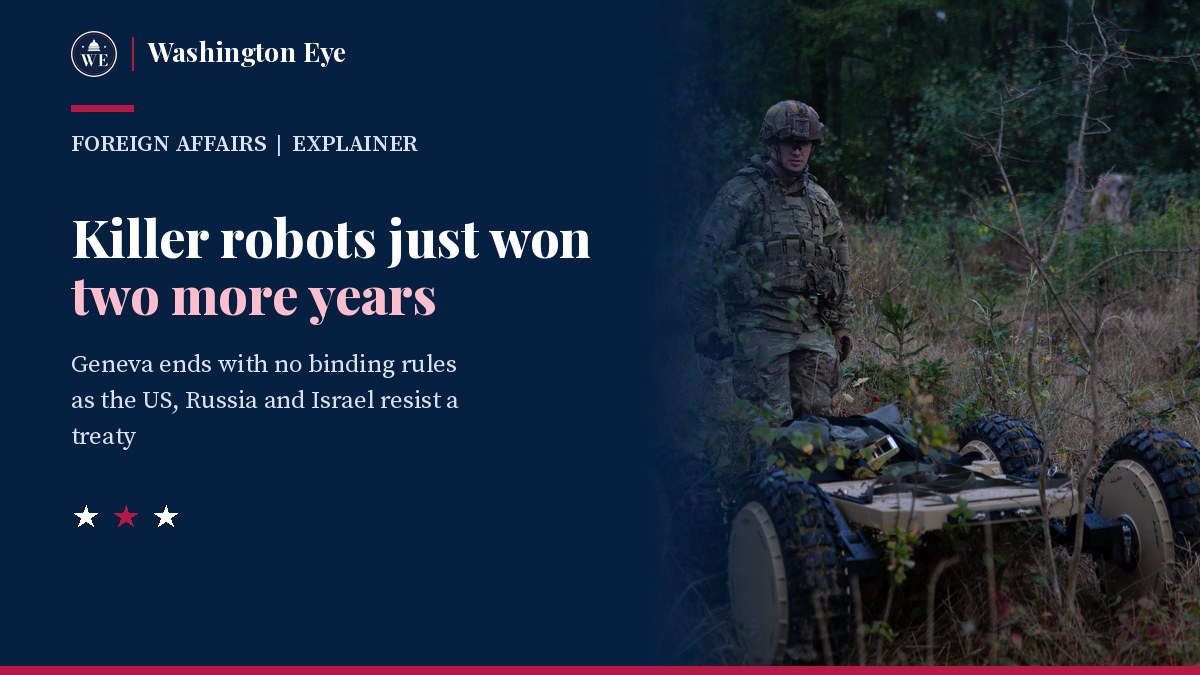
Diplomats in Geneva worked through the night and into the early hours of Saturday to settle a question that armies are already answering on the battlefield: should a machine ever be allowed to choose a human target and fire without a person making the final call? When the gavel finally fell at about a quarter to five in the morning, the answer from the world's governments was, in effect, ask us again in two years.
The 128 countries that belong to the Convention on Certain Conventional Weapons agreed to "launch the elaboration of an international instrument on lethal autonomous weapons systems, which should be conducted over the next two years," in the words of the conference president, Swiss diplomat Julien Thoni. What they did not agree on is whether that instrument will be a binding treaty, a set of voluntary guidelines, or something in between. That gap is the whole story, and it is why campaigners left the hall angry while the chair called the outcome a breakthrough.
Here is what was decided, who blocked what, and why a dry procedural fight in Switzerland matters to anyone who cares about how the next war will be fought.
What exactly are "killer robots"?
The diplomatic term is lethal autonomous weapons systems. The basic idea is simple: once switched on, the system can select and attack a target without a human intervening at the moment of attack. That covers a wide range of hardware, from armed drones and loitering munitions to ground robots, robotic boats and underwater vehicles that use software, increasingly artificial intelligence, to identify what to strike.
This is no longer a thought experiment. Semi-autonomous and AI-assisted weapons have already been used in Ukraine, Sudan and the Middle East, according to diplomats and rights groups who followed the talks. Stop Killer Robots, a coalition of more than 300 organisations, says such systems have been tested or deployed, including in the war in Ukraine. Anna Hehir, who leads military AI governance work at the Future of Life Institute, put it bluntly before the conference opened: these weapons are no longer science fiction.
What did the conference actually agree?
The Seventh Review Conference of the convention met from Monday, 16 November, and ran into overtime. The final text gives a group of governmental experts two years to work out the content of an instrument. According to Thoni, that work should flesh out "which weapons can be forbidden according to international humanitarian law, and which is not forbidden but can be regulated." Only after that will states decide whether the result should be a treaty and how far its provisions should bind them.
The target date is 2028. The UN disarmament chief, Izumi Nakamitsu, called two years "a very compressed timeframe" and urged governments to start work as soon as Monday. She insisted that "the path to, or possibility to, have a legally binding instrument is still open."
That is the optimistic reading. The pessimistic one came from Rain Liivoja of the Asia-Pacific Institute for Law and Security, who described the decision as one "nobody wanted but everyone could grudgingly live with," adding: "It remains possible, likely even, that there will be no treaty by the end of 2028."
Who wanted a treaty, and who did not?
The numbers favour the treaty camp. Over 95 states said during the week that they support a treaty, according to Stop Killer Robots, and in the run-up to the conference 163 countries voted for a UN resolution backing binding legal rules on autonomous weapons in conflict. UN Secretary-General António Guterres, the International Committee of the Red Cross and Pope Leo XIV have all called for strong, legally binding limits.
But the convention works by consensus, which means any one of the 128 member states can block a decision. The countries that actually build these systems used that power. The United States, Russia and Israel were among those opposed to a mandate to negotiate binding rules. Brazil's ambassador, Frederico Meyer, summed up the arithmetic in one line: "some countries have the power, some countries have the majority."
Between the two camps sat Britain, Germany and France, which proposed negotiating an instrument that would leave open whether it is legally binding, according to Verity Coyle of Human Rights Watch. The final text looks a lot like that middle position.
What was Washington's argument?
The American position was laid out in a four-page working paper dated 4 November. It asked for five more years of expert work aimed at a non-binding instrument, with a first version in 2029. Washington argues that existing international humanitarian law already governs how any weapon may be used, autonomous or not, so a new treaty is unnecessary.
The paper makes three further points. Voluntary rules can be updated quickly as the technology changes, while a treaty binds only the countries that ratify it, and only once it enters into force. It has not been shown, the paper says, that autonomous weapons are inherently indiscriminate or cause excessive injury. And it argues that "appropriate use of autonomous functions can enhance the implementation of existing prohibitions and restrictions" in the laws of war and "reduce the risks to civilians as compared to weapons without such capabilities." Hampering "responsible innovation," it warns, would run against the convention's own humanitarian purpose.
That is a serious argument, not merely a stalling tactic. A precision weapon that can tell a tank from a school bus may, in principle, kill fewer civilians than a dumb shell. The counterargument, made by the Red Cross, is that humanitarian law as it stands does not adequately address the specific risks these systems create, including unpredictable behaviour and errors that no human is positioned to catch in time.
And Russia?
Russia's role was more disruptive than argumentative. Moscow had not publicly stated its position going in, but it has resisted binding proposals in the past. During the week its objections over rules of procedure forced the cancellation of some formal meetings, and diplomats said negotiators spent hours overnight wrangling over a handful of words. Campaigners complained that most discussions were held behind closed doors, shutting out observers and civil society groups.
Stop Killer Robots said that "in the final hours, a small number of states weakened the mandate introducing uncertainty about the legal status of the final document." Its executive director, Nicole van Rooijen, warned that "delaying the creation of a legally binding instrument puts civilians and humanity at risk."
Why should readers far from Geneva care?
Because the timelines do not match. Diplomacy has given itself until 2028 to decide what kind of rules might exist. Militaries are moving on a faster clock.
Consider the United States. On 30 September, Defense Secretary Pete Hegseth announced a new four-star Autonomous Warfare Command to lead the joint force in unmanned and autonomous warfare. A Congressional Research Service note published this week says his memo sets a target establishment date of 1 October 2027, a full year before the Geneva process is due to report. "The pace of war is changing faster than the process to support it," Hegseth said when he unveiled the plan. The last time the Pentagon created a new combatant command was Space Command in 2019.
American policy on these weapons is governed by Defense Department Directive 3000.09, which requires that systems be designed so commanders and operators can exercise "appropriate levels of human judgment over the use of force." Critics note that this standard does not require a human to pull the trigger each time, and US policy does not prohibit developing or using lethal autonomous weapons.
The same logic applies to Russia, China, Israel, Ukraine and every other state investing in drones and robotics. Each has strong reasons to keep its options open while rivals are doing the same. That is precisely the dynamic arms control is designed to break, and precisely why it is so hard to break.
Has anything like this worked before?
Sometimes. The same convention produced a protocol banning blinding laser weapons in 1995, before such weapons were widely fielded. That is the model treaty supporters cite: ban a weapon before it becomes indispensable. The difference is that blinding lasers were a narrow category with little military value. Autonomy is not a single weapon but a capability that can be added to almost any system, a point the American paper makes directly.
When consensus forums stall, frustrated majorities have sometimes walked out and negotiated elsewhere. Some observers and former military officials are already suggesting a new process outside the current UN framework. The catch is obvious: a treaty that the leading military powers refuse to join may set a moral standard, but it will not bind the countries building the most capable machines.
What to watch next
First, the experts' group. Its early meetings will show whether states treat the two years as genuine negotiation or as a holding pattern. Nakamitsu said the group will make recommendations on the legal nature and form of the instrument, including whether it should be a binding protocol.
Second, the scope. Campaigners want explicit bans on systems that target people and on systems that do not allow meaningful human control, plus obligations to keep all other systems under effective control. Watch whether those ideas survive in the drafts.
Third, the battlefield. Every new report of drones or robots selecting targets on their own in Ukraine, Sudan or the Middle East will strengthen the case for rules, or harden the conviction among major powers that they cannot afford to fall behind.
Thoni argued that the deal "shows that even in today's deeply divided world, multilateral diplomacy can still deliver concrete results." A diplomat from a country that backed new laws offered a more honest verdict: "disappointing but could have been much worse." For now, the question of who decides when a machine kills remains where it was on Monday: with the governments building the machines.