
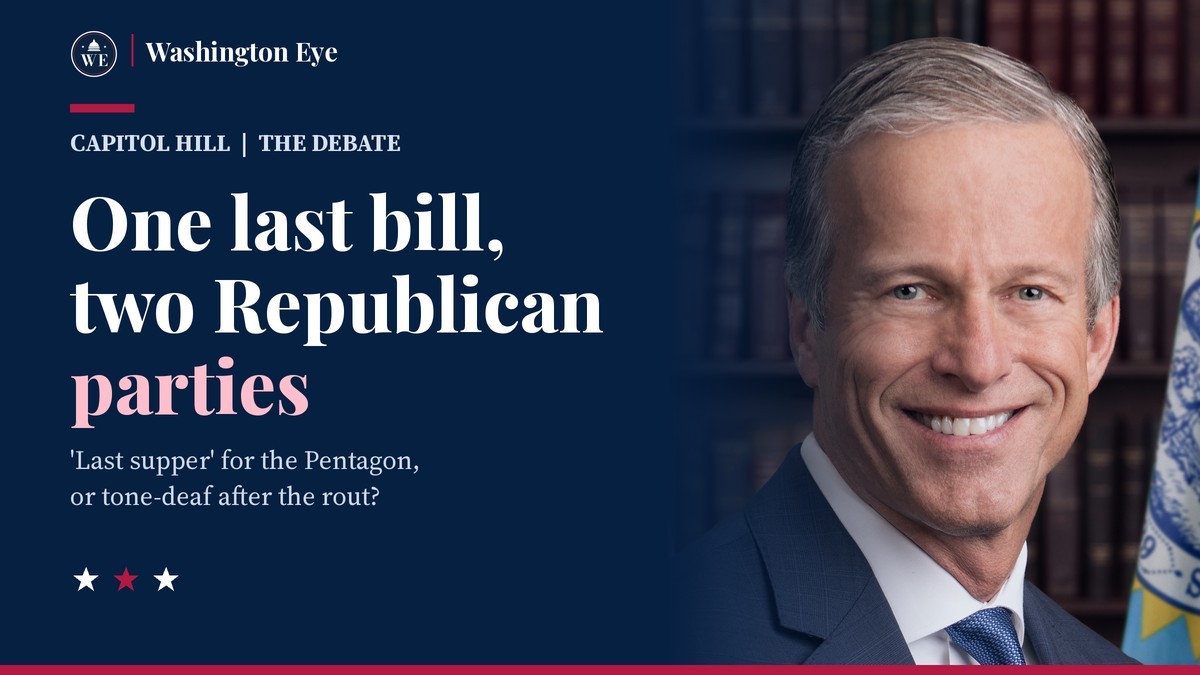
Senate Republicans spent most of Tuesday behind closed doors, in three separate meetings, arguing about how they had lost at least seven seats and what to do with the eight weeks of power they have left. By the time they emerged, they had re-elected John Thune of South Dakota as their leader and signed up to a resolution that sets an ambitious goal: to "maximize the 54 days we have with congressional majorities" and "to do everything humanly possible to pass a reconciliation bill before Jan. 3."
Senator Bernie Moreno of Ohio has a name for that bill. He calls it the "last supper" for the party's reign. The question now dividing Republicans is whether that final meal should be served at all, and if so, what goes on the table.
At the centre of the argument is money for the Pentagon. After roughly nine months of war with Iran, many Republicans say the military's stocks of munitions and high-end weapons must be rebuilt quickly. Budget reconciliation, the procedure that lets certain tax and spending bills pass the Senate with a simple majority and avoid a filibuster, is the only tool that would let them do it without a single Democratic vote. Republicans used it last year for their tax bill and again this year for immigration enforcement money. Once the new Democratic majorities are sworn in on January 3, the tool passes to the other side.
Yet the same war is the issue many Republicans blame for their defeat. President Donald Trump and Vice President JD Vance have both pointed to it as the main reason for the wipeout. On Monday the president told reporters that Iran was "militarily" finished, even as the naval blockade continues. A party-line bill that pours billions into the Pentagon while the conflict is unresolved would hand Democrats a simple line of attack: the voters said stop, and the outgoing majority spent more.
The divide does not fall neatly between hawks and doves. It runs through the conference.
The case for moving fast begins with the calendar. Democrats will control both chambers next year and have already signalled that they intend to use the power of the purse to squeeze the war. Senate Minority Leader Chuck Schumer has said plainly: "We are going to end the war." Representative Rosa DeLauro of Connecticut, the senior Democrat on the House Appropriations Committee, has gone further, promising to "claw back billions of dollars Republicans unilaterally provided to Border Patrol, ICE, and the Pentagon through budget reconciliation." For Republicans who believe the military is short of what it needs, the lame duck is the last moment they can act on their own terms.
Senator Roger Wicker of Mississippi, the chairman of the Armed Services Committee, has said simply that "we need to get reconciliation done." Senator Jim Banks of Indiana argues that the bill should be framed around readiness, not the conflict itself. It has, he said, "a lot more to do with funding our military and giving them what they need than it does the war."
Others make a moral argument. "We're there, like it or not like it," said Senator Jim Justice of West Virginia. "And if we've got folks there, and they need bullets and we can't give them the bullets, shame on us." Senator John Hoeven of North Dakota, a close ally of Mr. Thune, put the case in terms of leverage. Government funding runs out on December 11, and Democrats are weighing whether to block any stopgap that keeps money flowing to the war. A credible party-line bill, Mr. Hoeven argued, is "the only way we create some leverage with the Democrats." If Republicans simply wait, he said, Democrats "figure they have leverage because they'll have the majority in the new Congress."
The loudest pressure comes from the right of the conference. Senator Ron Johnson of Wisconsin, who chairs the Budget Committee and would have to write the budget resolution that unlocks the process, tried to delay Tuesday's leadership election and walked out as the vote began. With Senators Rick Scott of Florida and Mike Lee of Utah, he pressed Mr. Thune to commit to a reconciliation package and to cancel the Thanksgiving recess to make room for it. "We need a plan to get the Republican agenda done," Mr. Scott said. Mr. Johnson has complained that he is "not getting engagement from the White House, from either Senate or House leadership," and said he would present his own plan to colleagues at their Wednesday lunch. He also wants the bill to carry money for states for what he called "election integrity type of measures," part of a wider push for a version of the SAVE America Act, the stalled proof-of-citizenship voting bill, that could survive the Senate's budget rules.
The case against is just as forceful, and it comes from Republicans who are not usually allies. Senator Rand Paul of Kentucky called the idea "tone-deaf" and vowed to oppose it. Passing anything "to further or enhance the Iran war," he said, would amount to "not listening to the electorate." Senator Josh Hawley of Missouri, who has been sharply critical of the leadership since the election, was blunter still: "I can't imagine why we would do that." Senators Susan Collins of Maine and Lisa Murkowski of Alaska are also wary of using reconciliation.
Those four names matter because of the arithmetic. A reconciliation bill needs 50 Republican votes in the Senate, with the vice president breaking a tie, and a majority in the House. It also requires two rounds of unlimited amendment votes on the Senate floor, the marathon sessions known as vote-a-ramas, which give Democrats the chance to force painful roll calls on the war, on the economy and on anything else they choose. Defeated and retiring senators, some with new jobs to find, may have little appetite for all-night sessions in December. Mr. Hawley's own frustration was on display on Tuesday: "If you don't think after losing seven Senate seats minimum that we need to change course, I don't know what planet you're on."
There is also the matter of cost. Fiscal hawks have long insisted that new spending in a party-line bill be paid for, and Senate rules limit what reconciliation can carry. The House passed a budget resolution in July, by 216 votes to 214, that included $60 billion for defense, but Mr. Thune never brought it to the Senate floor, saying there were not enough Republican votes to pass it. The Pentagon's wider wish list is far larger: a $1.15 trillion regular defense budget, a $350 billion request meant to travel through reconciliation, and a $67 billion share of an $87.6 billion emergency request the White House sent in June to cover war costs. The war has cost at least $47 billion so far.
Mr. Thune himself sounds like a man managing expectations. He has called Pentagon funding a "major issue that has to be addressed," but has said he is not sure he has 50 Republicans ready to adopt a budget resolution and sit through the amendment votes. "I think we've got to keep it realistic to probably have any chance of passing, pretty narrow," he said this week. He also left the door open to avoiding the fight altogether if enough Democrats agree that "making sure that we have enough munitions and ammo and weaponry to be able to defend the country is a priority." In that case, he said, "maybe we won't have to go down that path, but we're scoping it out right now."
That is the real tension in the "last supper." Mr. Justice captured it when he described the effort as trying "to jam 18 things into a four-thing box." Some want only weapons money. Others want election measures, farm aid or help with the cost of living. Every item added to win one senator risks losing another, and every week of delay makes the job harder. The Senate is scheduled to sit for only about four more weeks this year, though Mr. Thune has said he is willing to add days. Senator John Kennedy of Louisiana, asked after hours of meetings whether Republicans had a plan, offered a memorable answer: "If you're asking me if we have a plan right now, I wouldn't recognize it if it jumped up and yodeled and bit me in the butt."
Outside analysts are sceptical. Todd Harrison, a defense budget analyst at the American Enterprise Institute, said the most likely outcome is that the bill "doesn't go anywhere, it doesn't even get a vote." Byron Callan, an analyst at Capital Alpha Partners, cut his estimate of the chance that another defense reconciliation bill becomes law from 15 percent to 10 percent the day after the election, and put the odds of a shutdown after December 11 at 50 percent.
Democrats, for their part, are preparing for a tougher year for the Pentagon either way. Representative Adam Smith of Washington, likely to chair the House Armed Services Committee in January, has called for "a more realistic and sustainable approach to our national security, one that does not require a defense budget in excess of $1 trillion." Some House Democrats want to go further and attach a ban on funding combat in Iran to any stopgap spending bill.
So the choice in front of Senate Republicans is not really about one bill. It is about what kind of minority they want to become. One camp sees a final party-line package as a duty to troops in the field and a last use of power that will soon be gone. The other sees it as proof that the party has not absorbed the message of November 3, and as a gift to Democrats who would love nothing more than a December spent debating war spending on the Senate floor.
Both arguments have force. If the military's stocks really are badly depleted, as many Republicans and defense analysts say, leaving the problem to a new Congress that wants to cut the defense budget carries real risk. But a bill that cannot muster 50 Republican votes, or that collapses under the weight of the 18 things senators want to put in it, would carry its own cost: another public display of a divided party, weeks before it hands over the gavel.
The first signals will come quickly. Watch whether Mr. Johnson's budget plan wins a broad hearing at the conference lunch, whether leaders cancel the Thanksgiving break, and whether any of the sceptics, from Mr. Paul to Ms. Collins, soften their stance. Watch, too, how talks on the December 11 funding deadline unfold, because the two fights are now tied together. If Republicans cannot agree on the menu soon, the last supper may never be served.