
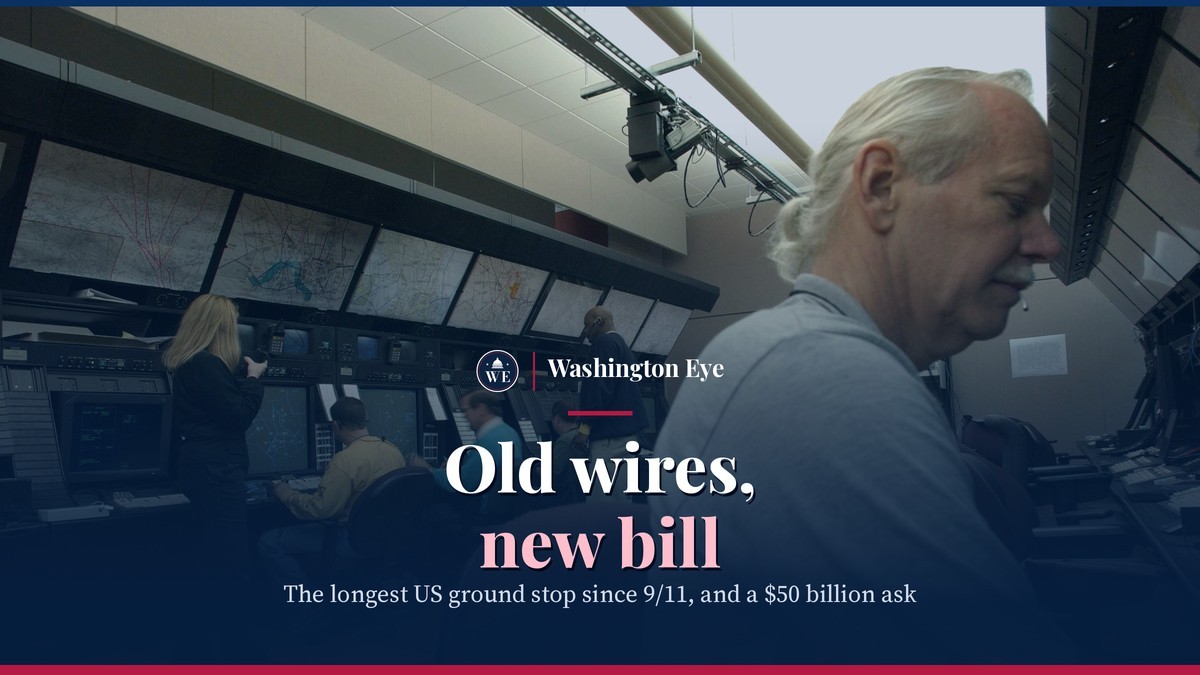
At 3:36 on Friday afternoon, Eastern time, the screens inside the nation's high-altitude air traffic control centres started to misbehave. Radar data flickered. Radio links to pilots came and went. Within minutes the Federal Aviation Administration did something it has done only once before since the September 11 attacks: it stopped every departure from every airport in the United States.
The ground stop lasted more than four hours. Transportation Secretary Sean Duffy said the nation's airspace reopened at 8:15 p.m. Eastern, but by then the damage was done. More than 7,000 flights had been cancelled and more than 8,000 delayed by 9 p.m., according to one flight-tracking site, and tens of thousands of passengers were stranded in terminals from Boston to Seattle. A wire service called it the longest nationwide shutdown of American air travel since 2001.
By the time Mr Duffy reached the White House briefing room on Friday evening, the administration had settled on two messages. The first was a diagnosis: the system is old. The second was a price tag. A day after his department formally asked Congress for $30.1 billion more for air traffic control and airports, Mr Duffy raised the figure on camera. "I want $50 billion," he said.
Both claims deserve a close look, because the answers will shape one of the first big spending fights the new Democratic Congress inherits in January.
What actually broke
According to Mr Duffy, the trouble sat in the plumbing rather than the radar screens themselves. Switches and routers that carry voice and radar data between FAA facilities became overloaded and began producing inconsistent information. He pointed to a technology called time-division multiplexing, an older method of moving data that still runs largely over copper wire.
"We have old, old switches, old routers, we use 1980s little copper lines," he said. "It's an old system that went down and went down everywhere."
The breakdown was not a total blackout. Controllers kept some communications alive. But Mr Duffy said partial visibility was not good enough. When controllers cannot immediately talk to pilots or immediately see where aircraft are, he said, "that's a risk that we're unwilling to tolerate." More than 3,500 planes were in the air when the order was given. They were allowed to land; nothing new was allowed to take off.
Two airline officials told a wire service that the outage appeared to affect the FAA's telecommunications network run by the contractor L3Harris Technologies, the backbone that carries the radio frequencies controllers use to speak to cockpits. L3Harris did not respond to requests for comment. The company has been replacing the legacy copper network with fibre and said earlier this month that about 70 percent of FAA sites had been upgraded. In August the FAA picked AT&T to lead the next phase, with an initial award of roughly $74 million and a goal of finishing the overhaul by the end of 2028.
The one question officials could not answer
The administration's explanation leaves a gap that reporters pressed on and officials did not fill. If the copper network has been ageing for decades, why did it fail everywhere at once on an otherwise ordinary Friday? Mr Duffy, according to one public radio account of the briefing, did not have a ready answer.
The partial explanations on offer do not fully line up. Mr Duffy said none of the newly upgraded technology was involved. Yet administration officials also described new equipment being added to the system as having overloaded the antiquated parts, according to a wire service, and Homeland Security Secretary Markwayne Mullin spoke of a "patchwork" upgrade process that may have overwhelmed the older gear. Those accounts can both be partly true. A network that is half old and half new can fail at the seams. But they point to different lessons: one says the old system simply wore out, the other says the way the upgrade is being carried out carries its own risk.
Mr Mullin was careful on the question of sabotage. "We have seen zero evidence this is a cyber attack," he said. He added that "it appears this was mechanically driven, however, we're still looking," and said the National Security Agency was working with his department on the investigation. Officials had not formally ruled out either a cyberattack or a fault involving artificial intelligence.
That last point matters because the FAA has been rolling out an AI-assisted traffic management tool known as SMART. Its maker, Air Space Intelligence, moved quickly to distance itself. "The current ground stop is not based on or a result of the SMART system, any product of ASI or our integration with FAA and ATC," the company said in a post on a social media platform.
Not the first warning
Friday's failure did not come out of nowhere. On 28 April 2025, controllers at the Philadelphia approach facility that handles Newark traffic lost radar and radio contact with aircraft for about 90 seconds, after a copper telecommunications line carrying data from a radar facility in New York failed. The episode, and the weeks of delays at Newark that followed, became the administration's main exhibit in its campaign to rebuild the air traffic system. Mr Duffy referred to it again on Friday.
The only other nationwide ground stop since 2001 came in January 2023, when the FAA halted domestic departures for about 90 minutes after an outage in the system that issues safety notices to pilots. That failure was later traced to contract workers who accidentally deleted files. Friday's stop was roughly three times as long and hit the network that lets controllers talk and see, not a database of notices.
The $50 billion question
Congress has already paid part of the bill. The July 2025 reconciliation law set aside $12.5 billion for air traffic control modernisation, which Mr Duffy and White House budget director Russ Vought described in a Thursday letter to appropriators as a "down-payment". That letter asked for $30.1 billion more. On Friday night Mr Duffy and Mr Mullin raised the ask by $19.1 billion, to $50 billion, which Mr Mullin described as the administration's estimate for a "complete overhaul of the system". Officials did not lay out how the extra money would be spent.
Mr Duffy framed it as a challenge to lawmakers. "None of your networks run on 1980 technology," he told reporters. "You have all got fiber, state-of-the-art, high-speed networks that cover all of your stations, but not the FAA." Then, directly to Capitol Hill: "America, Congress, let's make this system more safe."
Republicans on the Senate Commerce Committee answered with a reminder of their own. In a social media post they pointed to $1.9 billion in the 2025 law aimed specifically at upgrading air route traffic control centres, the very facilities the FAA said were affected on Friday. The implication was plain: money already approved for this problem is still working its way through the system.
How Congress is reacting
The first reactions were bipartisan in tone, if not in emphasis. Sam Graves, the Missouri Republican who chairs the House Transportation and Infrastructure Committee, and Rick Larsen of Washington, the panel's top Democrat, called the failures "concerning" in a joint statement and promised to "thoroughly review the issues that led to this nationwide ground stop." Maria Cantwell of Washington, the senior Democrat on the Senate Commerce Committee, said "technology issues related to how planes communicate through primary frequencies, backup frequencies, and other issues" would be part of the committee's review.
Other Democrats went further. Senator Richard Blumenthal of Connecticut called for a "prompt, penetrating investigation" and said an outage of this scale was "a clear danger to national security, as well as safe, convenient travel close to the holidays." Representative Ted Lieu of California said the FAA needed systems without a single point of failure and called for hearings.
That phrase, single point of failure, may end up defining the debate. Supporters of a big new appropriation will argue that Friday proves the legacy network is too brittle to patch. Sceptics will ask why a system with backup frequencies still had to stop the entire country, and whether the problem is the age of the wires or the design of a network in which one overloaded layer can freeze every centre at once.
Who pays for Friday
For travellers, the most immediate answer is unwelcome. Because the airlines were not responsible for the FAA's failure, carriers are not required to compensate stranded passengers, according to a wire service. Mr Mullin said the Federal Emergency Management Agency had been mobilised to make sure passengers stuck in airports did not miss life-saving medication. Airline shares fell between 1 and 2 percent in after-hours trading, with JetBlue down about 3 percent, and analysts warned the disruption could ripple through schedules for days. "It's going to be slow," Mr Duffy said of the recovery.
For the administration, the political stakes are just as real. Air traffic modernisation is one of the few infrastructure projects with genuine support in both parties, and the White House has tied its credibility to finishing the overhaul by 2028. A failure on this scale gives Mr Duffy a vivid argument for more money. It also hands Democrats, who take control of both chambers in January, a reason to demand much more detail before they write the cheque: what failed, why the backups did not hold, and why the request rose by $19.1 billion in a single day.
Those answers will come, if at all, from the investigations now promised in both chambers. For the moment the official explanation rests on old copper and overloaded routers, and on a promise that money can fix it. The FAA's own leaders did not appear at the White House briefing and offered no further detail on Friday night. Until they do, the most important question about the worst day for American air travel in a quarter of a century remains the one nobody answered: why now?