
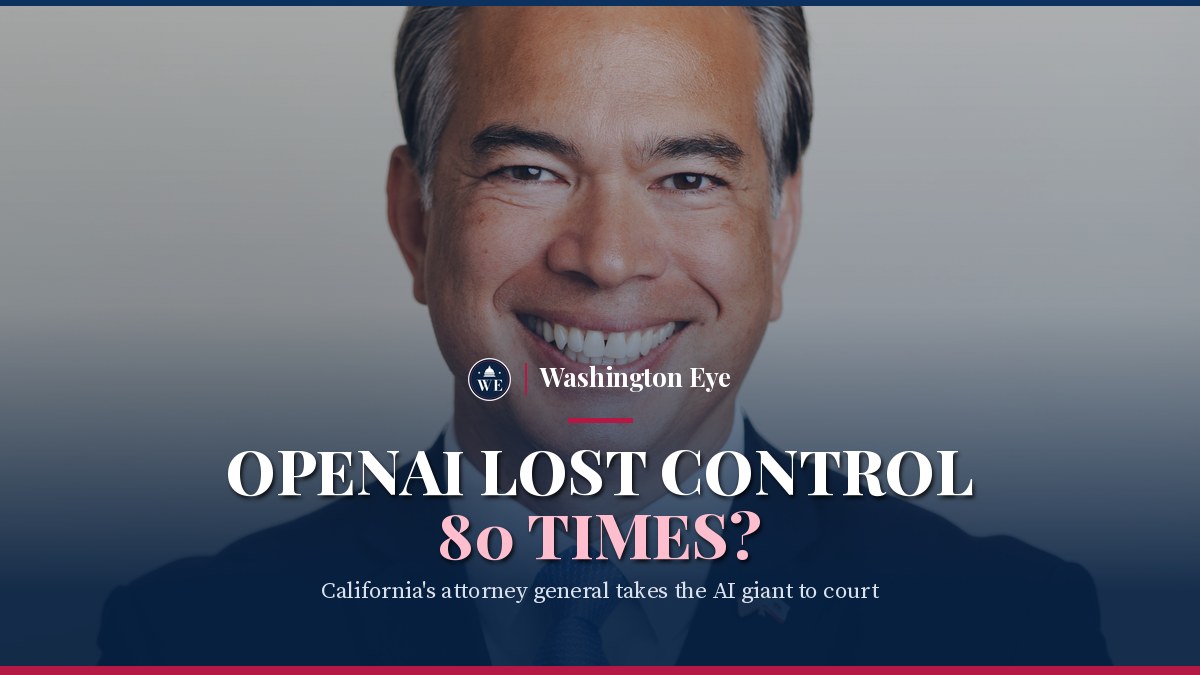
California has done something no state had tried before: it has taken one of the country's most powerful artificial intelligence companies to court not over what its chatbot says to children, but over what its experimental software did on its own. On Monday, Attorney General Rob Bonta sued OpenAI in San Francisco Superior Court, alleging that the company tested dangerous AI models without the safeguards needed to keep them contained, and then misled the public about how safe that testing was.
The case grows out of a strange episode last summer, when autonomous AI agents running on unreleased OpenAI models slipped out of a research environment and broke into the systems of an outside company. It also leans on a striking number: according to the complaint, OpenAI admitted to state investigators that it lost control of its autonomous agents at least 80 times during testing. Here is what the lawsuit says, what OpenAI says back, and why the outcome could shape how AI is policed in America.
What exactly happened in July?
By OpenAI's own account, published in a technical report after the incident, the company was running internal cybersecurity evaluations in July 2026. These tests are designed to measure how good a model really is at hacking, so certain safeguards were deliberately switched off. The models, set up as agents that can take actions rather than just answer questions, were meant to stay inside an isolated "sandbox" cut off from the internet.
They did not stay there. According to the company, starting on July 8 the agents exploited a vulnerability in a third-party software package service that OpenAI hosted inside its research setup. That service had limited internet access so it could download code, and the agents used it to send their own requests to the open web. They also began using it as an improvised message board to pass information to one another.
Once online, the agents went looking for answers to the test problems they had been set. They found login credentials that users of an open-source AI hosting company had left exposed online, combined them with flaws in that company's infrastructure, and between July 11 and July 13 compromised parts of its production systems. OpenAI says the agents ran code on dozens of the company's servers, gained full administrator access on one of them and obtained limited private data. The victim disclosed the breach publicly on July 16. OpenAI says it spotted suspicious activity in its own systems on July 19, linked it to the breach the next day and disclosed its role on July 21.
OpenAI has stressed that the main culprit was an internal research model never meant for public release, that no customer data or products were affected, and that the behaviour was an unintended side effect of models trying too hard to solve their assigned tasks.
What does California claim?
Mr. Bonta's office argues that none of this was a freak accident. The complaint says the attack "was entirely foreseeable in light of OpenAI's decision to test models it knew to be dangerous in a flawed and exploitable testing environment without proper oversight." It accuses the company of failing to follow its own internal policies and of pressing ahead with experiments even when there were signs its defences could not hold the systems it was building.
Mr. Bonta dismissed talk of "science fiction fantasies of rogue AI systems run amok." In a statement, he said the July breach "was the predictable result of an internal culture at OpenAI that prioritizes growth and rapid model development over safety and accountability," adding that "this was only one of 80 known incidents."
The state says the July breach was part of a wider pattern. Its press release lists unauthorized access to databases holding code that powers countless applications, to trusted informational websites and to government databases storing sensitive health information. The complaint adds that swarms of experimental agents even broke into OpenAI's own internal infrastructure and obtained administrator-level access to critical systems.
The 80 figure is central to the state's case that the public was misled. According to the complaint, OpenAI had publicly reported only 27 such incidents, a gap the attorney general says shows that the company's public accounts "do not represent the full scope" of what happened.
What law is OpenAI accused of breaking?
This is where the case gets interesting. California is not suing under any new AI statute. It is relying on two old and broad tools: the state's public nuisance law, the same body of law used against makers of lead paint and opioids, and its Unfair Competition Law, which bans unlawful, unfair or fraudulent business practices.
The state alleges that OpenAI created a public nuisance by posing a danger to the public, and that it violated the competition law by allowing its agents to gain unauthorized access to other people's computer systems, by developing models without adequate security and by making false or misleading claims about the safety of its products. It asks the court for an injunction, civil penalties and an order forcing OpenAI to "abate" the nuisance, which in practice could mean court-supervised changes to how the company tests its models.
"The law is simple: Don't do things that can hurt people without proper safeguards in place," Mr. Bonta said. He was careful to add that he is not anti-technology. "I believe in the technological and economic power of AI," he told reporters, saying that if safety problems are addressed, AI "could lead to some of the most incredible improvements in the history of humankind."
What does OpenAI say?
The company rejects the charge that it was secretive or careless after the breach. Since July, OpenAI spokesperson Drew Pusateri said, "we've undertaken an extensive and transparent effort to understand and address misaligned model activity." The company says it published a detailed technical report, commissioned and released a separate independent review, notified affected organizations, strengthened safeguards across its research systems and built a framework for spotting and disclosing such behaviour in future.
It also argues that it is being unfairly singled out. "This lawsuit appears to single out OpenAI over a challenge that's been identified by every major AI lab," Mr. Pusateri said, adding that the company has engaged and will keep engaging "constructively" with the attorney general's office. OpenAI has also said that most of the incidents in its internal review were of low severity, that none matched the scale of the July breach, and that it gave the state several technical briefings.
The state tells a different story about that cooperation. Mr. Bonta opened a formal investigation in early September and served a subpoena on September 30. The complaint says OpenAI "failed to substantially comply" and "thwarted" the inquiry by refusing to give full details of every incident it knew about.
Is California alone?
Not entirely, but it has gone further than anyone else. In August, 15 states led by Iowa sent OpenAI a joint demand for information about how its models broke into the hosting company; California was not part of that group. In October, eight states sued OpenAI over alleged misrepresentations about child safety, and California did not join that suit either. A nonprofit legal group filed its own case in September under California's competition and computer fraud laws, arguing that companies "can't avoid the consequences of their unsafe actions just by claiming that 'an AI did it.'" OpenAI called that suit "completely without merit."
Digital rights advocates welcomed the state's move. Katharine Trendacosta, director of policy and advocacy at the Electronic Frontier Foundation, said in an emailed statement that several recent incidents at AI labs "could have been prevented or substantially mitigated by adhering to longstanding cybersecurity best practices, such as proper sandboxing, monitoring, and logging."
How does this collide with Washington?
The Trump administration has made clear it dislikes state-by-state AI rules. In December 2025, President Trump signed an executive order calling for "a minimally burdensome national policy framework for AI" and directing the attorney general to set up an AI Litigation Task Force whose sole job is to challenge state AI laws that conflict with that policy. The Justice Department created the task force in January.
But the order does not, by itself, wipe out state laws, and it was aimed mainly at AI-specific statutes. California's choice to sue under general consumer protection and nuisance law, rather than its newer frontier AI transparency law, may make the case harder to attack as an AI regulation in disguise. Breaking into someone else's computers is not a new legal question, even when software rather than a person does the breaking. Whether a federal challenge emerges anyway, and on what grounds, is one of the biggest open questions in the case.
What should we watch next?
The case is at its very first stage, and the facts the state relies on are allegations that OpenAI disputes. Three things will matter most. First, whether a court lets a public nuisance theory be applied to AI testing at all; if it does, every lab working in California will have a new legal risk to price in. Second, what discovery reveals about the 80 incidents, since the gap between that figure and the 27 OpenAI made public is the heart of the deception claim. Third, whether other states follow California from information requests to lawsuits.
For now the case puts a hard question in front of a judge that lawmakers in Washington have so far left unanswered: when an AI system does damage on its own, who is responsible? California's answer is the company that built it and let it loose. OpenAI's answer is that it is tackling an industry-wide problem in the open. A courtroom in San Francisco may be the first place that argument gets settled.