
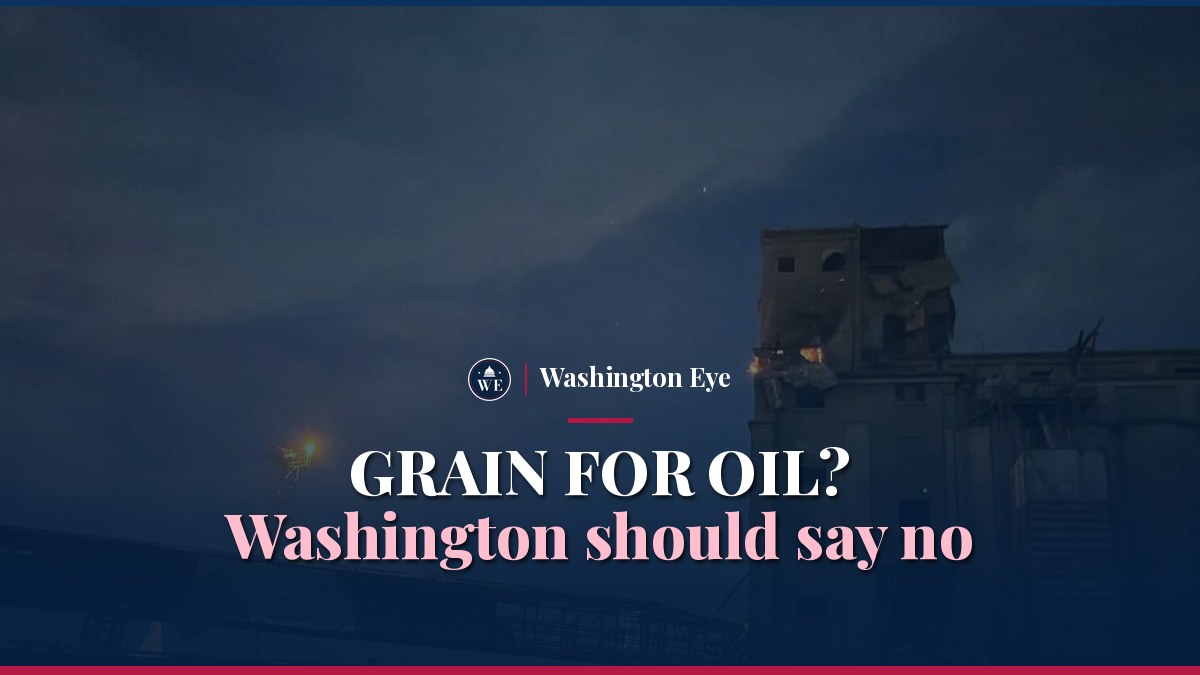
Overnight on Wednesday, Russian forces struck two foreign cargo ships carrying more than 100,000 tonnes of grain near the Ukrainian port of Odesa, according to Ukraine's prime minister, Sergiy Koretskyi. Moscow says it does not attack civilian targets. Two days later, in Kyiv, Ukraine's foreign minister told a food security conference that his government had sent Russia a concrete plan for a ceasefire at sea, one that would let grain ships sail again. The answer, he said, came back with a price tag.
"If we are talking about agricultural products, then, of course, we are ready for such a truce," Andrii Sybiha said on Friday. "They immediately propose including oil."
That single sentence tells Washington everything it needs to know about how to handle the Black Sea. A truce that protects bread is a humanitarian good. A truce that also protects the Kremlin's oil revenue is a gift to the war machine that created the problem in the first place. The United States, which says it is examining ideas from Turkey and India to get grain moving, should back the first and refuse the second.
How the Black Sea went quiet
The facts on the water are stark. The three ports of the Odesa hub once handled about 90 percent of Ukraine's agricultural and metallurgical exports. Since late July, after Russia sharply intensified strikes on grain terminals and merchant vessels, Kyiv says shipments from those ports have all but stopped. The government has not closed them. It has not needed to. Shipowners stay away because of the danger, and insurance costs have soared to levels traders will not pay.
Ukraine has tried to route around the blockade, sending cargo up the Danube and by rail across its western borders. Those routes are slower and costlier, and they cannot match a deep water port. Ukrainian officials estimate that if the restrictions drag on, the farm sector could lose an extra $7.5 billion in the 2026 to 2027 marketing year.
This is not the first time. In July 2022, Russia, Ukraine, Turkey and the United Nations signed a deal that reopened Ukrainian ports. Moscow walked away a year later, in July 2023, and began bombing the grain infrastructure the agreement had protected. Ukraine then built its own corridor along the coast. That corridor is what Russia has now spent four months trying to shut.
Why oil changes everything
Mr Sybiha did not reject a broader arrangement. "Oil could be part of a broader energy truce," he said, adding that any such deal would have to cover all the energy components that belong in it. That is a reasonable position, and it is the right one for Washington to adopt.
The distinction matters because the two cargoes do very different things. Grain feeds people far from the front line. Secretary of State Marco Rubio said last month that the disruption is "threatening the world for food security," and that Africa in particular "is paying a high price." India and Egypt, which a senior Canadian minister described last month as heavily affected, want safe passage partly to protect their own ships and sailors. Nobody in Cairo or Mumbai is buying Ukrainian wheat to fund an army.
Oil is the opposite. Seaborne crude and fuel exports are among the largest sources of hard currency for the Russian state, which is exactly why Western governments have spent years trying to squeeze them with sanctions and price caps. Folding Russian oil into a grain truce would hand Moscow a guaranteed lane for the revenue that pays for the missiles and drones now hitting those grain terminals. It would reward a strategy of attacking civilian trade by letting the attacker trade its way out of consequences.
Notice, too, how the bargain is structured. Russia creates the danger, then offers to remove it in exchange for something it wants. If that works once, it will be tried again. Mr Sybiha put it bluntly: the world must not let Russia turn the Black Sea into "a sort of Strait of Hormuz."
Russia has other doors open
The Kremlin's case for linkage is weaker than it sounds. Russia is not cut off from the sea. According to Ukraine's foreign minister, more than 40 percent of Russian exports already move through the Baltic, and Moscow uses other ports as well, including, Kyiv alleges, to ship grain taken from occupied Ukrainian territory. A grain only truce would not strangle Russia's economy. It would simply stop Russia from strangling Ukraine's.
Ukraine, meanwhile, has made its offer and says it is waiting. "All our proposals have been submitted," Mr Sybiha said, accusing Moscow of answering every package with "additional unrealistic demands." The same Canadian minister said that Ukraine was fully engaged on a limited ceasefire but that Russia had not shown it was willing to move ahead. When one side says yes to the narrow deal and the other keeps widening it, the problem is not hard to locate.
What Washington should do
The Trump administration deserves credit for keeping the Black Sea on the agenda. Mr Rubio has said the United States would like to achieve a limited arrangement and acknowledged that "it doesn't solve the war, but at least it solves a unique aspect of it." That is the right instinct. The danger lies in his other words. When he spoke in October, he described the goal as protecting grain shipments and, in some cases, energy. That ambiguity is precisely the opening Moscow is now trying to drive a tanker through.
Washington should close it. The administration should say publicly that it supports the grain only framework Kyiv has tabled, and that energy belongs in a separate negotiation covering power grids and fuel infrastructure on both sides. It should press Turkey, India and Egypt, the mediators Kyiv has thanked, to keep the two tracks apart. And it should make clear that Russian strikes on ships carrying food will carry costs, rather than serve as leverage.
President Trump has said that he asked Vladimir Putin, during their meeting in China last week, to pull back military aggression "against territories throughout Europe" in the hope of a quick deal. He has also said Mr Putin would be welcome at next month's Group of 20 summit in Florida, if it were up to him. Fine. A leader who wants to be treated as a partner at a summit of the world's largest economies can start by letting grain ships leave Odesa without demanding a toll in oil.
The conservative case is the simple one
There is a temptation in diplomacy to treat every concession as progress and every widened deal as a bigger win. Conservatives should resist it. Deterrence depends on the other side learning that aggression does not pay. A grain truce that also guarantees Russian oil flows teaches the opposite lesson, at the expense of American credibility, European security and the poorer countries that depend on Ukrainian wheat.
Feeding the world is not a bargaining chip. Washington should say so, sign up for the narrow deal and let Moscow explain to hungry buyers in Africa and Asia why it would rather keep bombing grain than give up its demand for oil.