
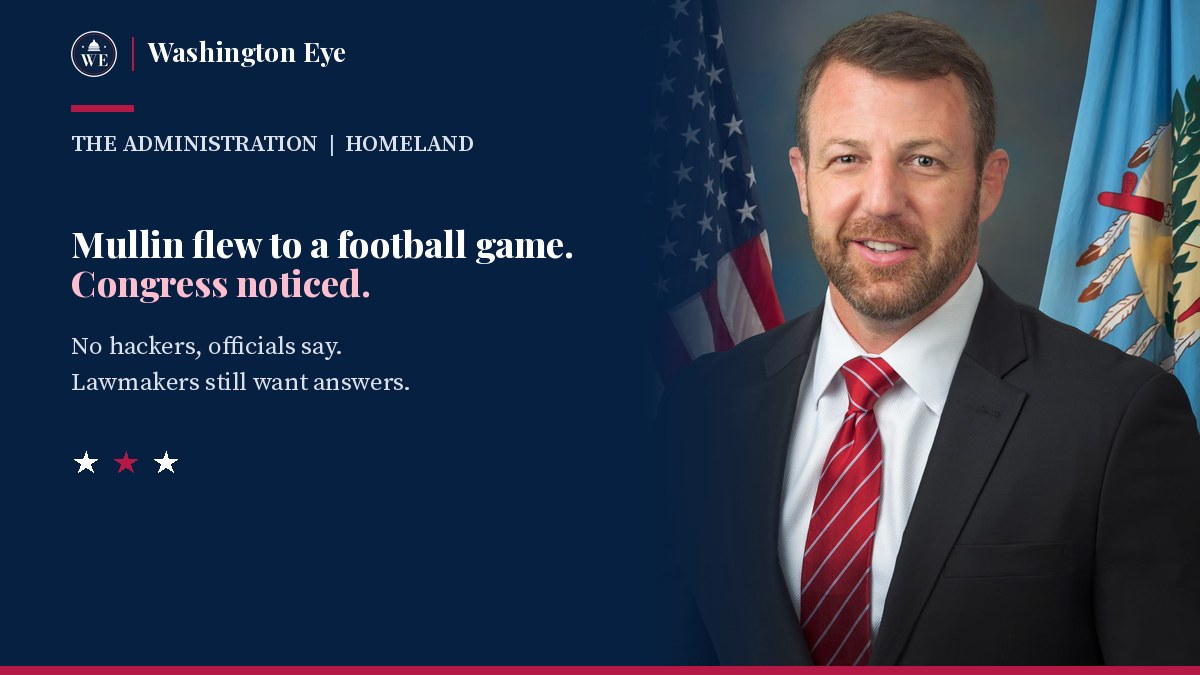
Markwayne Mullin came to Capitol Hill on Wednesday to talk about the gravest threats facing the United States. For a good part of the morning, he found himself talking about a college football game.
The Homeland Security secretary sat before the House Homeland Security Committee for its annual hearing on worldwide threats, this year titled "Worldwide Threats to the Homeland: 25 Years After 9/11." Beside him were the Director of National Intelligence, Jay Clayton, and the FBI's deputy director, Christopher Raia. The agenda was heavy: a run of technology outages that has left Americans uneasy, reported Iranian plotting against senior officials, and the future of immigration enforcement. But the question that followed Mr. Mullin into the room was simpler. Why did he take a government plane to watch LSU play Texas on Saturday, the day after a nationwide ground stop left travelers stranded across the country?
His answer, and the broader message the three officials delivered about the outages, will shape how the administration enters a much tougher year. The hearing was also the first chance for House Democrats, fresh from their midterm victory, to test the questions they plan to ask when they take control of the chamber's committees in January.
The flight he could not escape
Mr. Mullin tried to get ahead of the issue. He told lawmakers the trip with his family had been planned for some time, and that his niece had never been to an LSU game. He wanted, he said, to be "a good uncle."
He described a debate inside his team that morning. "We had discussions at 10:00 Saturday morning. Should we cancel it? We had deep conversations about it," he said. The conclusion, in his telling, was that canceling once the airspace had fully reopened could send the wrong signal. "I was meeting the governor there, I was meeting other people there, that would show maybe distrust that we're not even willing to fly," he said.
He made two further points. He said he is required to fly on government aircraft and that he paid for the trip himself. And he stressed that the skies were open: some 36,000 flights, he said, flew safely on Saturday after the ground stop was lifted. A day earlier he had put it more bluntly, saying his team "would have never went" if the airways had not been "completely open" for 21 hours.
Critics are not persuaded that open airspace was the point. The ground stop on Friday afternoon lasted more than four hours, and thousands of flights were cancelled. Even after planes were moving again, airlines spent the weekend trying to get passengers to their destinations. The top Democrat on the committee, Representative Bennie Thompson of Mississippi, criticized the secretary for flying to the game while that disruption was still playing out. The image of a cabinet officer heading to a stadium on a government jet while families slept in terminals is the kind of moment that tends to outlast the policy details around it.
No hackers, three officials say
On the larger question, the three witnesses spoke with one voice. In the space of a few days, the country has seen the air traffic control breakdown, problems with a major software company's services, outages at big banks and airlines, and a disruption at the National Security Agency on Monday. The timing fed speculation of a coordinated attack. The officials said they had found nothing to support that.
"I understand the timing of these incidents can raise questions, and it should," Mr. Clayton said in his opening remarks. "These are separate service outages associated with maintenance and technical changes. They are not a coordinated or state-sponsored attack."
Mr. Mullin said the department had contacted private industry as part of its review. "We have seen nothing that would indicate that they are related," he said. Mr. Raia said FBI cyber specialists had been involved from the start. "At this point, there is no indication whatsoever that there is any cyber malicious activity related to any of those incidents," he said, adding that the bureau would keep working with private companies "in an abundance of caution."
Officials have traced the aviation failure to the plumbing of the air traffic system. According to officials, the installation of a new router at a facility in Arkansas flooded the network with data, overwhelming an older system and causing the telecommunications failures that forced controllers to halt traffic. Mr. Mullin has blamed old copper wiring. "There's no cyber threat that's taking place. The homeland is very secure," he said ahead of the hearing.
He also argued the response itself was a success. "The whole of government went to work, every aspect of it," he told the committee. "We landed over 4,000 planes when the ground stoppage went out because of the communication and didn't have one single incident. That in itself is a great success."
The binary question
Not every member accepted the reassurance. Representative Dan Goldman, a New York Democrat, pressed Mr. Clayton on the NSA outage. "It's your testimony today that the technological problems that the NSA faced on Monday were from internal software and technological upgrades," he said.
Mr. Clayton would go only so far. "We have no indication that they have come from external threat actors," he replied, before describing routine maintenance such as software patches, upgrades and hardware replacement that can require systems to be taken offline and restarted.
"It's a pretty binary. It's either external or internal, right?" Mr. Goldman asked. When the answers stayed general, he accused the intelligence chief of dodging. "You're a very smart person, and you're clearly not answering my direct questions," he said.
The exchange captured the gap between what officials can rule out and what they can explain. Saying there is no evidence of an attack is not the same as saying exactly what went wrong inside one of the country's most secret agencies. Mr. Clayton, who also advises the president on artificial intelligence, offered a wider explanation: aging systems are falling behind faster than ever. "The speed of compute and the level of capability of applications that use that compute is increasing substantially," he said, which means legacy systems that looked old six months ago look much older a year later. That argument cuts two ways. It supports the administration's push for new money to modernize air traffic control and other infrastructure. It also concedes that critical systems are fragile enough to fail on their own.
The FBI chair that stayed empty
The hearing opened with a rebuke from the Republican chairman, Representative Andrew Garbarino of New York, aimed not at the witnesses but at someone who was missing. FBI Director Kash Patel declined to testify, and Mr. Garbarino made his displeasure public.
"I am disappointed that Director Patel chose not to appear before the committee today," he said. "There was no surprise or last-minute request, and despite repeated attempts over the span of several months between then and now to find any date when he could testify, the director made clear that he had no intention of appearing." A worldwide threats hearing, he said, "transcends politics, and the director should be here to brief Congress."
A Republican chairman scolding a Trump appointee in public is notable on its own. It also previews a broader problem for the administration. When Democrats take the gavels in January, they will not need to ask politely. Mr. Thompson used his time to tell Mr. Mullin that he needed to answer letters seeking department files ahead of investigations planned for the new Congress.
Iran, sleeper cells and an aspirational threat
The most serious material in the hearing concerned Iran. Lawmakers raised reports that Iranian-linked actors could be developing plans to target senior administration officials in Washington with a radiological weapon, often called a dirty bomb, or with chemical weapons.
Representative Michael Guest, a Mississippi Republican, asked directly: "Are we concerned about the possibility of sleeper cells?" Mr. Mullin answered: "Is it a concern? Of course. Are we fighting it and stomping it down every single day? Absolutely."
Mr. Clayton said Iranian threats inside and outside the United States "have dramatically increased," and warned about online radicalization by foreign extremist networks. "That's not theoretical; it's real. We saw it in New York," he said. Mr. Raia offered a note of caution. "A lot of the reporting is largely aspirational," he said, while insisting that the bureau still takes it seriously and has revamped its Iranian threat mission center. None of the officials publicly confirmed that Iranian sleeper cells were preparing attacks or that any dirty bomb or chemical plan had become operational.
Immigration, and a secretary who blames the past
Immigration took up the rest of the morning. Democrats pressed Mr. Mullin on reports that Immigration and Customs Enforcement cut corners on training during its hiring surge. Under questioning from Representative Shri Thanedar of Michigan, the secretary repeatedly said those decisions came before he took office in March. "We restored training back to the full 13 weeks, and we're going to continue to do that," he said. "I can't answer for the previous administration. You want to ask questions with my tenure there, I'll be happy to answer all those."
The exchange turned testy. Mr. Thanedar said barbers in Detroit go through more training than ICE officers. Mr. Mullin replied that he had never been a barber, and later told the congressman that his questions had already been answered and that his staff was not doing him "any justice." It was a reminder that Mr. Mullin, a former senator, is comfortable trading blows with members of Congress. That may serve him well in a hearing. It will be tested harder in January.
What to watch
Three things will decide whether Wednesday was a bad morning or the start of a longer problem. The first is the outages. If any later investigation finds that one of these failures was not routine after all, the officials' categorical language will be quoted back at them. The second is the flight. The secretary's defense rests on the claim that the airspace was open and that he paid his own way; Democrats are likely to ask for the records when they gain subpoena power. The third is the empty chair. Mr. Patel's refusal to appear angered a Republican chairman this year. Next year, the chairmen will be Democrats, and they have already begun sending notices.
For now, the administration's message is clear: the homeland is secure, the outages were accidents, and the secretary did nothing wrong by going to the game. The coming Congress will decide how long that message holds.