
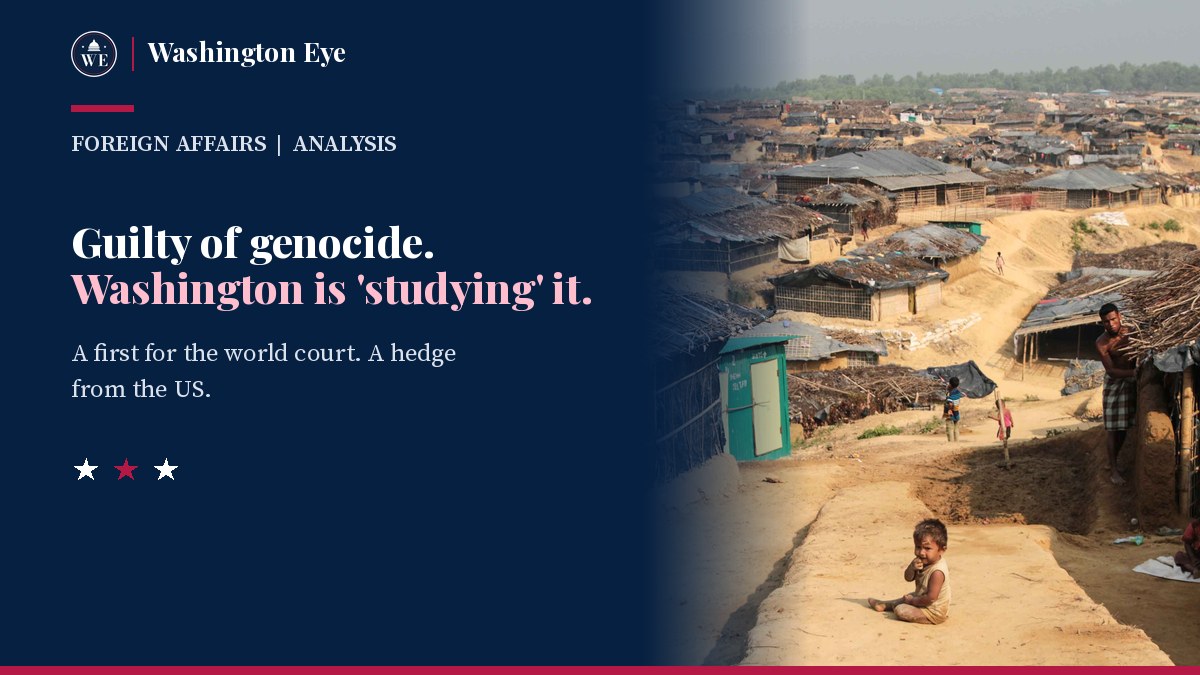
For eighty years, the International Court of Justice had never found a country guilty of genocide. On Thursday in The Hague, after a reading that lasted about three hours, it did. By nine votes to six, the judges ruled that Myanmar committed genocide against its Rohingya minority during the military's 2017 "clearance operations" in northern Rakhine State, and that it failed to prevent the crime, failed to punish it and failed to pass the laws the 1948 Genocide Convention requires.
The ruling is final, binding and cannot be appealed. It is also, in the most practical sense, unenforceable by the court itself. And the reaction from Washington was notably cooler than the reaction from almost every other Western capital. A State Department spokesperson said the United States was "studying the decision to fully assess its implications" and stressed that "preventing politicisation" of the court was of "paramount importance."
That caution tells you as much about the next fight as the verdict tells you about the last one.
What the court actually found
The case was brought in November 2019 by The Gambia, a small West African state that used the Genocide Convention's provision allowing any party to take another to the court. It centred on what happened after Rohingya insurgents from the Arakan Rohingya Salvation Army attacked more than 30 police posts in August 2017. Myanmar's army, backed by local mobs, responded with a campaign that emptied whole districts.
The court found that about 10,000 Rohingya were violently killed and that roughly 815,000 people were targeted in some way. More than 700,000 fled to Bangladesh on foot or by sea. Reading the judgment, the court's president, Yuji Iwasawa of Japan, said the security forces "killed thousands of Rohingya civilians, perpetrated widespread acts of sexual violence as well as acts of extreme violence against children and attacked fleeing Rohingya."
The hardest legal question in any genocide case is intent. It is not enough to show mass killing; a court must find an intent to destroy a protected group "in whole or in part." Here the majority concluded that "genocidal intent is the only reasonable inference that can be drawn from the evidence." Iwasawa said Myanmar had the "intention to destroy" a substantial part of the Rohingya population and engaged in "extensive destruction of evidence," burning and disposing of bodies and bulldozing cleared sites. The court also held that Myanmar breached a 2020 order to preserve evidence.
Two other findings will matter well beyond Myanmar. According to Antonia Mulvey, executive director of Legal Action Worldwide, the court did not accept Myanmar's counterterrorism defence, the argument that the army was simply responding to an insurgency, and it found for the first time that rape and sexual violence could be acts of genocide. The judges also looked at the years before 2017, finding that measures such as limiting married Rohingya couples to two children were discriminatory and aimed at eroding their rights.
Myanmar did win one point. The court found that the state did not directly and publicly incite private persons to commit genocide, even though it described an "anti-Rohingya hate speech campaign" that portrayed the group as "sub-human" and overlapped with the clearance operations.
The bill Myanmar is told to pay
The remedies are sweeping on paper. Myanmar must investigate everyone reasonably suspected of genocidal acts and, where warranted, prosecute and punish them. It must give guarantees of non-repetition. It must allow the "safe, voluntary and dignified return" of displaced Rohingya to their homes, whether they are inside Myanmar or abroad, and reunite families. And it must compensate the Rohingya group and its members.
The court did not set a figure. Instead, it gave Myanmar two years to report back on the restitution it has adopted and on the amount and form of compensation, after which a later phase of the case will settle reparations.
Few people expect Naypyitaw to cooperate. Myanmar's government, now headed by the former junta chief Min Aung Hlaing after a military-backed government took office in April, has long insisted its forces fought terrorists. Its representative at the January hearings, Ko Ko Hlaing, told the judges the country "was not obliged to remain idle and allow terrorists to have free reign," and offered "no comment" on Thursday. On Friday, government spokesperson Khaing Khaing Soe called the ruling unfair. "I want to say that this decision is not a unanimous decision by everyone, it is not fair," the spokesperson told reporters in the capital.
Pro-military social media channels went further, circulating posts noting that the court "has no police or military to enforce" its rulings and that major powers sometimes ignore them. That is true. The court's only formal route is to report non-compliance to the UN Security Council, where China and Russia hold vetoes and have shielded Myanmar's generals before.
Why Washington is hedging
The American response stands out because the United States is not neutral on the facts. In 2022, the State Department formally determined that Myanmar's military committed genocide against the Rohingya. The United States also says it is the largest single donor to the Rohingya humanitarian response, and Thursday's statement repeated "grave concerns over the continued abuses of human rights against Rohingya Muslims and members of other minority groups" while calling for more burden-sharing on aid.
So why the hedge? The answer sits in another docket. South Africa has accused Israel of genocide in Gaza before the same court, a charge Israel calls "wholly unfounded." That case is years from a final ruling, but the Myanmar judgment is the first time the court has explained, in a winning case, how it infers intent. Philippe Sands, the British barrister who helped bring the case for The Gambia, called the Gaza case the "elephant in the room" during the hearings. He said in a radio interview that a ruling against Myanmar did not mean the court would rule the same way on Gaza, but that if Myanmar had been cleared, the case against Israel "would, in effect, be over."
Washington has been signalling its worry for weeks. Mike Waltz, the US ambassador to the United Nations, accused the Gambia's ad hoc judge, Navi Pillay, the South African jurist awarded this year's Nobel Peace Prize, of trying "to lower the legal threshold for proving genocide so that weakened and false standard can later be weaponised against American and allied soldiers." He said Washington would "not allow globalist, faux judges to weaponise the law against our troops." Secretary of State Marco Rubio said in a speech last week that for a "global elite," international law is "an instrument to advance their interests under the pretence of universal principles."
Before the verdict, a Washington think tank close to the administration predicted that a genocide ruling would lead to American sanctions on the court, and the judges were reported to have taken advice on protecting their assets. The administration has already sanctioned judges of the separate International Criminal Court, which tries individuals, after it issued an arrest warrant for Israeli Prime Minister Benjamin Netanyahu. It has not, so far, questioned the legitimacy of the International Court of Justice, which settles disputes between states. "Studying" leaves every option open.
The rest of the world moved faster
Others did not wait. Britain expelled Myanmar's defence attache, summoned its charge d'affaires and called for an urgent Security Council session on the judgment, with Foreign Secretary Ed Miliband promising "further action in the coming days." The European Union said that "compliance with ICJ's decisions is not optional, it is an obligation under international law." UN Secretary General Antonio Guterres called the ruling "a reaffirmation that impunity for such horrific acts must not stand," and the UN human rights chief, Volker Turk, said it "must now translate into real action."
In the camps around Cox's Bazar in Bangladesh, home to around a million Rohingya, refugees watched the verdict on big screens. "This is like formal recognition of our suffering," said Mohammed Nowkim, a Rohingya driven out of Rakhine in 2017 who now lives in Canada. Arsalan Suleman, lead counsel for The Gambia, called it "a landmark victory for the Rohingya people." But Jaivet Ealom of the Rohingya Consultative Council was blunt: "I think it is not going to change anything immediately." Rakhine is still a war zone, contested between the army and the Arakan Army, and Rohingya civilians are still being attacked there.
What to watch
Three things will show whether this verdict becomes a turning point or a footnote. First, whether a Security Council session happens and whether China and Russia block any action, only a day after their leaders sat with President Donald Trump in Shenzhen and signed a declaration urging the International Criminal Court not to abuse its powers. Second, whether Southeast Asian governments that had been quietly normalising ties with Myanmar's new government now attach any cost to ignoring the ruling. As one Crisis Group analyst put it, "what matters now is whether the governments engaging Naypyidaw are prepared to attach any cost to ignoring it."
Third, and most directly for Americans, what the State Department concludes once it finishes "studying." The United States called this a genocide four years ago. If the administration now treats the court's agreement as a threat rather than a vindication, it will be because of where the precedent might lead next, not because of anything that happened in Rakhine.