
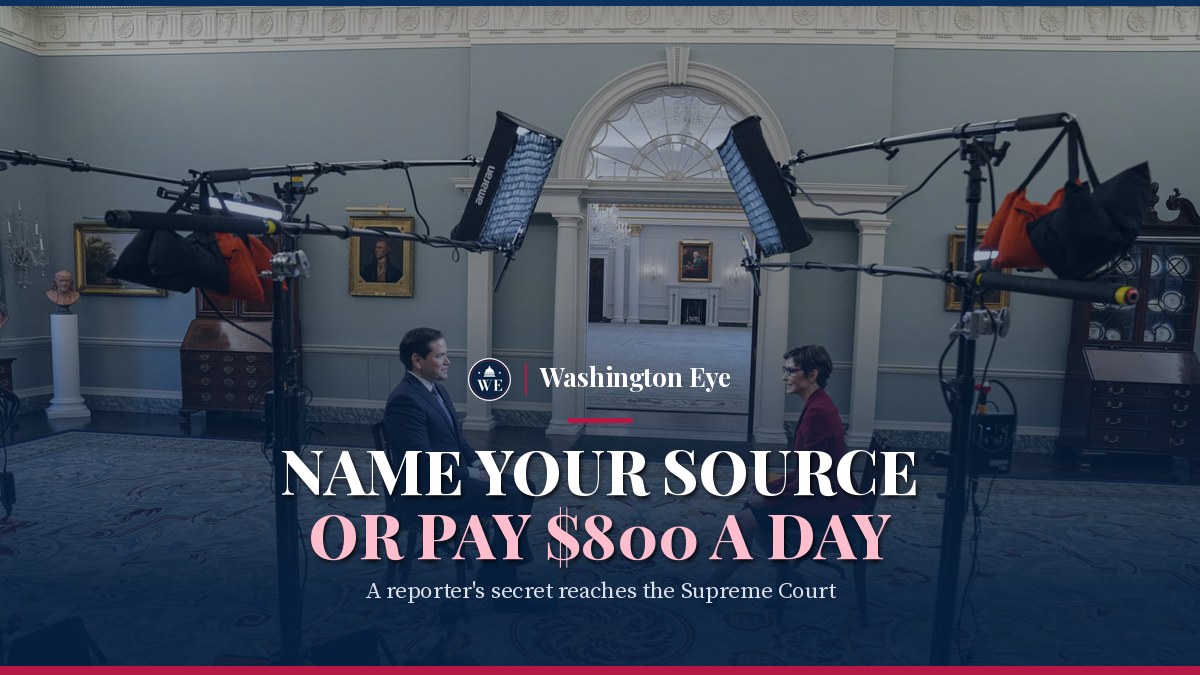
Catherine Herridge has spent close to three decades asking powerful people questions they would rather not answer. Next week, nine justices will decide whether to take up the one question she has refused to answer herself: who gave her the files?
The veteran investigative television reporter, now 62 and working independently, has been held in civil contempt by a federal judge in Washington for refusing to name the source behind a set of 2017 reports about a Chinese American scientist whom the FBI investigated for years and never charged. The penalty is $800 a day, paused while she appeals. If the Supreme Court declines her petition, the pause ends, the fine starts to run, and the threat of jail moves from theory to possibility. The case, Herridge v. Chen, is set for the justices' private conference on December 4.
It is the kind of fight that rarely reaches the high court. The justices have not ruled on a reporter's right to protect confidential sources since 1972, and they have never addressed one in a civil lawsuit. That is why press freedom groups, a performers' union and three Republican senators are now urging the Court to step in, and why the woman at the centre of it is talking openly about what she thinks is at stake.
"If the decision in my case stands, you're never going to see another Deep Throat or another Daniel Ellsberg because a reporter's promise of confidentiality will be meaningless," Herridge said in an interview published this week. She added that she worries less about herself than about "the next generation of reporters in Washington, D.C."
A career built on leaks
For most of her career Herridge was a national security correspondent for a major cable news network, covering terrorism, intelligence and the FBI. In 2019 she moved to a rival broadcast network, and she left it in a round of layoffs in early 2024. Since then she has worked as an independent journalist. The subjects she built her name on are the subjects that live and die on confidential sourcing: counterintelligence cases, internal disputes at the Justice Department, and classified programmes that officials do not discuss on the record.
In 2017 she reported on an FBI investigation into Yanping Chen, the founder of the University of Management and Technology, a Virginia school whose students included military service members paying with Defense Department tuition assistance. The FBI had opened its inquiry in 2010, examining statements Chen made on immigration forms about her past work connected to a Chinese space programme, and whether her school was used to pass information about the US military to Beijing. After six years, prosecutors declined to bring charges.
Herridge's reports described that investigation and the disagreement inside government over the decision not to charge. They included photographs of Chen and documents from the case file. A brief filed in support of Herridge by Senators Ted Cruz, Mike Lee and Cynthia Lummis says her reporting presented evidence that Chen had been a colonel in the Chinese People's Liberation Army and had concealed it on her immigration forms, and notes that the Pentagon later dropped Chen's university from its tuition assistance programme on national security grounds, a decision Chen did not challenge.
The other side of the story
Chen tells a very different story, and her lawyers tell it bluntly. In their brief opposing Supreme Court review, they describe her as an American citizen who endured a years long investigation, was never accused of a crime, and then saw protected government records leaked to a reporter, most likely by investigators unhappy that she would not be charged. The resulting reports, they argue, falsely insinuated that she was a Chinese spy.
In 2018 Chen sued the FBI and the Defense Department under the Privacy Act, the 1974 law that generally forbids federal agencies from disclosing records about a person without consent. To win damages she has to show the disclosure was intentional or wilful, and that is very hard to do without knowing who did the disclosing. Her lawyers say they spent years trying: questioning government witnesses and third parties and pressing for records. Only when those efforts failed, in 2022, did they subpoena Herridge.
U.S. District Judge Christopher Cooper agreed that Chen had exhausted the alternatives and that the source's identity went to the heart of her claim. In a deposition in September 2023, Herridge declined to name her source or say how and when she received the material, telling the court she was refusing so that she could seek appellate review. Judge Cooper held her in contempt in February 2024 and imposed the daily fine.
In September 2025 a unanimous three judge panel of the federal appeals court in Washington upheld that ruling, in an opinion by Judge Gregory Katsas. The court said it recognises a qualified reporter's privilege, but that a litigant can overcome it by showing two things: that the information is central to the case, and that every reasonable alternative source has been exhausted. Herridge did not contest that both tests were met. In May 2026 the full appeals court declined to rehear the case without a single judge asking for a vote.
Why her lawyers think the justices will listen
Herridge's petition asks a question the Court has avoided for half a century: whether, and when, a civil plaintiff can force a journalist to reveal a confidential source under the First Amendment or the federal rules of evidence. In 1972, in Branzburg v. Hayes, the justices held that reporters could not use the First Amendment to refuse to testify before a criminal grand jury. Lower courts have since built their own patchwork of protections on top of that ruling, and they do not all agree.
Herridge has made the geographic unfairness the heart of her public argument. "If I had been a reporter in Boston in the First Circuit, a subpoena would have been thrown out years ago, but I'm a reporter in Washington, D.C., where we have the weakest protections and really need the most protections for our sources," she said.
The senators' brief pushes the same point further. It argues that the appeals court's two step test "erroneously compels disclosure no matter the cost to national security or the First Amendment", and that because so many Privacy Act suits are filed in Washington, the capital's rule is in practice a national rule. Instead, the senators want judges to weigh the public value of the reporting and the harm of exposing the source case by case. SAG-AFTRA, the union that represents roughly 10,000 television and radio journalists, makes a similar complaint, writing that nothing in the lower court's analysis "measured the value of the reporting to the public, the reporter's interest, or the effect on future newsgathering."
Chen's lawyers answer that there is nothing new here. They point out that the Court turned down a petition raising the same arguments in 2006, after the same appeals court ordered reporters to identify their sources in a Privacy Act suit brought by the nuclear scientist Wen Ho Lee, and that nothing has changed since. The unanimity of the judges below, they argue, shows that this corner of the law is settled. The Justice Department, a defendant in Chen's lawsuit, has waived its right to respond.
How these fights usually end
History suggests that cases like this tend to end in a cheque, not a cell. In the Wen Ho Lee case, news organisations contributed $750,000 to a settlement in 2006 so that their reporters would not have to reveal their sources. In 2008 a former newspaper reporter, Toni Locy, was held in contempt and fined up to $5,000 a day for refusing to name sources in a Privacy Act suit brought by the former Army scientist Steven Hatfill, whom officials had linked to the 2001 anthrax attacks. The contempt order fell away after the government settled with Hatfill for $5.8 million.
Herridge has one advantage most freelancers do not. Her former employer, the cable network that aired the 2017 reports, has paid for her lawyers from the start and says it still supports her. She says that is exactly the problem: an independent reporter without a corporation behind her could be ruined by a fine like hers, and would think twice before taking on a story built on a leak.
The bigger fight in Congress
There is still no federal shield law. Most states protect reporters' sources in some form, but federal courts are left to improvise. The PRESS Act, which would bar federal authorities from forcing journalists to reveal sources except in narrow cases such as preventing terrorism or imminent violence, passed the House unanimously in January 2024. It then stalled in the Senate after President-elect Donald Trump urged Republicans to kill it, and Senator Tom Cotton blocked an attempt to pass it by unanimous consent that December.
The politics may now be shifting. Press freedom advocates see the bill as an early test for the Democratic majorities taking over Congress in January, though Democrats will not have the votes to override a veto on their own. And the administration has pursued reporters' records aggressively: this summer the Justice Department subpoenaed several reporters at a major American newspaper over their coverage of security concerns about a Qatari jet donated to serve as Air Force One, before dropping the subpoenas after a federal judge sharply criticised them. Gabe Rottman of the Reporters Committee for Freedom of the Press warned that if there is no federal reporter's privilege, "that would open the door to much more aggressive action."
That is what makes Herridge an unusual standard bearer. Three of the Senate's most conservative members are backing a reporter whose stories pleased the right, while the plaintiff on the other side is a woman who was never charged with anything and says a leak wrecked her reputation. Both sides can claim a principle: the public's interest in a press that can keep its promises, and a private citizen's right not to have her government file handed to a television crew.
What happens next
The justices will consider the petition on December 4, and the earliest word could come in an order list days later. They could grant it and hear the case this term, deny it and leave Herridge facing the fine, or hold it while they think. Denial would not be a ruling on the merits, but it would leave Washington's rule standing for every reporter in the city where most national security leaks are published.
Herridge has said that she will not name her source. If the Court says no, the next question will not be legal at all. It will be how long a 62 year old reporter is prepared to pay $800 a day, or more, to keep a promise she made nine years ago.