
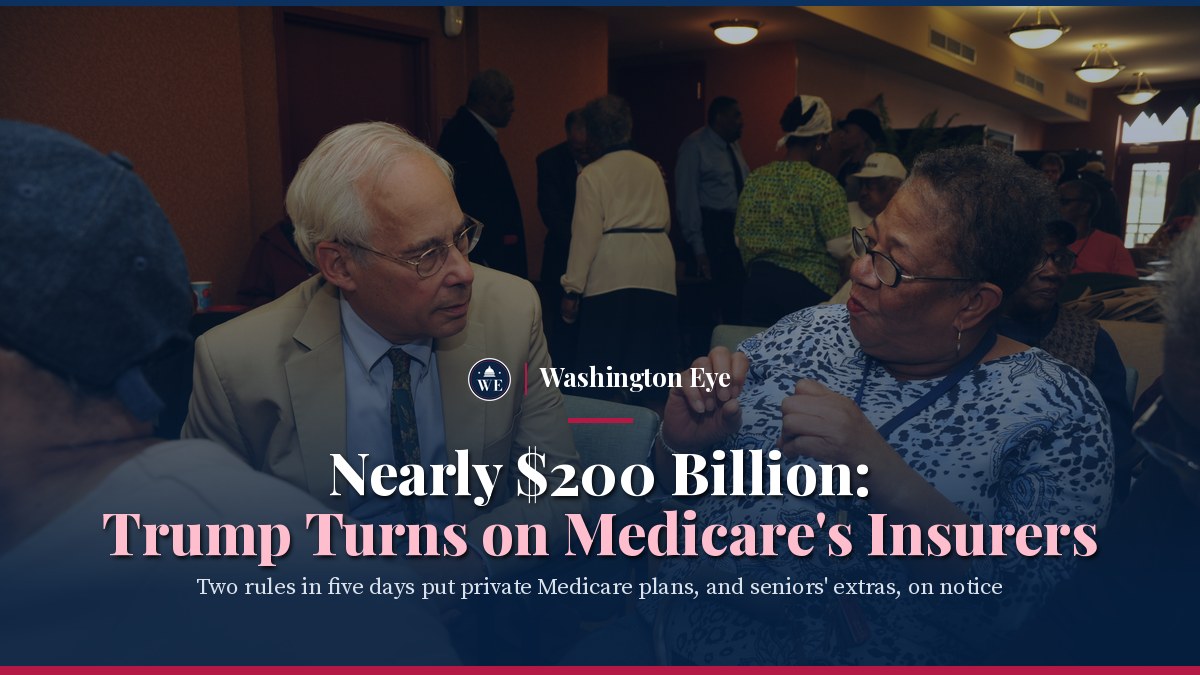
For most of the past two decades, Medicare Advantage has been the part of the federal health system that Republicans liked best. It hands the care of older Americans to private insurers, it rewards competition, and it now covers more than 35 million people. So it is worth pausing on what the Trump administration has done to it in the space of five days.
On 16 November, the Centers for Medicare and Medicaid Services proposed an anti-fraud rule that it estimates would claw back about $90.2 billion from Medicare Advantage plans over ten years. On 20 November, the same agency proposed a second rule that rewrites the star ratings used to hand out quality bonuses, a change it estimates would cut payments to the plans by $107 billion between 2028 and 2037. The two figures cover slightly different windows and both are estimates attached to proposals, not final law. Added together, they come to nearly $200 billion.
Investors understood the message at once. On Monday morning, before the opening bell, shares in UnitedHealth Group fell about 6%, Humana and CVS Health dropped more than 4% each and Molina Healthcare slid almost 8%. By one count, UnitedHealth and Humana had lost 19% and 16% of their value respectively since the previous Monday, when the first rule appeared. One industry analyst called the second proposal "almost overwhelming in size, scope, and the impact on the industry."
This explainer sets out what the two rules actually do, who stands to lose, who might gain, and why a Republican administration has chosen this moment to squeeze an industry its own party long defended.
What are star ratings, and why do they matter so much?
Every Medicare Advantage contract is graded from one to five stars on a long list of measures covering clinical outcomes, patient experience and the routine processes of care, such as screenings and follow up calls. The ratings were meant to help seniors compare plans and to push insurers to coordinate care better. Plans that reach four stars or more qualify for quality bonus payments, and those bonuses are enormous: they are on course to exceed $13 billion this year. Small shifts in the grading formula can therefore move billions of dollars and, with them, share prices.
Critics have long argued that the system rewards paperwork more than health, and that so many plans clear the four star bar that the bonus has become a general subsidy rather than a reward for excellence. Insurers have their own complaints. They have filed a string of lawsuits this year arguing that regulators changed the grading sheet unlawfully.
What does the new star ratings proposal change?
Three things. First, it shrinks the measure set. The administration had already removed 11 measures for 2027. The new proposal would remove 19 more, leaving 15 measures focused on clinical outcomes and patient experience, plus a handful of process measures in areas where plan performance is still poor.
Second, it scraps the "reward factor", an extra boost given to plans that perform consistently well across measures. Third, it narrows a "hold harmless" protection that shields plans from sudden drops on certain improvement measures. Today that cushion applies to contracts rated four stars or higher. Under the proposal, it would apply only to contracts at 4.5 stars or above.
The effect is to raise the bar. According to the agency's own analysis, roughly 58% of Medicare Advantage plans with drug coverage would receive lower ratings, about 20% of contracts would lose their quality bonus, and just 2% would gain one. The changes would apply to performance measured in 2028, feeding into the 2030 ratings and the bonuses paid in 2031. The agency puts the saving at $11.5 billion in 2031 alone.
Which insurers are most exposed?
The pain would not be shared evenly. One investment bank's analysis estimated that the share of UnitedHealthcare members in plans rated four stars or above would fall from 68% to 9% if the rule were finalised unchanged and insurers did nothing to respond. For CVS, the figure would fall from 70% to zero. Humana, which has invested heavily in quality scores, would hold up better, dropping from 95% to 83%. Elevance would slip from 47% to 36%.
Another analyst estimated that, across the industry, enrollment in plans rated at least four stars would fall to 28% for 2031 bonus payments, compared with 51.5% under current rules. Analysts at a third firm judged the proposal "particularly negative" for UnitedHealth and Humana, the two largest players in the market.
And the fraud rule?
The 16 November rule carries a deliberately combative name: Comprehensive Regulations to Uncover Suspicious Healthcare, or CRUSH. It covers Medicare, Medicaid, the Children's Health Insurance Program and the Affordable Care Act marketplace, with new grounds for denying or revoking provider enrollment, tighter rules for medical equipment suppliers and mandatory fraud reporting by private plans. But almost all of the money comes from one provision.
That provision revives tougher risk adjustment data validation audits. Medicare pays private plans more for sicker members, so plans have a financial incentive to record as many diagnoses as possible. The audits check a sample of medical records to see whether those diagnoses are supported. The agency now proposes to take the error rate found in a sample and apply it to every enrollee in the contract, a method known as extrapolation, starting with payment year 2018. In the rule, the agency says the program it oversees carries about $21 billion a year in overpayments caused by inflated risk scores.
This is not a new fight. A version of the extrapolation policy was finalised in 2023, and a federal court in Texas vacated it in September 2025. The new proposal reissues it, again without the "fee for service adjuster" that insurers argue is needed to compare their records fairly with traditional Medicare. Without the rule, the agency estimates its audits would recover just $439.1 million over the decade. With it, the figure rises to $90.2 billion, with the heaviest collections, $16.8 billion a year, landing in 2028 and 2029.
What else is in the 20 November package?
Not everything is a cut. The administration presents the rule as a way to open the market to smaller rivals. New plans would have to prove that their networks of doctors and hospitals are adequate during their first year of operation rather than at the application stage, removing what the agency calls a substantial barrier to entry. Three behavioural health specialties would be merged into one for network purposes, and plans would get more credit for telehealth.
There is a nutrition plank, too. Food benefits offered by Medicare Advantage plans would have to meet the current federal dietary guidelines, with exceptions where a clinician recommends a specific product. "Medicare food benefits should pay for nutritious food that helps people improve their health and manage chronic disease," said Robert F. Kennedy Jr., the health secretary. A new mandatory ten year experiment, starting in 2029 in selected states, would test fresh quality incentives, let plans target some extra benefits at low income members and trial a new way of adjusting payments for members' health.
"People with Medicare should be able to choose coverage based on what matters most to them: quality, affordability, and access," said Dr Mehmet Oz, who runs the Medicare agency. The administration's argument, in short, is that the program has become too generous to the biggest carriers and too hard for newcomers to enter.
Who might welcome it?
Regional and nonprofit plans, for one. The Alliance of Community Health Plans, which represents many of them, said it was "guardedly optimistic Medicare Advantage can move toward greater competition, less gaming, higher quality and savings for taxpayers." Its chief executive, Ceci Connolly, added a pointed political note: "Voters made clear on Election Day they want accessible, affordable, high-quality coverage and care and that will be the ultimate measure of these proposals."
Fiscal hawks have reason to cheer as well. The agency's own figures put the overpayments from inflated risk scores alone at about $21 billion a year. For a party that has just been beaten badly in the midterms and is looking for savings it can defend, cutting what it describes as overpayments to large corporations is easier to sell than cutting benefits.
Who pays in the end?
This is the question seniors should watch. Insurers do not simply absorb lost revenue. Analysts expect plans to respond with lower supplemental benefits, higher premiums or more cost sharing, changes one analyst said would "worsen benefits for members" and weaken the program's appeal. The extras that draw many people into Medicare Advantage, such as the food and grocery benefits used nearly 40 million times by chronically ill members last year, are the kind of optional benefits plans can trim without changing core coverage.
There is also time for the industry to adapt. Because the new star rules would apply to performance measured from 2028, plans have more than a year to improve on the measures that remain. Several analysts expect the final rule to be softer than the draft, and at least one has told clients to "expect industry litigation." Given that the industry has already won in court once on extrapolation, that is a safe bet.
What happens next?
Comments on the fraud rule are due on 19 January 2027. The star ratings rule will be open for 60 days once it is formally published. Insurers will lobby hard, and they will find allies in Congress among members who represent districts where Medicare Advantage enrollment is high and popular.
The political twist is what makes this worth following. Private Medicare has long been championed on the right as proof that competition works. Now a Republican administration is the one sending the bill. Whether that bill is paid by shareholders or by the seniors who use these plans will decide whether this ends up as a rare bipartisan win on health spending, or as the next fight over who cut Medicare.