
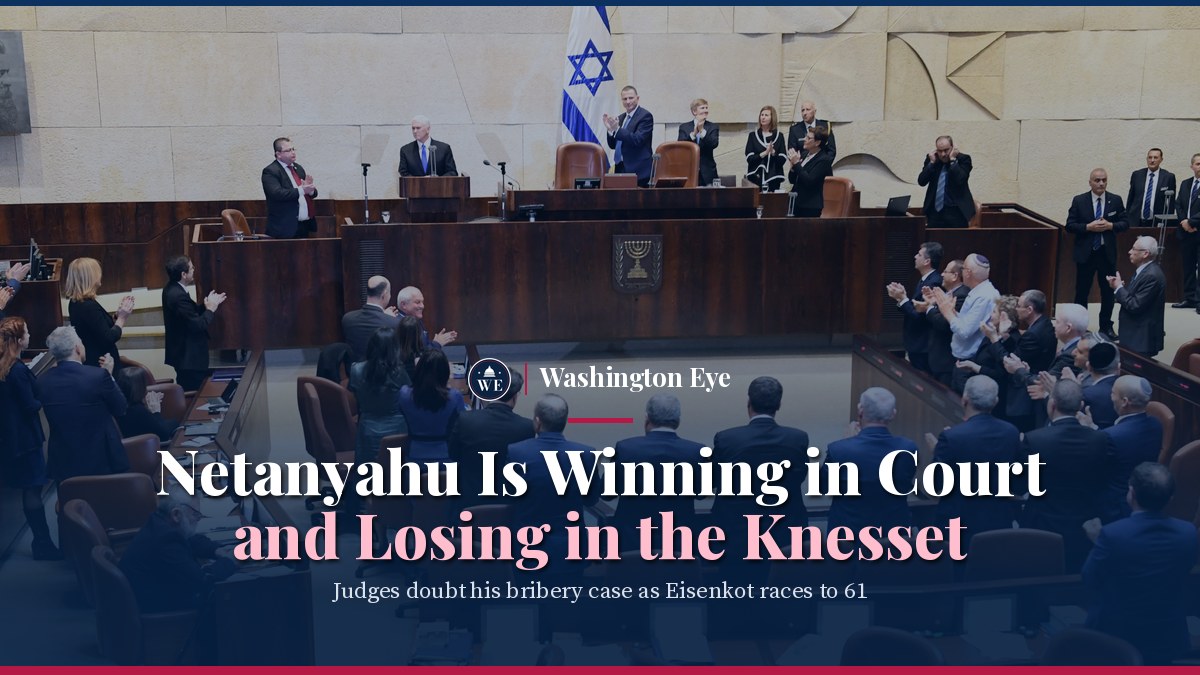
For six years, Benjamin Netanyahu has told Israelis that the corruption case against him was built on sand. On Wednesday, the three judges trying him said something uncomfortably close to that. In a hearing that lasted about ten minutes, they told the attorney general that the chances of convicting him on the most serious charges were low and that "the public interest requires a rethink" of the whole prosecution.
It was the best legal news Mr Netanyahu has had since he was indicted. It arrived in the same week that his political rival, Gadi Eisenkot, signed up two coalition partners and set a target date to swear in a government that would end the longest premiership in Israel's history. Israel's caretaker prime minister is suddenly winning in court and losing in parliament, at the same time.
What the judges actually said
Mr Netanyahu faces three cases. The gravest, known as Case 4000, alleges that he used his power over telecoms regulation to benefit Bezeq, then Israel's largest telecoms company, and its controlling shareholder, Shaul Elovitch, in exchange for favourable coverage on a news website Mr Elovitch also owned. It is the only case that includes a bribery charge, alongside fraud and breach of trust.
The Jerusalem District Court panel, Judges Rivka Friedman-Feldman, Moshe Bar-Am and Oded Shaham, had twice before, in June 2023 and again this June, urged prosecutors to reconsider the bribery count. This time they went further, casting doubt on the fraud and breach of trust charges too. "Regarding this count, we assess that the prospects of conviction are low, to a degree that justifies reconsidering the matter," they said.
Their reasons go to the heart of the prosecution's story. The claim that Mr Netanyahu ordered a senior official to help Bezeq rests largely on the testimony of Shlomo Filber, a former director general of the Communications Ministry who turned state's witness. The judges said it was difficult to base findings on his account, given his cross-examination, the changes in his version, and "objective data" that do not match it. They also voiced "serious doubt" that prosecutors had proved the website was unusually responsive to requests from the Netanyahu family, and doubted that Mr Netanyahu was shown to have known about such treatment at the time.
In Case 2000, which concerns talks between Mr Netanyahu and the publisher of a major Israeli newspaper about friendlier coverage in return for steps against a rival daily, the judges questioned whether the conduct described amounted to a crime at all. On Case 1000, which alleges that he accepted expensive gifts such as cigars, champagne and jewellery from wealthy businessmen, they did not rule out a conviction but suggested the two sides seek an agreement.
The court was careful about the limits of what it was doing. The comments, it stressed, were impressions, not a verdict, and applied to Mr Netanyahu alone, since the other defendants have not yet testified. No charge has been dismissed. That decision belongs to the attorney general, Gali Baharav-Miara, whom the judges took the unusual step of summoning in person. She said prosecutors would review the comments. Mr Netanyahu's lawyer has called for criminal mediation.
A lifeline, not an acquittal
For Mr Netanyahu's camp, Wednesday looked like vindication. His defence had spent months arguing that much of the supposed favourable coverage was routine requests for corrections or comment, many of them ignored, and that a key meeting at the centre of the bribery story could not have happened when prosecutors said it did. His allies will now say that the case should never have been brought, and that years of national division were the price of a weak indictment.
His critics will answer that the judges have not cleared him of anything. The gifts case remains alive, and any plea deal could carry legal consequences. Prosecutors have previously said that any agreement would have to include real penalties, possibly a finding of moral turpitude that could bar him from public office for years. That is precisely why Mr Netanyahu has resisted a deal.
Instead, he has pursued a pardon. He formally asked President Isaac Herzog for clemency in November 2025, without admitting guilt, and Donald Trump publicly pressed Mr Herzog to grant it. In April, Mr Herzog declined to rule on the request for now and pushed instead for mediated plea talks. The Justice Ministry's pardons department advised against clemency while the trial is still running. According to reports in Israel on Wednesday evening, Mr Netanyahu does not intend to withdraw his request, even after the judges' remarks.
Meanwhile, in the Knesset
The court's timing could hardly be more awkward for the man trying to replace him. Israel's October 27 election left no bloc with the 61 seats needed for a majority in the 120 member Knesset. Mr Netanyahu's Likud and its far right and ultra-Orthodox allies won 53 seats. The four parties around Mr Eisenkot, a former army chief who leads the centre right Yashar party, won 48. But 67 lawmakers backed Mr Eisenkot as prime minister, and Mr Herzog gave him the mandate.
This week that mandate began to look like a government. On Tuesday, Yashar agreed a coalition pact with Avigdor Liberman's right wing Yisrael Beytenu, the first formal alliance since the vote. On Thursday, after a brief walkout, the left wing Democrats led by Yair Golan agreed a preliminary deal that hands them four ministries: public security, labour and social affairs, communications, and culture and sport.
The arithmetic is still hard. One route runs through United Torah Judaism, the ultra-Orthodox party with seven seats, which would bring a minority government to 55. That government would then need one of the two Arab led parties, which hold 19 seats between them, to stay outside it and not vote against it. Mr Liberman, long a fierce critic of both the ultra-Orthodox parties and the Arab parties, has softened, saying that a government with a "clear Jewish majority" could be presented by the end of next week. Any deal with United Torah Judaism would also require a compromise on the explosive question of drafting seminary students into the army.
Mr Eisenkot's 28 days run out on Sunday, December 6. His party wants a swearing in on Wednesday, December 2, partly because December 7 is the anniversary of the death of his son, who was killed fighting in Gaza. Mr Herzog can grant a 14 day extension, to December 20, and presidents usually do. If Mr Eisenkot fails, Mr Netanyahu would get his own chance, and if nobody succeeds Israel would go back to the polls next year.
Why it matters beyond Israel
The two tracks now pull against each other. A weaker prosecution removes one of the biggest arguments against Mr Netanyahu and strengthens his hand if coalition talks stall. Officials in the Eisenkot camp, according to reports in Israel, fear he could use the remaining days to derail them, either by offering a national unity government in which he would serve second in a rotation, or through a dramatic security move such as a strike on Iran.
For Washington, that last scenario is not abstract. The United States has been fighting Iran since February, Gulf shipping lanes are again under threat, and on Thursday Kuwait blamed Iran for a drone attack that killed two Italian workers, a charge Tehran denied. Whoever leads Israel in December will help decide whether that war widens or winds down. Mr Netanyahu has been Mr Trump's closest partner in the region. Mr Eisenkot, a former chief of staff who sat in Mr Netanyahu's war cabinet before quitting it, would be a different kind of ally: no less hawkish on Iran, perhaps, but far more dependent on a fragile coalition stretching from the nationalist right to the left.
There is also a question of precedent. Israel has spent years arguing over whether a sitting prime minister on trial can govern, and over whether the courts and the attorney general were overreaching against an elected leader. A collapse of the bribery case would hand Mr Netanyahu's supporters their strongest evidence yet for the overreach argument, and would shape the fight over judicial power that has divided the country since 2023.
For now, the outcome rests on two decisions that have not been made. Ms Baharav-Miara must decide whether to drop the charges the judges have all but invited her to abandon. Mr Eisenkot must decide what price he is willing to pay to get to 61, or to govern without it. Both could land within days. The man in the middle of both stories is the one who has survived every previous attempt to write him off.