
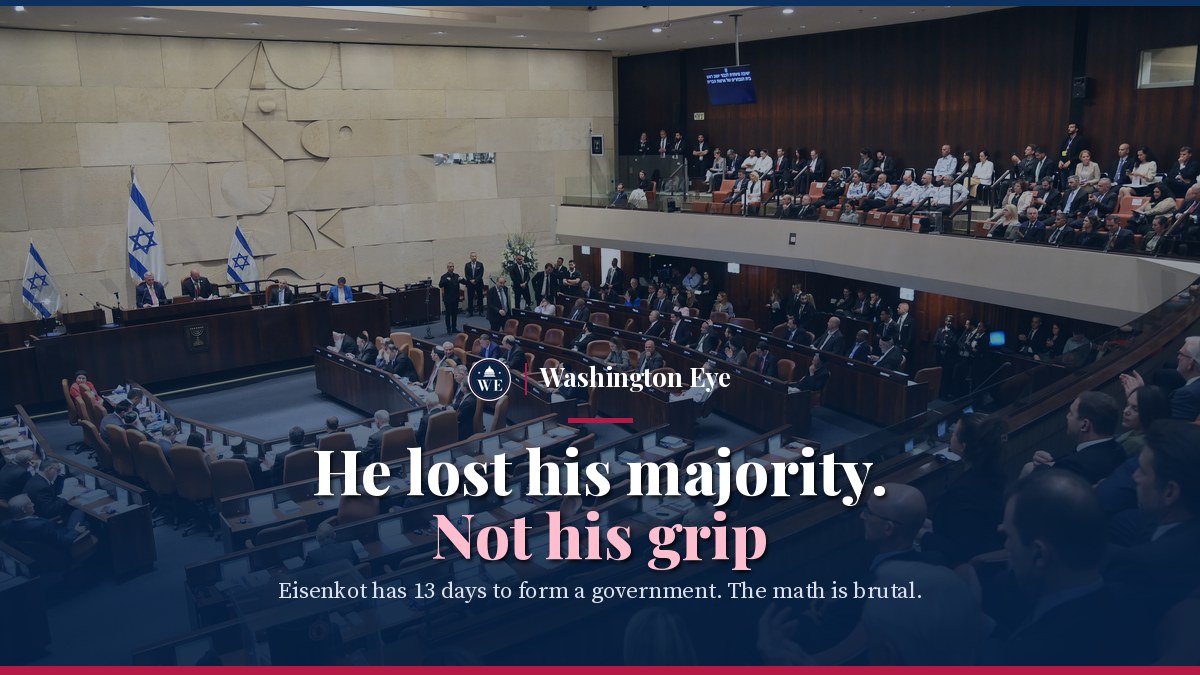
Four weeks after Israelis voted, the man they elected to lead a change of government is still counting to 61. On Sunday, negotiators for Gadi Eisenkot's Yashar party and Benjamin Netanyahu's Likud sat in a hotel in Herzliya, north of Tel Aviv, for more than four hours. They walked out with a two line joint statement saying they had "outlined their positions on a range of substantive issues" and that "a follow-up meeting will be held." No date was given. No deal was struck.
Eisenkot, a former army chief of staff, holds the mandate to form Israel's next government until December 6, thirteen days from now. Netanyahu, who lost his parliamentary majority in the October 27 election, remains caretaker prime minister until someone replaces him. That gap between losing a majority and losing power is where Israeli politics now lives. Here is what is happening, and what could happen next.
Who actually won the election?
Nobody won outright, which is the whole problem. The four party bloc led by Eisenkot, which campaigned on ending the Netanyahu era, won 48 of the Knesset's 120 seats. Netanyahu's outgoing coalition of Likud, the ultranationalist right and the ultra-Orthodox parties won 53, short of the 61 needed for a majority. Two Arab-led parties, the Joint List and Ra'am, won a record 19 seats between them: 11 for the Joint List and 8 for Ra'am.
Inside Eisenkot's camp, his own Yashar party holds 21 seats. His partners are B'Yachad, the joint list of former prime ministers Naftali Bennett and Yair Lapid, with 12; the left-leaning Democrats under Yair Golan with 8; and Avigdor Liberman's hawkish, secular Yisrael Beytenu with 7. All four leaders promised voters that Netanyahu would go. They do not agree on how to make that happen.
President Isaac Herzog gave Eisenkot the mandate on November 8, after he was recommended by his Zionist allies and by both Arab-led parties. Under Israeli law he had 28 days, which runs out on December 6, and he can ask for one extension of 14 days.
What went wrong in Sunday's talks?
Almost everything that matters. Likud sent its parliamentary faction chairman, Ofir Katz, and attorney Michael Rabilo. Yashar sent lawmaker Chili Tropper with advisers Yoav Horowitz and Guy Gutman. According to Israeli press accounts of the meeting, the two sides agreed on only two principles that were never really in dispute: that Israel is the nation state of the Jewish people, and that no Palestinian state should be established.
On the hard questions they stayed apart. Yashar demanded that Itamar Ben Gvir, the far right national security minister, be kept out of any unity government. Likud refused. Likud asked the Eisenkot bloc to freeze legislation it is already pushing through the Knesset. Yashar refused. Both sides said they could draft a framework for a state commission of inquiry into the failures before the Hamas attack of October 7, 2023, but they split over the most sensitive point of all: who would appoint its members. On military service for ultra-Orthodox yeshiva students, Likud insisted that "the Haredim need to be in the room" before anything is decided.
The biggest issue of all, who would be prime minister, was not discussed in depth. Likud has reportedly insisted that Netanyahu serve first under any rotation deal. Yashar officials have said Eisenkot would serve as prime minister for the entire term, with no rotation at all. Shortly after the meeting ended, Netanyahu posted online attacking two Arab lawmakers, Ahmad Tibi and Mansour Abbas, and urging that no government be formed with their parties.
Why is Netanyahu even in the room?
Because the arithmetic forces everyone to look at him. A unity government between Eisenkot's bloc and Likud would reach a comfortable majority without relying on either the Arab-led parties or the ultra-Orthodox. Netanyahu has publicly pushed for exactly that.
On Saturday, Likud published its terms. It demanded an end to "all personal attacks and incitement" against Netanyahu and to political "boycotts" of him and his government, a direct challenge to Eisenkot's pledge never to serve under him. It also set four principles: recognition of Israel as the nation state of the Jewish people, opposition to Palestinian statehood, keeping Israel's security zones in Gaza, Lebanon and Syria, and "a broad agreement" with ultra-Orthodox leaders on the status of yeshiva students. Its published conditions did not say outright that Netanyahu must remain prime minister.
Critics see something else at work. Netanyahu faces corruption charges, and he has opposed an independent state inquiry into October 7. A unity deal that kept him in the top job, even for a period, would protect him on both fronts. Bennett, who has backed a unity government but only under Eisenkot, said on Saturday that "the distrust of Netanyahu is justified" and that the talks would quickly show whether Likud wanted unity or was simply running down the clock. "We will not allow them to do that," he said.
What are Eisenkot's other options?
There are four realistic paths, and each one splits his own camp.
The first is the unity government with Likud, favoured by Bennett. Bennett said on Saturday that he was "committed to establishing, together with our partners, a government of national repair led by Gadi Eisenkot," and that his party "will not join him or his bloc under any circumstances," meaning Netanyahu. That statement came days after a two and a half hour meeting between Bennett and Netanyahu that both camps described as a security briefing, and that some in Eisenkot's bloc privately saw as a betrayal.
The second is a coalition with the two ultra-Orthodox parties, Shas and United Torah Judaism, which hold 13 seats between them. Added to Eisenkot's 48, that is exactly 61. Liberman, once the loudest critic of draft exemptions, now champions this route. "Netanyahu can be replaced only from the right, not from the left," he said, adding that there would be "a political and ideological price" he was willing to pay. The obstacles are large. Shas has said it is sticking with Netanyahu. The spiritual leaders of one United Torah Judaism faction, Rabbi Dov Landau and Rabbi Moshe Hillel Hirsch, reportedly rejected a proposal that would have preserved exemptions for 3% of each conscription cohort and told negotiators not to discuss any framework with "quotas or restrictions" on Torah scholars. Eisenkot's whole bloc campaigned on ending mass exemptions.
The third is a minority government that depends on outside support from Ra'am and the Joint List. Yashar officials have said both parties would get no ministries and no seat in the security cabinet. Golan has pushed hardest for this option. Liberman has said he would vote against it, warning that "a coalition that relies on the Arab parties won't last more than a few months." Ra'am's leader, Mansour Abbas, has sounded calm. "A government headed by Eisenkot will be formed, and we have not reached the point of no return," he was quoted as saying.
The fourth path is failure: the mandate expires or a confidence vote is lost, and the process moves on without Eisenkot in charge of it.
Can a minority government really pass?
Possibly, because Israeli law does not require 61 votes in favour. A new government needs more votes for it than against it in the confidence vote. That is why Yashar officials have said: "If there is no other government, we will bring the minority government to a vote in any case before the mandate expires, before December 6." An Israeli newspaper reported that the vote could come as early as November 28 or 29.
Run the numbers, though, and the margin is thin. If Netanyahu's 53 lawmakers vote no, Eisenkot needs more than 53 yes votes, or enough abstentions to change the count. All 48 members of his bloc plus Ra'am's 8 would give him 56, enough if the Joint List abstains. But if Liberman's 7 vote against, that same coalition falls to 49 against 60. Even with both Arab-led parties voting yes and Liberman voting no, the count would tie at 60 to 60, and a tie is not a win. In practice, the minority option works only if Liberman abstains or comes on board, or if Bennett's and Lapid's lawmakers hold together behind a government they have said they dislike.
What happens if Eisenkot fails?
The rules here matter more than the speeches. If Eisenkot puts a government to a vote and loses, his mandate ends on the spot, no matter how many days remain. President Herzog then has three days to hand the task to another lawmaker, and the law rules out giving it straight back to Eisenkot. The obvious candidate would be Netanyahu, though Herzog is not obliged to choose him. A second candidate gets 28 days with no extension.
Herzog could instead tell the Knesset that he sees no one able to form a government. That opens a 21 day window in which 61 lawmakers can sign a request naming a candidate, who then gets 14 days. If that fails too, the Knesset is treated as dissolved and a new election is held on the last Tuesday before 90 days run out. Through all of it, Netanyahu stays on as caretaker prime minister.
There is a quieter cost as well. The temporary Arrangements Committee, which runs the Knesset's business until permanent committees are formed, is chaired by Yashar lawmaker Roy Folkman because the law gives the chair to the faction holding the mandate. If the mandate passed to Netanyahu, control of that committee would pass with it.
Why should anyone outside Israel care?
Because the next government will make decisions that reach far beyond the Knesset. Likud's own conditions name Gaza, Lebanon and Syria, where Israeli forces hold security zones. Any government will shape how Israel handles the confrontation with Iran, the future of Gaza and its relationship with Washington, which remains its most important ally. A government led by Eisenkot has promised a state commission of inquiry into October 7 and, in Bennett's words, a limit of eight years on any prime minister's time in office. A government that keeps Netanyahu would almost certainly do neither.
Israel has held five elections in under four years before, between 2019 and 2022. Another early vote would mean months more of a caretaker government during a period of war on several fronts.
What should we watch this week?
Three things. First, whether Yashar and Likud actually set a date for a third round, and whether rotation and Ben Gvir finally reach the table. Second, whether United Torah Judaism receives and answers a new proposal on yeshiva students, which the party was reportedly expecting in the coming days. Third, whether Liberman, Bennett and Lapid signal how they would vote on a minority government if Eisenkot calls their bluff.
Netanyahu has lost the majority that kept him in office for most of the past four years. What he has not lost is the ability to make every alternative look harder than him. Eisenkot has thirteen days to prove that it is not.