
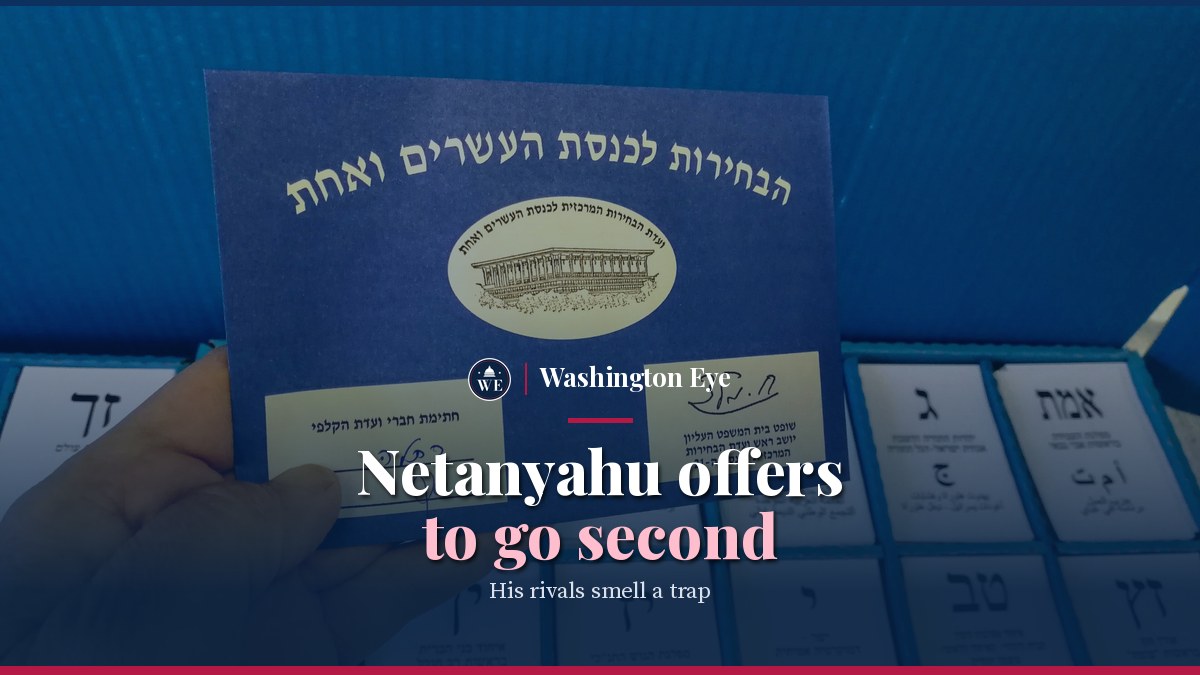
For a month, Benjamin Netanyahu has insisted on one principle above all others: the biggest party leads. On Saturday evening he gave it up. In a statement posted online after the Sabbath ended, Israel's caretaker prime minister said he would accept a rotation in which his rival, Gadi Eisenkot, serves first as prime minister in a national unity government, with Mr Netanyahu as alternate prime minister at the start of the term.
It is the largest concession Mr Netanyahu has offered since the October 27 election cost his coalition its majority. It may also be the most suspicious. Within minutes, the people Mr Eisenkot needs to form a government were calling it a trick. The question for the next eight days is whether the offer is a genuine retreat by the longest serving leader in Israel's history, or a way to run down the clock on the man trying to replace him.
What Netanyahu actually offered
The wording mattered. "Given the magnitude of the existential threat and the possibility that a government could be formed that lacks the ability to confront it, my responsibility as a leader requires me to set everything aside, including the principle that the largest party should lead," Mr Netanyahu said. He added that Mr Eisenkot would serve first, "while I serve as alternate prime minister at the beginning of the term."
He did not hide that he thinks the arrangement is upside down. Likud, he noted, is the largest party "by a large margin", with about a quarter of a million more votes than Mr Eisenkot's Yashar. Likud won 27 seats in the 120 member Knesset; Yashar won 21. "Naturally, I should lead the unity government, or at least be first in a rotation," he said. In return for stepping aside, he asked for "genuine, sincere and accelerated negotiations" and a "similar willingness" to compromise from the other side.
The statement then turned into something closer to a campaign speech. Mr Netanyahu spent much of it attacking the two Arab led parties, Ra'am and the Joint List, whose support Mr Eisenkot may need. He called them supporters of terrorism and claimed, without offering evidence, that they planned to grant citizenship to hundreds of thousands of Palestinians, create autonomous Arab zones in the Galilee and the Negev, and pull Israeli forces out of buffer zones in Gaza, Syria and Lebanon. "Without firing a single shot, hostile elements will take over the country from within," he said.
That framing tells you who the offer is really aimed at. It is less a message to Mr Eisenkot than to the voters and lawmakers on the centre right who are uneasy about a government that leans on Arab parties from outside.
Why now
The timing is not mysterious. President Isaac Herzog handed Mr Eisenkot, a former army chief, a 28 day mandate on November 8, after a majority of lawmakers recommended him. That mandate runs out on Sunday, December 6, though Mr Herzog can extend it by 14 days, to December 20. Over the past week Mr Eisenkot has signed coalition deals with Avigdor Liberman's right wing Yisrael Beytenu and Yair Golan's left wing Democrats. Only Naftali Bennett's B'Yachad, the remaining party in what Israelis call the change bloc, has yet to sign.
Mr Bennett is the hinge. He has argued publicly for a unity government with Likud, saying it would be better than a coalition that depends on ultra-Orthodox or Arab parties. According to a report on an Israeli television channel on Saturday night, he told Mr Netanyahu that if he did not offer Mr Eisenkot the first turn as prime minister by Sunday, B'Yachad would drop its push for unity and sign with Yashar. If that report is right, Mr Netanyahu did not volunteer his concession. He made it a day before a deadline set by the one partner who still had reasons to keep talking to him.
Mr Netanyahu also had a new card to play. Days earlier, the judges in his corruption trial said the chances of convicting him on the most serious charges looked low. He opened Saturday's statement by saying that "truth and justice came to light in court", and argued that many Israelis who had never voted for him now saw "no longer any justification for the boycott that prevented unity." For years the main argument against sitting in a government with him was that a prime minister on trial for bribery should not lead the country. He is betting that the argument has lost its force.
Rivals smell a trap
The answer from most of the change bloc came fast. "Enough with the tricks and games. Netanyahu lost," Mr Golan said, urging his allies to "respect the will of the voters." Mr Liberman had warned the day before that such an offer would be "merely a ploy", designed to drag out talks until the mandate expires and push Israel toward another election.
The sharpest reply came from Yair Lapid, a former prime minister who is now Mr Bennett's number two in B'Yachad. He called the offer "another transparent con by a serial fraudster who has deceived every partner and violated every agreement." His test was simple: swear in a government led by Mr Eisenkot first, and only then talk about bringing Likud in. That puts Mr Lapid openly at odds with his own party leader.
Mr Bennett himself chose a careful middle line. In a statement on Saturday night he said Mr Netanyahu had made "the right decision", but that the burden of proof that the offer was a real intention and not lip service lay with Mr Netanyahu. He listed conditions: a state commission of inquiry, an eight year limit on a prime minister's time in office, an agreement on the judicial system that stops the overhaul laws from taking effect, and a fairer share of the burden for those who serve in the army. He summed up his approach with an old Hebrew saying, roughly "respect him, and suspect him, and suspect him again", and added: "Above all, quickly."
Inside Likud, the reaction looked rehearsed. Ministers released near identical messages at the same moment, casting the choice as a test of whether Mr Eisenkot's camp loves Israel more than it hates Mr Netanyahu. One Likud lawmaker went further, framing the alternative as fulfilling the dream of Hassan al-Banna and Yusuf al-Qaradawi, two of the best known figures of the Muslim Brotherhood. The far right finance minister, Bezalel Smotrich, welcomed the offer.
The ghost of 2020
Mr Netanyahu's opponents do not have to imagine how a rotation with him can end. They remember it. In 2020, after three inconclusive elections, he signed a rotation deal with Benny Gantz, another former army chief, under which Mr Gantz was due to take over as prime minister in November 2021. The government never reached that date. It collapsed in December 2020 after failing to pass a budget, a failure that sent Israel to a fourth election and left Mr Gantz without the premiership he had been promised. Mr Gantz and his allies blamed Mr Netanyahu for engineering the collapse; Mr Netanyahu's camp blamed Mr Gantz's party.
That history is why the debate now is about guarantees, not just about who goes first. Going second can be a cheap promise when the first term can be ended early. Even Likud officials have reportedly asked how they would persuade Mr Eisenkot that a deal would be honoured this time. There is a counter example: the 2021 rotation between Mr Bennett and Mr Lapid did hand over the premiership, when Mr Lapid took office in July 2022 as that coalition fell apart. But that deal was written by people who trusted each other more than anyone in this negotiation trusts Mr Netanyahu.
Mr Eisenkot's own position is that rotation is the least of it. In a long post on Friday, he said the negotiating teams had met only five times in two weeks and that Likud had refused to back a state commission of inquiry into the failures around Hamas's attack of October 7, 2023, to remove what he called extremists from government, or to pass a law requiring military or national service for all. "The rotation is only the tip of the iceberg," he wrote. What Likud had put on the table, he said, was "the same government, the same partners, no change, no conscription law." He added: "I do not intend to cooperate with such a charade."
Saturday's offer answered the rotation question and left the rest untouched. Mr Netanyahu promised only to reach "understandings" on conscription with his ultra-Orthodox partners, the same partners whose demands sank that issue in his last government.
Eisenkot's other road
Mr Eisenkot is not short of alternatives, but none of them is comfortable. His four party bloc, including B'Yachad, has 48 seats, well short of the 61 needed. To close the gap he can turn to the two ultra-Orthodox parties, the two Arab led parties, or some mix. United Torah Judaism, with seven seats, is one option, but any deal with it would require a compromise on drafting seminary students. Officials in Yashar have said that if no deal is reached with Likud or the ultra-Orthodox, they will bring a minority government to a vote before the mandate expires, with Ra'am and the Joint List supporting it from outside, without ministers or seats in the security cabinet.
That route has its own price. It hands Mr Netanyahu exactly the argument he made on Saturday. It is also why one development on Saturday night may matter as much as the rotation offer: Ra'am's leader, Mansour Abbas, was expected to state in a television interview that Hamas is a terrorist organisation, one of Mr Eisenkot's conditions for any party joining his government. Mr Eisenkot, for his part, spent part of Saturday condemning a spate of settler attacks in the West Bank, promising to end what he called "the anarchy" there "in the coming weeks", a signal that he intends to govern on a different footing whatever coalition he builds.
Why it matters beyond Israel
For Washington, the identity of Israel's next prime minister is not a side issue. The United States has been at war with Iran since February. On Saturday, President Donald Trump said a deal with Tehran was due to be signed within a day and that the Strait of Hormuz would then be open to all, while Iran's foreign ministry said no signing date had been set. Whoever leads Israel will shape how that agreement is received, whether it holds, and how Israel acts in Lebanon, Syria and Gaza while it does.
Mr Netanyahu has been Mr Trump's closest partner in the region. Mr Eisenkot, who sat in Mr Netanyahu's war cabinet before quitting it, is no dove on Iran, but a government built on a fragile coalition from the nationalist right to the Arab parties would be a different kind of ally. A unity government with Mr Netanyahu as alternate prime minister would keep him close to the centre of power and, crucially, inside the room on security decisions.
The next test comes quickly. Mr Bennett is due to meet Mr Eisenkot on Sunday. If talks with Likud open in earnest, the mandate will almost certainly be extended. If they do not, Mr Eisenkot may try to swear in a government within days. Either way, Mr Netanyahu has changed the question Israelis are asking. It is no longer whether he will give up the top job. It is whether anyone believes him when he says he will.