
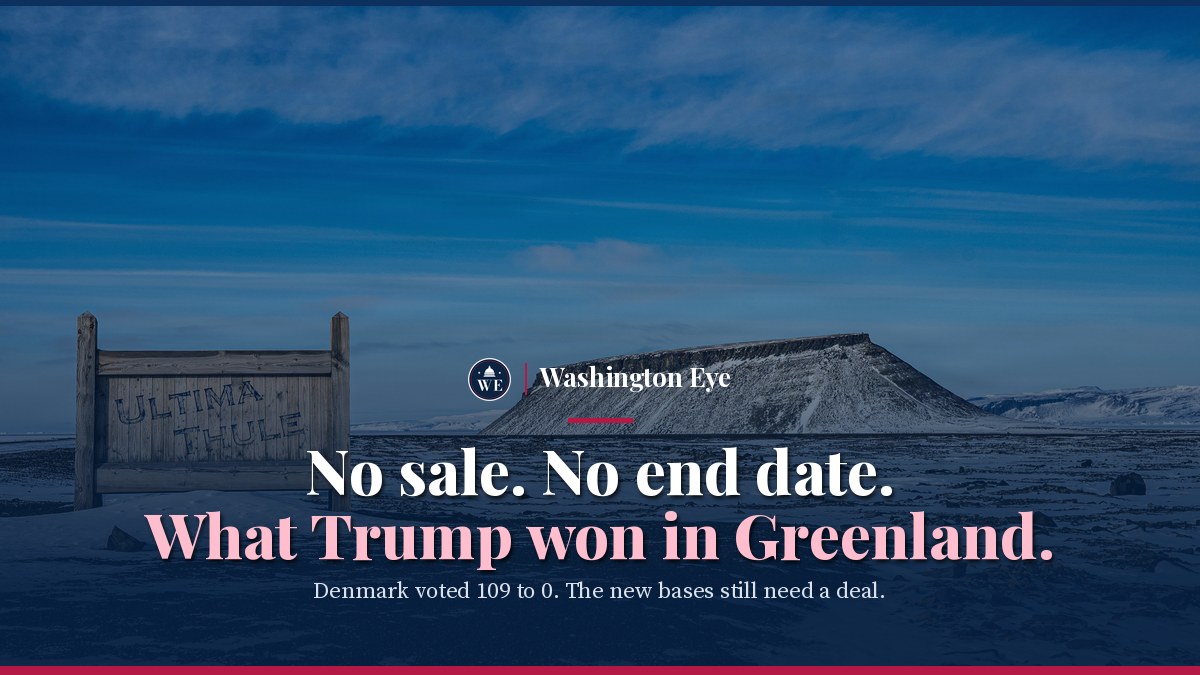
For most of this year, the question about Greenland was whether the United States would try to take it. On Thursday the Danish parliament answered a smaller, more practical question instead. By 109 votes to 0, with every member in the chamber voting yes, lawmakers in Copenhagen approved a defence pact between Denmark, Greenland and the United States. Greenland's own parliament had already backed it on November 3. Once Denmark formally tells Washington that both parliaments have consented, the agreement becomes legally binding.
President Donald Trump did not get the island. He did get something that his predecessors never had: a defence arrangement with no end date, written rights to move American aircraft and submarines around Greenland with few limits, and a formal say over which foreign investors can buy into the island's most sensitive industries. What follows is a plain guide to what was agreed, what was not, and why a deal about an ice sheet of 57,000 people matters well beyond the Arctic.
What exactly did Denmark approve?
The text is an amendment to a 1951 agreement on the defence of Greenland, the Cold War pact that gave the United States the base now known as Pituffik Space Base in the island's far northwest. Trump, Danish Prime Minister Mette Frederiksen and Greenland's Prime Minister Jens-Frederik Nielsen signed the update on September 22 at United Nations headquarters in New York, on the sidelines of the General Assembly. It could not take effect until both the Danish parliament, the Folketing, and Greenland's parliament, the Inatsisartut, consented. The Danish constitution requires that step for agreements of this kind.
The vote itself was undramatic. The Folketing has 179 seats; all 109 members present voted in favour on the second reading. Danish Foreign Minister Lars Lokke Rasmussen said afterwards: "We have now resolved our part of the equation. This is a positive development, as it removes all uncertainty surrounding Greenland and establishes a proper framework for future cooperation."
Does Congress get a vote?
No. The White House is treating the deal as an executive agreement, not a treaty, so it does not go to the Senate for the two thirds approval a treaty would need. The administration's argument is that the original 1951 pact was itself handled as an executive agreement, and this text only amends and supplements it. Denmark's parliament noted on Thursday that the president had the authority to conclude the agreement on behalf of the United States without later approval from Congress. That is a notable point for American readers: a major expansion of American military rights in the Arctic will enter force without a single recorded vote on Capitol Hill.
What does the United States actually get?
Four things stand out in the published text.
First, more bases. The United States may "modernize and expand its activities" at Pituffik, and it is allowed to establish additional defence areas at Narsarsuaq in the south and Mestersvig in the northeast. Narsarsuaq is a former civilian airport and Second World War airfield with deep water access and a long runway that American military engineers have recently surveyed. Mestersvig is a remote, far less developed outpost used by a Danish naval dog sled patrol. Either government can also propose new defence areas in future. If talks in a joint committee fail to produce agreement within 90 days, the dispute is escalated to deputy ministers and then to ministers.
Second, freedom of movement. American aircraft may fly over and land anywhere in Greenland, and American public vessels may have undersea access to and movement within Greenland's territorial waters "without restriction except as mutually agreed upon." Analysts at a Washington security think tank have pointed out that the explicit undersea language is new; the 1951 text spoke of free movement between bases by land, air and sea, but did not spell out submarines.
Third, permanence. The 1951 agreement was tied to the life of the North Atlantic Treaty. The new one has no end date and can be changed only by mutual consent. If Greenland ever becomes independent of Denmark, the agreement stays in force provided Greenland joins NATO, and an independent Greenland would take over the kingdom's obligations under it.
Fourth, a gate on foreign money. States outside NATO and the European Union, and investors from those states, are barred from gaining "significant influence" in sensitive sectors, and Washington gains a formal voice over investment from such countries in critical infrastructure and strategic industries, including the extraction of natural resources. No country outside NATO may set up its own military installations or keep a persistent military presence on the island. In practice, this is aimed at China and Russia, which Trump has repeatedly cited as the reason Greenland needs American protection.
And the Golden Dome?
The preamble says the parties share an interest in American military access to Greenland "including through establishment of a Golden Dome defense system," the missile shield Trump wants completed in the United States by 2028. That is the only mention. There is no design, no site and no deployment plan in the text. Greenland has historically been where America watches for incoming threats rather than where it shoots them down; the reference leaves room for interceptors later, but nothing in the agreement commits anyone to them.
What did Trump not get?
Ownership. The agreement reaffirms the Kingdom of Denmark's sovereignty and territorial integrity and recognises the Greenlandic people as a people under international law with the right to self-determination. No territory changes hands.
He also did not get unilateral control over new bases. The "modalities and technical details" for Narsarsuaq and Mestersvig must still be agreed by all three governments, and any further sites need the approval of both Copenhagen and Nuuk. On Thursday, Lokke Rasmussen said the United States had not yet informed Denmark of any plans to establish new military bases, despite Trump's promise at the signing ceremony that Washington would "immediately begin the process of developing a large military presence in the appropriate locations."
It is also worth remembering how much America already had. The 1951 agreement already allowed the United States to station as many troops in Greenland as it wished, and more than 100 American military personnel are permanently based at Pituffik. Denmark had said for months that it was open to a larger American presence. What it rejected was the demand for full control.
How did we get from threats to a 109 to 0 vote?
Trump first floated buying Greenland in 2019 and revived the idea before returning to the White House in 2025, refusing to rule out economic or military pressure. The crisis peaked in January. After American forces seized Venezuelan leader Nicolas Maduro, Trump said Washington would act on Greenland "whether they like it or not," and he threatened escalating tariffs on European allies until the United States was allowed to buy the island. Copenhagen reportedly sent blood supplies to Greenland, along with explosives that could be used to destroy runways, in case of an American attack.
Days later, at the World Economic Forum in Davos, Trump dropped the tariff threat, ruled out force and announced with NATO Secretary General Mark Rutte what they called the framework of a future deal. Formal talks between Washington, Copenhagen and Nuuk began at the end of January and produced the September text.
At the signing, the tone had changed completely. Frederiksen called it "a deal that can last forever." Nielsen called it a "win-win-win" and stressed that "for Greenland, it is not only an agreement about us, it is an agreement with us." Secretary of State Marco Rubio said this week that the agreement "modernizes the United States-Denmark-Greenland defence partnership and bolsters the national security of the United States and our allies in NATO." The American ambassador in Copenhagen, Ken Howery, said in a post online that he was "thrilled" by the unanimous vote and called the pact "a tremendous accomplishment."
Is everyone in Greenland happy?
No, and the margin in Nuuk tells the story. Greenland's parliament approved the deal 16 to 0, but seven members abstained. Every party backed it except Naleraq, the most prominent voice for Greenlandic independence, which won about a quarter of the vote at the 2025 election. Naleraq neither voted for nor against. Its complaints were concrete: no direct payment to Greenland for American military access, weak environmental commitments, no guarantee that service contracts would go to fully Greenlandic owned firms, and no referendum. "No economic benefit has been gained from the agreement," party chair Pele Broberg said during the debate.
The session was bitter. Greenland's foreign minister, Mute B. Egede, accused Naleraq of disclosing confidential information from a closed committee meeting; the parliament's leadership reported the matter to the police, and Naleraq answered with a motion of no confidence in Egede that every other party rejected. Egede, for his part, said he was glad and relieved, and that it had been a long road.
The agreement does try to answer the economic complaint. It says contracts for building, maintaining and servicing the defence areas should go to Greenlandic sources "to the maximum extent possible," taking into account their capacity. Greenland's committee on foreign and security policy has also asked its government to study the deal's effects on jobs, education, the environment and affected local communities, and to report to lawmakers at least once a year.
Even supporters in Copenhagen admit the damage of the past year has not vanished. "There is a significant task of rebuilding ahead," Lokke Rasmussen said of trust between Denmark and the United States. "But this will take place within the framework of an agreement, which is a good thing."
Why should anyone outside the Arctic care?
Because Greenland sits on the shortest route between North America and Europe, and that geography is becoming more valuable, not less. Missile threats are shifting from simple ballistic arcs to manoeuvring weapons such as hypersonic glide vehicles and cruise missiles, and any serious shield over North America needs sensors and, perhaps, interceptors far to the north. The island's mineral wealth, which Trump has cited alongside security, is the other reason Washington wanted a say over who invests there.
For Europe, the deal is meant to close a chapter that put the alliance under unprecedented strain: an American president openly threatening the territory of an ally. It does so on Denmark's terms on sovereignty and on America's terms on access. NATO welcomed the agreement in September, saying it would "help advance security, stability and cooperation in this vital region."
For the United States, the lesson is double edged. The pressure campaign produced more than quiet diplomacy had in decades: permanent rights, new sites and a veto over Chinese and Russian investment. But it also left a close ally checking its runway demolition plans, and it was achieved without Congress. The next tests are practical. Watch for the formal Danish notification to Washington, the first technical talks on Narsarsuaq and Mestersvig, and whether the Pentagon names Greenland in its Golden Dome plans. Until then, the deal is a framework with a great deal of empty space on the map, which, in Greenland, is fitting.