
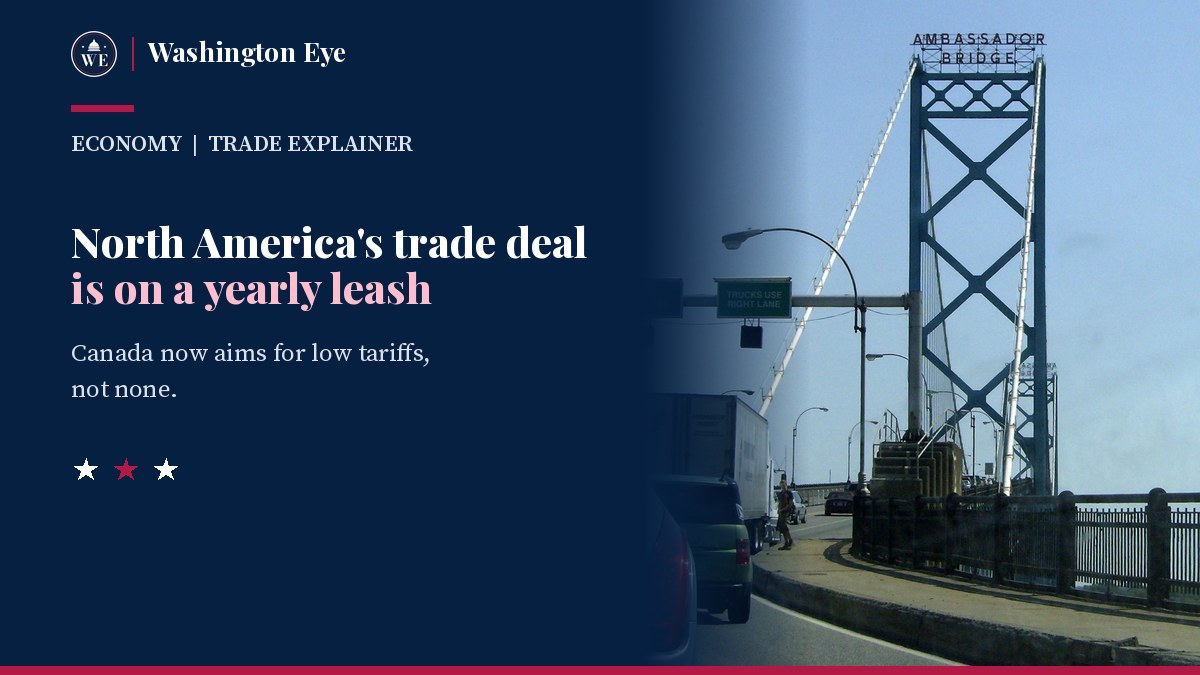
On Tuesday, Canada's chief negotiator with Washington sat before a parliamentary committee in Ottawa and said out loud what many trade lawyers had suspected for months. The goal is no longer a return to tariff-free trade with the United States. "I have suggested that we are trying to get to the lowest rate of tariffs on the narrowest basket of goods, with the most preferential access for Canadian businesses and Canadian workers," Janice Charette told lawmakers. The other side of the table, she added, has "shown to date an unwillingness to enter into any arrangement in which there is full tariff-free trade."
A day later, in Shenzhen, Mexican President Claudia Sheinbaum emerged from a meeting with President Donald Trump on the sidelines of the Asia-Pacific summit and said talks to ease US tariffs were "very far along." Two neighbours, two very different moods, and one agreement that is supposed to bind all three countries together.
That agreement, the United States-Mexico-Canada Agreement, is still legally alive. But since July it has been living on a much shorter leash, and the tariffs layered on top of it now matter more to factories, farmers and shoppers than the treaty's own rules. Here is how North American trade got here, what the tools in the fight actually are, and why a Democratic Congress arriving in January may find it harder to change course than its campaign speeches suggested.
What happened to the trade pact in July?
The pact took effect on July 1, 2020, with a built-in sunset that its predecessor never had. It runs for 16 years, to July 1, 2036, and requires the three governments to sit down for a formal joint review on its sixth anniversary. If all three confirm they want to continue, the clock resets for another 16 years.
On July 1, 2026, that review took place by video link. Canada and Mexico both said they wanted to extend. The United States did not. In a statement that day, the US Trade Representative, Jamieson Greer, said Washington "did not agree to renew the USMCA in its current form" and that "the USMCA is not renewed," while adding that the agreement "remains in force pending resolution of these issues or until the Agreement's termination."
That refusal did not kill the deal. Preferential tariffs, rules of origin and dispute settlement all still apply. What it did was switch on a different clause. The three governments must now hold a joint review every single year until they either agree to extend or the agreement expires in 2036. The next one is due by July 1, 2027, and the trade office is already collecting public comments for it, with a deadline of January 12. The leaders can also agree to a fresh 16-year term at any time with a written confirmation, no renegotiation required. In practice, that turns the extension into a bargaining chip that Washington can hold back for as long as it likes.
Why is Canada being treated so differently from Mexico?
The two tracks split sharply over the summer. Washington and Mexico City held bilateral negotiating rounds starting in May, covering car rules of origin, steel and aluminium, and what both sides call economic security. Canada joined the July review meeting but did not begin the same kind of text-based talks.
Then, on July 20, the president reached for a law no president had used to impose tariffs before. Section 338 of the Tariff Act of 1930 lets the White House add duties of up to 50 percent on a country found to be discriminating against American commerce. Mr Trump signed three proclamations at once, putting a 50 percent tariff on nearly $20 billion of Canadian goods, roughly 5 percent of everything the United States buys from Canada. The administration cited three grievances: Canadian cheese quotas that it said favour European exporters, Canadian retaliatory tariffs aimed only at American vehicles, and provincial boycotts of American alcohol. Wine, cement, dairy and even hockey equipment ended up on the list. The duties took effect in August.
Canadian officials say summer talks then collapsed over what they called unreasonable last-minute demands from Washington. More US tariffs followed, and Ottawa answered with countermeasures. On November 1, Prime Minister Mark Carney said in a post online that the two teams would start working again. Three senior Canadian officials have since said that Dominic LeBlanc, the minister in charge of the US relationship, now meets his US counterparts weekly in a more formal way, with regular phone and video calls involving Mr Greer and Commerce Secretary Howard Lutnick, though he has not travelled to Washington since talks restarted. There is no formal deal on the table. Autos and steel remain the main sticking points.
Mexico, by contrast, has the warmer channel. Its officials say their first priority is relief from the national security tariffs on steel, aluminium and cars, and they point out that about 80 percent of Mexican exports already enter the United States duty free under the pact. The stakes are enormous: the two countries traded about $779 billion in goods in the first nine months of this year. Even so, the relationship is not calm. Last week Mr Trump threatened to double tariffs on Mexico if it failed to stop migrant caravans heading north. Mexican officials say the caravan in question is still far to the south in Chiapas and had shrunk to 781 people by Tuesday. Ms Sheinbaum says she will see Mr Trump again at the Group of 20 meeting in Miami in December.
Which tariffs are actually in force now?
The legal map has changed more this year than at any point since the trade war began. On February 20, the Supreme Court ruled that the International Emergency Economic Powers Act did not authorise the sweeping tariffs the president had imposed under it in 2025. Importers who had paid them are now pursuing refunds on roughly $166 billion in duties, and the government has appealed an order for universal refunds.
The White House moved quickly to fill the gap. It imposed a temporary 10 percent universal tariff under Section 122 of the Trade Act of 1974, a balance-of-payments power capped at 150 days. When that expired on July 24, the trade office replaced it the same day with tariffs on about 60 economies, set at 10 or 12.5 percent, under Section 301, justified by investigations into forced labour. Unlike the Section 122 duty, those have no fixed end date.
Layered on top are the product tariffs under Section 232, the national security law, on goods such as steel, aluminium and cars, which are exactly the ones Canada and Mexico most want removed. Add the Section 338 duties on Canada, and North American trade now runs on a patchwork of statutes rather than a single treaty. By one university budget lab's count, the average US tariff rate has climbed from around 2.5 percent when Mr Trump returned to office in January 2025 to 11.2 percent now. One tax research group estimated that, as of August, the tariffs were adding an average of $820 a year to household costs.
Has the midterm result changed the administration's mind?
Not so far. In a television interview on November 12, Mr Greer was asked about the Democratic gains. "We have to rebalance global trade," he said. "So with Democrats gaining in the midterms, that has not changed the fact that we have a trillion-dollar trade deficit, or that China has a trillion-dollar trade surplus." He also argued that tariffs are too small to move prices much, noting $130 billion in tariff revenue in the first half of the year against roughly $13 trillion in total consumption. And he waved away business complaints about uncertainty. "Sometimes when people say they want certainty, they're saying, 'I want to go back to no tariffs. I want to import freely from China and other places,'" he said. "That's not going to happen."
That fits what Ms Charette described in Ottawa. "The United States is reorienting and reordering its trade relationship with every country on the world," she said. "This is not just about Canada." Every country that has struck a deal with Washington, she noted, has had to accept some level of tariff.
What can the new Democratic Congress actually do?
Democrats ran hard against tariffs as a cost-of-living issue, and they won. When the new Congress is sworn in during January, they are expected to hold roughly 260 House seats and 56 in the Senate. "We need to stop the Trump tariffs that have increased costs on everyday Americans by thousands of dollars," Hakeem Jeffries, the House Democratic leader, told reporters after the election.
The bills are already written. One, sponsored by Chuck Schumer, the Senate Democratic leader, would repeal both Section 122 and Section 338, the two powers used for the stopgap universal tariff and the Canada duties. A broader bill from Senator Ron Wyden of Oregon, the top Democrat on the Senate Finance Committee, would require Congress to approve new tariffs under Sections 232, 201 and 301, scrap Sections 122 and 338 entirely, and create a joint committee on tariffs and trade to vet presidential proposals. Mr Wyden and Representative Richard Neal of Massachusetts have also opened oversight, asking Mr Lutnick on November 12 to preserve all records from the national security investigation behind tariffs on imported semiconductors.
The problem is arithmetic. Neither majority comes close to the two thirds needed to override a veto, and the president has made sure everyone knows it. "I have the ultimate power, it's called 'veto,'" Mr Trump said in a television interview after the election, and he posted a picture of a red campaign-style hat with the word VETO printed on it. Several Republican critics of the tariffs, including Senators Susan Collins and Thom Tillis and Representative Don Bacon, are leaving Congress, which thins the pool of possible override votes further.
Some trade lawyers expect Democrats to aim narrower. Arun Venkataraman, a former senior Commerce Department official, said he sees more support "for specific tariff actions than they are to do a broadside against underlying" authorities. "I think that perhaps the more focused and strategic approach is to address particular tariffs and then be able to get Republican support for some of that," he said. Tariffs on Canadian goods, which hit border states and farm states hard, are an obvious first test.
What should North America watch next?
Three dates matter. The Group of 20 meeting in Miami in December will show whether Mexico's "very far along" talks turn into relief on steel, aluminium and cars. The January 12 comment deadline and the arrival of the new Congress will show how loudly American manufacturers, farmers and retailers push for a quick extension of the pact. And July 1, 2027 brings the next annual review, the first chance for Washington to sign off on a new 16-year term, or to hold it back again.
Until then, the deal that was sold in 2020 as a guarantee of stability now works more like a lease renewed one year at a time. Ottawa has quietly adjusted its sights from tariff-free to tariff-light. Mexico is betting on personal diplomacy. And for American families, the bill for that uncertainty is already showing up at the checkout, whatever happens in the next round of talks.