
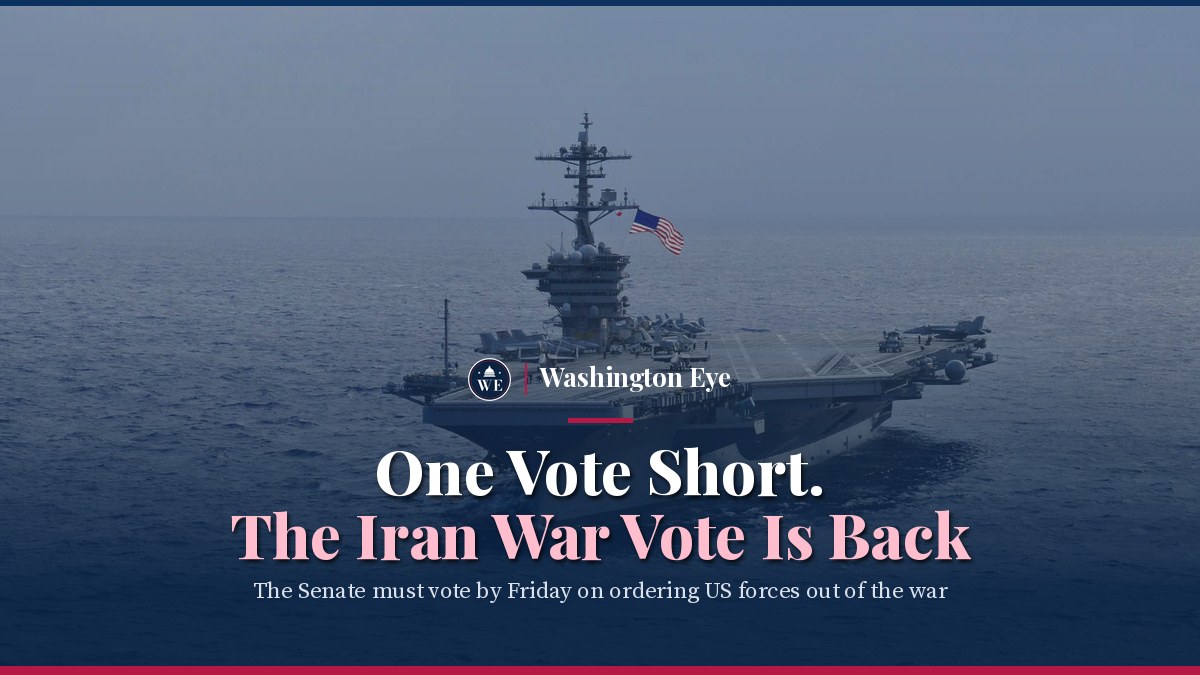
In September, the Senate came within a single vote of telling President Trump to bring American forces home from the war with Iran. The tally was 49 to 50. Four Republicans crossed over, one Democrat crossed the other way, and one Democrat was absent. The war went on. This week, by Friday at the latest, senators get to vote on it again.
The measure is House Concurrent Resolution 93, sponsored by Representative Seth Moulton of Massachusetts. The House adopted it on September 15 by 220 votes to 204, with every Democrat who voted backing it and seven Republicans joining them. It then sat in the Senate Foreign Relations Committee for two months. On November 9, Senate leaders agreed by unanimous consent to pull it out of committee and bring it to the floor no later than Friday, November 20, with six hours of debate split between the parties and then a straight vote on adoption.
Plenty of people in Washington will tell you this vote does not matter. A concurrent resolution never reaches the president's desk, so he cannot veto it, but administrations of both parties have argued for decades that this route under the War Powers Resolution is unconstitutional and cannot bind them. A 1983 Supreme Court ruling against legislative vetoes is the main reason most lawyers agree. Even if the resolution passes, the carriers will not turn around on Saturday morning.
That is all true. It is also beside the point. This is the first recorded vote on the war since voters delivered their verdict on November 3, and every senator who casts it will be telling the country whether they heard that verdict or not.
What the voters said
Democrats did not win the Senate by talking about procedure. They flipped at least seven Republican seats, including Texas, Kansas, Iowa, Ohio, Maine, North Carolina and South Carolina, and picked up dozens of House districts, many of them places Mr. Trump carried easily two years ago. Voter surveys pointed to three drivers: living costs, alleged corruption and the war. Those first two are hard to separate from the third. Gasoline and diesel prices surged as the conflict stretched past six months, and House Democratic leader Hakeem Jeffries has blamed what he calls a "reckless and costly war of choice in Iran" for pushing up fuel and fertiliser costs and, through them, grocery bills.
The most striking admission came from inside the administration. Vice President JD Vance wrote in a post online after the election that "the reason we lost is the war." Asked about that, Mr. Trump did not dispute it. "I think it's largely true because it drove the gasoline up a little bit short term," he said, before adding that he "would have done nothing different."
The public has been less forgiving. A national poll released a week after the election found that 71 percent of Americans want Congress to pass legislation ending the conflict, including 93 percent of Democrats and 51 percent of Republicans. A majority of the president's own party, in other words, now wants lawmakers to do the thing the Senate fell one vote short of doing in September.
A war that is "effectively over," except it is not
The White House has an answer ready: the war is winding down anyway. After meeting Qatar's prime minister at the White House on November 9, Mr. Trump said American military operations against Iran were "effectively over." If that were the whole story, the resolution would be a formality.
It is not the whole story. On Sunday, the aircraft carrier USS Theodore Roosevelt arrived in the region, joining the USS George H.W. Bush and the USS George Washington, three carrier groups enforcing a naval blockade of Iranian shipping. Iran, after a two-month lull in direct attacks, has claimed a strike on an American radar system in Bahrain, and a tanker was hit for a second time near the Strait of Hormuz on Tuesday, leaving its crew unaccounted for. Qatar's foreign ministry warned the same day that the escalation posed a "grave danger" to any deal.
Meanwhile the president has stepped back from the diplomacy that might end the war on paper. In a post online last week he said, "We don't need a deal with Iran. Those days have long since passed," and announced that he had asked Mr. Vance, who had been leading renewed outreach to Tehran, to turn his attention to a task force on welfare fraud instead. Officials close to the mediation say the two sides' core demands are no longer far apart. The White House response has been to rely on the blockade and wait.
That is what a war without an end date looks like: fewer headlines, more ships, no exit plan and no vote. The War Powers Resolution of 1973 was written for exactly this situation. It gives a president 48 hours to notify Congress after sending forces into hostilities and caps any unauthorized engagement at 60 days, with a 30-day grace period to withdraw safely. The conflict began in late February. Nobody in the administration seriously argues that Congress has authorized it since.
Count the votes
The September arithmetic is the reason this week matters. Senators Susan Collins of Maine, Lisa Murkowski of Alaska, Rand Paul of Kentucky and Thom Tillis of North Carolina voted with Democrats. Mr. Tillis, who leaves the Senate early next year, explained his first yes vote in plain legal terms: 60 days had passed since the administration told Congress in July that military action against Iran had restarted. Senator John Fetterman of Pennsylvania was the only Democrat to vote no, and Senator Angela Alsobrooks of Maryland did not vote.
Run the same lineup with full attendance and the count is 50 to 50. Under Senate rules a tie fails, and the only person who can break it is the vice president, the same man who says the war cost his party the election. It is hard to imagine a sharper test of whether the people in charge mean what they say after a defeat.
There is also a quieter group to watch. Several Republican senators are serving out their final weeks after losing their seats or choosing to retire. They no longer face a primary electorate, and the general electorate has already spoken. Senator Bill Cassidy of Louisiana voted for an Iran war powers measure in June, then changed his vote after a heated private meeting with the president, and voted no again in late September after huddling with party leaders off the floor. Whether lame-duck Republicans feel freer this week, or more loyal, is the open question of the vote.
Why a symbolic vote still counts
Critics of these votes, on both sides, call them messaging exercises. The better word is record. Since the war began, Democrats have forced more than a dozen votes on it. In June, the same four Republicans helped the Senate adopt an earlier House-passed resolution, a rebuke that lasted about a day: after a contentious meeting with the president, key Republicans shifted and a follow-up effort fell short. Each vote has made it harder for senators to claim the war happened around them rather than with their consent.
This one would carry more weight than the rest because of what comes next. The government's current funding runs out on December 11. Senator Tim Kaine of Virginia, who has led the Senate push against the war, has said the goal is to "cut off funding for the war, unless the president is able to convince Congress to authorize it," and that the cutoff language belongs in next month's spending bill. Senators Chris Van Hollen of Maryland, Michael Bennet of Colorado, Bernie Sanders of Vermont and Tammy Duckworth of Illinois have said in a joint statement that "when we vote on appropriations, we intend to fund the government and stop funds for this war."
There is precedent. In 1973, Congress ended American combat in Southeast Asia with a provision in a stopgap spending law barring funds for "combat activities by United States military forces in or over or from off the shores of North Vietnam, South Vietnam, Laos or Cambodia." That is the power the Constitution actually gives Congress, and it does not depend on any contested reading of the War Powers Resolution.
But a funding fight is easier to win when the Senate has already said, on the record, that the war should stop. Democratic leaders have not yet agreed on how hard to push in December. Senator Patty Murray of Washington, the top Democrat on the Appropriations Committee, has said the party is exploring "every tool" but cannot end the war "with the snap of our fingers." Senate Democratic leader Chuck Schumer has promised that "we are going to end the war" and called the power of the purse "one of the ways of deterring a president who does war without the consent of the American people," without endorsing the harder line. A majority vote this week would hand the December negotiators something they do not have now: proof that a majority of the Senate already agrees with the voters.
The vote voters are waiting for
The objection that the resolution "does nothing" misunderstands what Congress is for. War is the one decision the Constitution assigns first to the legislature, precisely so that the people who send Americans into danger have to answer to the people who pay for it. For nine months, the Senate has let the president make that decision alone. On November 3, voters made clear they noticed.
Six hours of debate and one roll call will not end the blockade or bring a carrier home. They will show whether senators of both parties are willing to put their names next to the war they have allowed to continue. Last time, the answer was one vote short. Voters have since made their view plain. The least the Senate owes them this week is a yes.