
Republicans lost both chambers of Congress on 3 November, and within a week the most important man in the party admitted something rare. In a television interview, President Donald Trump said his deportation drive might have been "too tough", and suggested that hard working immigrants with jobs in hotels and landscaping, people whose only offence was crossing the border illegally, should perhaps be allowed to stay. His Homeland Security Secretary, Markwayne Mullin, said the next day that permanent legal status for people protected under the Deferred Action for Childhood Arrivals programme could be on the table in a deal with Democrats. Then the door started to close. On 9 November the President told reporters: "There won't be amnesty." He had already promoted Stephen Miller, the architect of his immigration crackdown, to White House chief of staff.
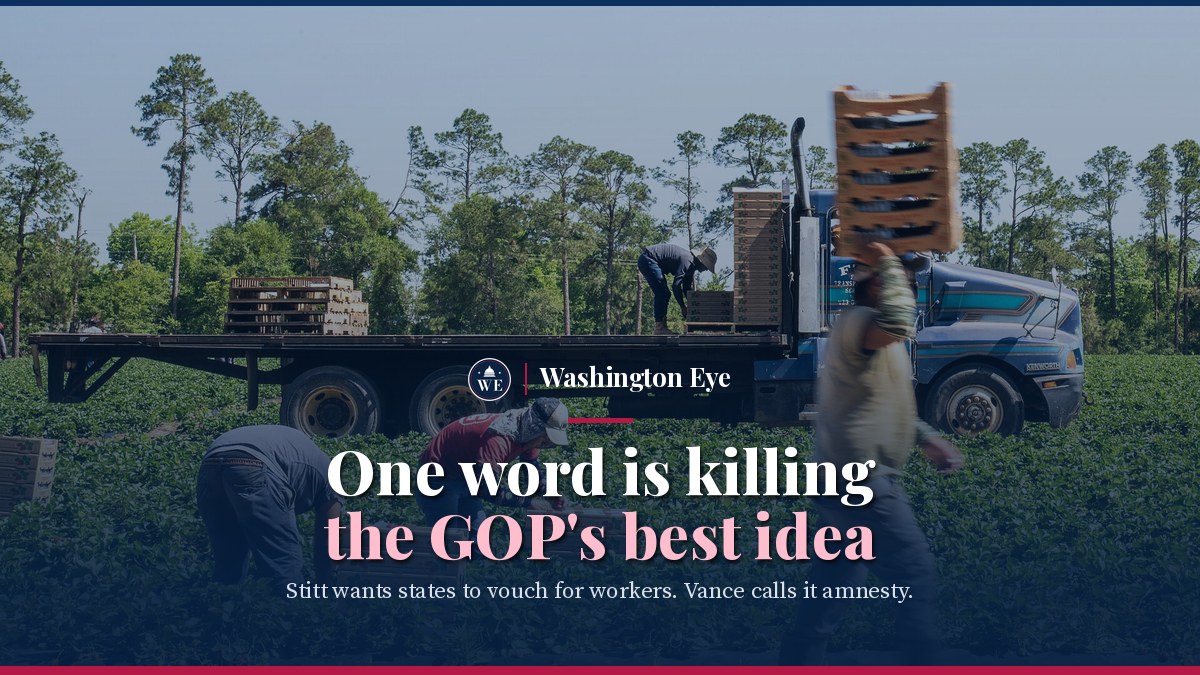
Into that confusion stepped Kevin Stitt, the Republican governor of Oklahoma and a former chairman of the National Governors Association, with the most conservative immigration idea anyone has floated in years. And a likely 2028 presidential contender in his own party answered him with a single word.
We think the governor is right, and the word is wrong. If Republicans let "amnesty" end this conversation, they will not stop immigration reform. They will simply guarantee that a Democratic Congress writes it without them.
What Stitt actually proposed
Strip away the noise and the Oklahoma plan is short. Secure the border, which Stitt credits Mr Trump with doing. Remove criminals, which almost everyone in both parties supports. Then let governors vouch for workers that employers in their states genuinely need, through a legal, federally sanctioned workforce permit. No citizenship. No green card by the back door. No forgiveness for crimes beyond the original illegal entry.
"To me, we're overthinking it," he said at a forum for new governors in Park City, Utah, on 18 November. "It's as simple as, if an employer is vouching for an employee, the state governors should be able to issue that workforce permit. Period, end of story." He added that he does not believe in "just automatically giving U.S. citizenship" and that Washington keeps failing because "each side thinks they're winning on it". That, he argued, is "why you saw this huge swing in the midterms."
This is not a new conversion. In February, as chairman of the governors' association, Stitt was already making the case that "I'm closer to the agricultural needs of Oklahoma than somebody in Washington, DC," and that a Democratic governor such as Maryland's Wes Moore understands his state's fisheries better than any federal office. His pitch then, as now, was a bipartisan bloc of governors forcing Congress to act.
The one word answer
Vice President JD Vance replied the next morning in a post online. "I like Kevin, but what does 'bipartisan immigration reform' mean?" he wrote. "If you mean making it harder for megacompanies to defraud our visa system, great. If you mean we should pass legislation to make it harder for employers to violate our immigration law, I'm all ears. But to a lot of people, this sounds like an effort to give amnesty to people who have broken our laws. It is morally and electorally disastrous."
Notice what the Vice President did not say. He did not say the plan was amnesty. He said it "sounds like" amnesty "to a lot of people". That is a political forecast, not a policy argument, and it is the kind of forecast that 3 November should make every Republican strategist a little more humble about.
Stitt hit back in a newspaper column on 25 November. "I have never called for amnesty," he wrote. "But the vice president and his allies use the word like a dog whistle for an online audience. It confuses the issue and, by design, shuts down a debate that deserves rigor." He listed his own record: Oklahoma Highway Patrol operations under the federal 287(g) enforcement programme, support for ending birthright citizenship, backing for the state House Speaker's push to end state welfare benefits for non citizens. Then came his sharpest line: "If our country ever drifts toward citizenship without people paying their dues, it will be because Republicans did not finish the job of reforming the system when we held a full majority."
That last sentence should sting, because it is simply true. Republicans held the House, the Senate and the White House for two years and did not pass a workforce visa overhaul. On 3 January they lose two of the three.
Why this is a conservative idea
Conservatives have spent decades arguing that Washington is too far from the farms, factories and small towns it regulates, and that states are better laboratories for policy. On immigration, the states are already acting like laboratories, whether Washington likes it or not. When new federal Medicaid eligibility rules for many lawfully present immigrants took effect on 1 October, eight states, six of them Democratic trifectas, chose to pay for replacement coverage themselves, according to a review by an election research group. Ten states, eight of them Republican trifectas, went the other way and added extra citizenship verification and reporting. In Texas, outgoing Governor Greg Abbott froze new H-1B visa petitions at state agencies and public universities from January 2026, and the Democrat who beat him, Gina Hinojosa, has promised to lift that freeze when she takes office on 19 January.
States, in other words, already shape who works where. What they cannot do is grant work authorisation. The Supreme Court has struck down state immigration laws as an intrusion on federal power since 1875, and nothing in Stitt's plan pretends otherwise. That is the point of asking Congress. A state permit would exist only because federal law created it, with federal background checks, federal caps and federal power to revoke it. That is federalism in its proper form: Washington sets the rules and the borders, and the states, which actually know their labour markets, help decide who fills the jobs.
Other countries have done versions of this for years, which is presumably what Stitt meant when he said "Other countries have figured this out." Canada, for example, lets its provinces nominate economic migrants for the needs of their own regions while the national government keeps the final say on security and admission.
Utah already tried, and Washington said no
Republicans also do not need to look abroad. In 2011 Utah's Republican legislature passed HB116, a state guest worker programme that would have let immigrants already living in the state without legal status obtain a permit by paying a fine, passing a background check and showing English proficiency. A Republican governor, Gary Herbert, signed it. Its sponsor said one purpose was to show Congress that a rational solution was possible. It never took effect, because successive federal administrations never granted the waiver it needed. Utah lawmakers were still lamenting that this year, and a 2026 bill to repeal it died in the state Senate.
In 2019 a Utah Republican congressman, John Curtis, now a senator, tried the federal route with a pilot programme that would have let states opt in and sponsor three year work visas, with allocations matched to each state's economy. It went nowhere. The idea has been sitting on the shelf, with conservative fingerprints all over it, for fifteen years.
Vance's worries deserve answers, not a veto
None of this means the Vice President's concerns are empty. He is right that large companies have gamed temporary visa programmes, and right that employers who knowingly hire illegally face too little risk. He is also right that a permit for people already here illegally is the hardest part of any deal to sell, and that the Utah law included exactly that group.
But those are design problems, and conservatives should be the ones solving them. A serious Republican version of the Stitt plan would tie every state permit to a named employer and a verified job, require mandatory electronic employment verification for any business that uses the programme, set hard annual caps, bar permit holders from federal welfare, and make the permit expire the moment the job or the clean record does. It would grant no status that counts toward citizenship. It would include tough penalties for the "megacompanies" Mr Vance says he worries about. Every one of those conditions is something the Vice President said he is "all ears" to hear.
Calling that amnesty does not make it amnesty. Amnesty, in the sense voters fear, means forgiving the breach and rewarding it with permanent status. A revocable, capped, state sponsored work permit with no route to citizenship is closer to the opposite: it brings people into a system where they are known, taxed and removable.
The real electoral disaster
The politics cut against the Vice President, too. Mr Trump himself floated relief for long settled workers. His Homeland Security Secretary opened the door on the roughly 436,000 people with active protection under the childhood arrivals programme, according to federal figures compiled by an immigration advocacy group. A bipartisan Dream Act from Senators Dick Durbin and Lisa Murkowski is already written. When a Democratic Congress takes over in January, a deal of some kind is likely to be on the table whether Republicans want one or not.
Republicans can meet that moment with a plan that puts governors, employers and enforcement at the centre, or they can meet it with a slogan. A slogan will not stop a Democratic majority from passing a broader bill and daring the White House to veto popular protections for workers and childhood arrivals. A governors' plan might actually shape the result.
Kevin Stitt is a term limited governor who ends his time in office in January 2027. He is not running against JD Vance for anything. That is what makes his argument worth hearing. He is telling his party, from a deep red state whose farmers, manufacturers and aerospace employers need workers, that the choice is no longer between reform and no reform. It is between reform written by Republicans and reform written without them.
One word should not settle that choice. The Vice President asked what bipartisan immigration reform means. Oklahoma's governor has given him an answer. Republicans should take it seriously before Democrats take it over.