
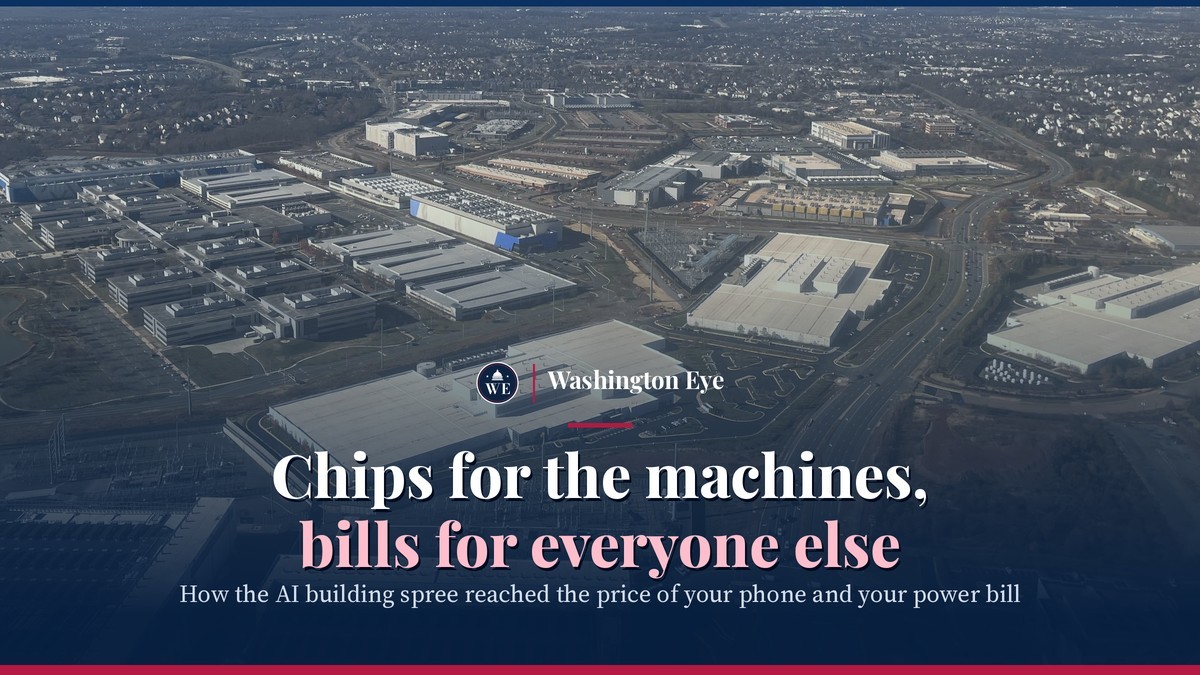
For most of the past three decades, consumer electronics were the one corner of the American budget that reliably got cheaper. A new phone, laptop or television usually cost the same or less than last year's model while doing more. October broke that pattern in a way the government's statisticians had never recorded before.
Smartphone prices rose 1.4 percent from September to October, the largest monthly increase on record, according to the consumer price index released on Tuesday. Computer prices climbed 0.5 percent. Television prices jumped 3.3 percent in a single month. Economists who track the data have a short explanation for all three: the scramble to build the data centers that run artificial intelligence is now competing with households for the same parts, and households are losing.
That finding matters well beyond the electronics aisle. It adds a new and stubborn ingredient to an inflation problem the Federal Reserve was already struggling to contain, and it lands just as Congress, fresh from an election in which data centers became an unlikely campaign villain, is trying to decide who should pay for the AI build-out.
The headline numbers were bad enough on their own. The consumer price index rose 0.4 percent in October after seasonal adjustment, above the 0.3 percent economists had expected. It followed a 0.6 percent jump in September. Core prices, which exclude food and energy, rose 0.3 percent for the third month in a row, roughly 50 percent faster than the monthly pace consistent with the Fed's 2 percent target.
The Bureau of Labor Statistics did not publish a year-over-year figure this time, because last year's long government shutdown disrupted its data collection for October 2025. Private estimates put the annual rate at about 4 percent, up from 3.7 percent in September.
Economists have spent most of the year blaming three forces for that climb: tariffs, the oil shock from the war with Iran, and housing costs. October's report forced a fourth onto the list. "Core inflation today reflects three outsized shocks: tariffs, energy prices, and AI-related demand," Josh Hirt, a senior US economist at the asset manager Vanguard, wrote in a note after the release.
Thomas Ryan, a senior North America economist at Capital Economics, has pointed to the mechanism. The data center boom, he said, has created a shortage of technology equipment such as the memory chips that go into household devices like iPhones.
The memory market is unusually concentrated. Three companies, Samsung Electronics, SK Hynix and Micron Technology, make more than 90 percent of the world's memory chips. According to Ramon Llamas, a research director for mobile devices at the market research firm IDC, all three made the same decision in late 2025.
"There are three primary manufacturers of memory, and in late 2025, all of them pivoted the vast majority of their supply towards AI centers instead of consumer electronics," he said in an interview this autumn. "Scarcity of memory has driven up prices for memory, and those price increases have been passed on to the consumer."
The scale of the spending on the other side of that trade explains why the chipmakers chose as they did. The ratings firm S&P Global estimates that capital spending by the largest American cloud and AI companies will exceed $1.3 trillion in 2027, up from a projected $870 billion this year and $470 billion in 2025. A phone maker ordering memory for a mid-range handset cannot outbid that.
The results show up first at the bottom of the market. One technology research firm estimates that prices of existing smartphone models have risen about 15 percent worldwide this year, with newly launched models roughly 25 percent more expensive than a year ago. Shipments of phones costing under $100 fell almost 60 percent year over year in the second quarter, by another firm's count. Americans have so far been partly shielded, with US phone prices up about 5 percent this year, but October's record monthly jump suggests that cushion is thinning.
Memory is only one channel. A national news agency's analysis of the October report noted that data center construction has also driven up the cost of computer chips, power generation equipment and copper, "with little sign of easing."
The second channel runs through the power grid. Electricity prices rose 0.9 percent in October alone, and overall energy prices climbed 0.7 percent. Gasoline and heating oil, still elevated by the Iran war, did much of the damage, but economists now routinely list data centers alongside the oil shock as a cause of higher power bills.
A working paper from the Federal Reserve Bank of Dallas, cited by Senate Democrats this month, estimates that data center demand has already pushed up wholesale electricity prices by 6.9 percent nationally, and projects that the effect could reach 12.3 percent by 2028. A single large facility can draw as much electricity as a small city, and when a utility builds new transmission to serve it, the cost can end up spread across every other customer's bill unless regulators assign it to the data center.
That is the part voters noticed. By the end of August, campaigns and outside groups had spent more than $31 million on political advertising that mentioned data centers, according to an analysis of ad-tracking data, and more than 99 percent of that money paid for spots attacking the projects. On Election Day, 41 local ballot measures concerning data centers appeared in 10 states, and all but one resulted in rules to restrict or limit their development, according to an academic analysis published this week. In Washington state, community groups plan to ask lawmakers for a three-year moratorium on new data center construction when the legislature meets in 2027.
For the central bank, the AI channel is awkward because it is not obviously temporary. An oil shock fades when the fighting stops or tankers start moving again. Tariff effects, as Moody's chief economist Mark Zandi has argued, should wash out of the monthly figures by the end of the year if the White House does not add new ones. But a multiyear investment boom that soaks up chips, copper and electricity could keep pressure on those prices for as long as the spending lasts.
Fed officials were already leaning toward tightening before the AI fingerprint showed up. Governor Christopher Waller said in a speech in London on Tuesday, hours before the report, that if monthly core inflation reached 0.3 percent or higher in October, the Fed should consider a half-point increase at its December meeting, double the usual step. Core inflation came in at exactly 0.3 percent.
Lorie Logan, president of the Dallas Fed and a voting member of the rate-setting committee this year, said she supports two more quarter-point increases and that the Fed could "move more rapidly this winter" than it has this fall. She also made a point that cuts against blaming everything on AI. Services such as doctor visits, childcare, dining out and hotels are still rising fast, she said, and their prices "aren't particularly sensitive to tariffs, conflict in the Middle East or surging demand for computer chips."
Anna Paulson, president of the Philadelphia Fed, put it more bluntly: "Underlying inflation is above target, and it hasn't come down." Austan Goolsbee of the Chicago Fed called the report "borderline disturbing."
Futures markets now put the odds of a rate increase at the Fed's December 8 and 9 meeting at about 90 percent, and the odds of a second increase in January rose sharply after the report. The Fed raised rates in September for the first time since 2023 and held them at about 3.9 percent in October.
There is an irony in that path. Higher interest rates raise the cost of borrowing for the very construction projects, data centers and the power plants and transmission lines that feed them, that are driving part of the price pressure. Whether that cools the AI build-out or simply squeezes everyone else first is one of the open questions of the coming year.
On Capitol Hill, the politics of the server farm have produced something rare: bipartisan agreement. Weeks before the election, the House passed the Ratepayer Protection Act by 417 to 3. It asks states to consider policies that make data centers pay for the grid upgrades they require. The three members who voted no were progressives who argued that voluntary measures did not go far enough.
The Senate is now moving a far more ambitious package, the Bipartisan American Affordability and Jobs Act, which cleared a procedural vote 73 to 25 on Monday and has President Trump's endorsement. Alongside a broad overhaul of federal permitting law, it would direct federal energy regulators to require that data centers bear the full cost of serving them and of the grid upgrades they trigger, so those costs are not shifted to households and small businesses. A revised version released last weekend dropped an earlier 20 megawatt threshold, so the rule would apply to data centers of every size. A final Senate vote is expected the week of November 16, and the House would still have to act before the current Congress ends in January.
"Just one week ago Americans sent a clear message: They want Congress focused on making their lives more affordable," said Senator Martin Heinrich of New Mexico, the top Democrat on the Senate Energy and Natural Resources Committee. Several Democrats have warned that their votes to begin debate are not yet votes for the final bill, citing concerns about tribal sovereignty, environmental protections and state authority.
Even if it becomes law, the measure addresses only one of the two channels. Assigning grid costs to data centers could ease the pressure on household power bills over time. It does nothing about the memory chips, copper and turbines that the AI industry is buying up on world markets, and no act of Congress can order three Asian and American chipmakers to send more of their output back to phone factories.
The AI build-out is not the main reason inflation is running near 4 percent. Housing, energy and tariffs still account for more of October's increase, and Fed officials are right that services inflation has its own momentum. But the October report showed something new: the costs of the most celebrated investment boom in a generation are no longer confined to company balance sheets and local zoning fights. They are showing up on the price tag of the device in nearly every American's pocket and on the monthly power bill.
That gives both parties an incentive to act, and it gives the Fed one more reason to keep raising rates. For consumers, it means the old assumption that next year's phone will cost less than this year's may not hold for a while.