
The screenshot is small and the exchange is brief. On one side is Samuel Ramer, the general counsel of the FBI, the bureau's most senior lawyer. On the other is Drew Lynch, an associate of Donald Trump Jr. Between them is a letter that had gone to FBI Director Kash Patel about a fugitive doctor, and a small icon that, according to the man who made the image public, means every message in the thread was set to disappear after one week.
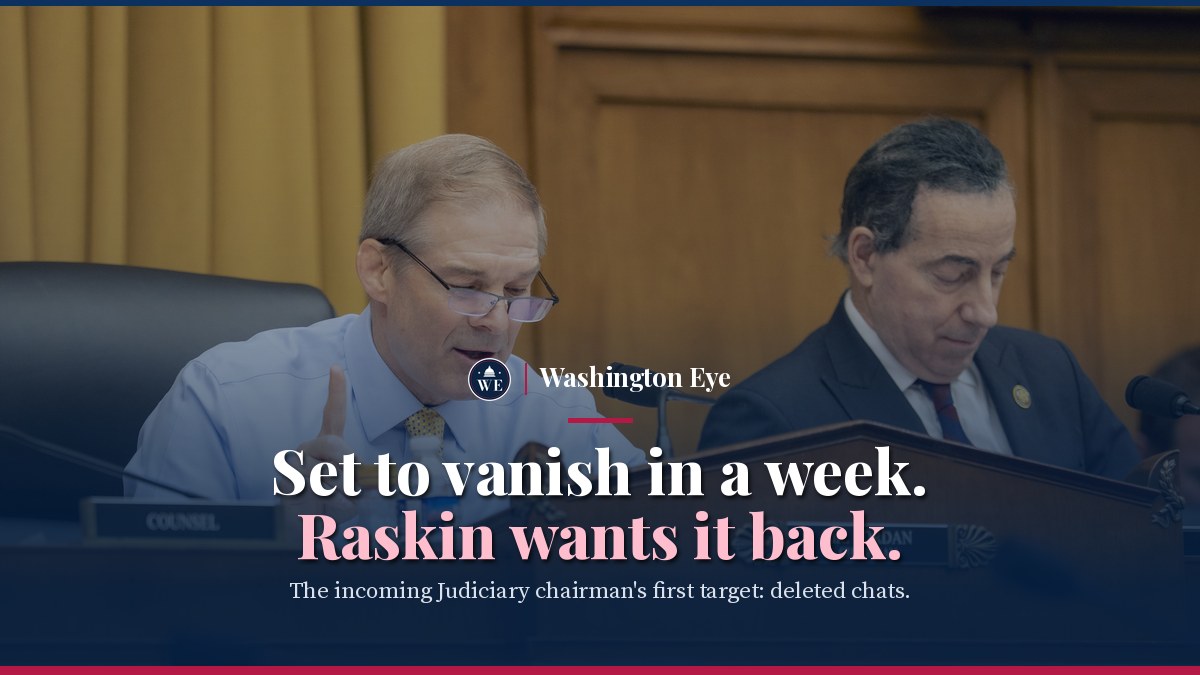
That icon is now the opening exhibit in what promises to be the most aggressive congressional oversight campaign of President Trump's second term. Representative Jamie Raskin of Maryland, the top Democrat on the House Judiciary Committee and the man expected to take its gavel when Democrats assume control of the House in January, attached the screenshot to a half dozen nearly identical letters made public on Friday. They went to Attorney General Todd Blanche, Homeland Security Secretary Markwayne Mullin and the heads of the FBI, the Bureau of Prisons and Immigration and Customs Enforcement.
"There is significant evidence that Trump Administration officials have engaged in the widespread destruction, mutilation, and concealment of government records, seemingly with the express purpose of circumventing federal record preservation laws," Raskin wrote. Of Ramer, he was blunter still: "It is a felony to unlawfully conceal, remove, alter, or destroy federal records, as Mr. Ramer appears to have done here."
The Justice Department pushed back within hours. A spokesperson said the department "follows all legal requirements for the management of federal records involving its official functions and decisions" and added that its staff would "not be intimidated." The White House did not respond to requests for comment, according to published reports.
The fight over a single disappearing chat is, in miniature, the fight that will define the next two years in Washington. To understand where it is headed, it helps to understand the man who started it.
What the letters actually say
Strip away the rhetoric and the letters make three demands. First, preserve everything: every document, record and electronically stored communication, "particularly such records created on non-government messaging applications." Second, find what is already gone. Raskin asked the FBI to "open an inquiry to identify records under its purview that have been improperly deleted from non-government applications" and, under 44 U.S.C. § 3106, to "initiate immediate action to recover these records." That provision of the Federal Records Act obliges an agency head to notify the National Archives of unlawful destruction and to seek recovery, through the attorney general if necessary. Third, stop doing it.
The Ramer exchange, as Raskin describes it, concerned "a potential or ongoing investigation involving an individual wanted by federal authorities on health care fraud and related charges." The image appears to show Ramer passing Lynch a letter that had been sent to the FBI director about Abubakar Atiq Durrani, a doctor indicted in 2013, along with what looks like a link to a report that Durrani had been found in Pakistan in 2024. It is not clear whether Ramer was using a personal phone or a government one. Lynch, a producer for Kimberly Guilfoyle, the former ambassador to Greece, has separately been sought for questioning by the House Oversight Committee in its inquiry into Guilfoyle's request for money from a Trump ally to pay down credit card debt before her confirmation hearing.
Raskin says the chat is "just one of many" examples of deleted communications shared with his committee. "The FBI's top lawyer should be ensuring that all 35,000 FBI employees are preserving government and law enforcement records," he wrote. "Instead, he has conducted official business on a platform specifically configured to erase communications."
The administration has been here before. In March 2025 a journalist was accidentally added to a group chat on a commercial encrypted messaging app in which senior national security officials discussed imminent strikes on the Houthis in Yemen. The Pentagon's inspector general later concluded that Defense Secretary Pete Hegseth had shared nonpublic operational details from his personal phone hours before the strikes, in breach of department rules, and found that the messages had not been properly retained because they were set to delete. Raskin's letters are built on the premise that the habit never stopped.
The professor who became a prosecutor
Raskin, 63, was born in Washington in December 1962, the son of Marcus Raskin, a former aide on President John F. Kennedy's National Security Council who went on to co-found the progressive Institute for Policy Studies, and Barbara Raskin, a journalist and novelist. He graduated from Harvard College in 1983 and Harvard Law School in 1987, worked as an assistant attorney general in Massachusetts and then spent more than 25 years teaching constitutional law at American University's Washington College of Law.
That classroom background still shapes how he fights. In the Maryland Senate, where he served from 2007 to 2016 and rose to majority whip, he helped lead the push to legalise same-sex marriage and became known for a retort to a colleague that has followed him ever since: when lawmakers take office, he said, they swear on the Bible to uphold the Constitution, not the other way around. He arrived in Congress in 2017 representing Maryland's 8th District, a heavily Democratic seat anchored in Montgomery County outside Washington.
His national profile was forged in the worst weeks of his life. On December 31, 2020, his 25-year-old son Tommy, a Harvard Law student, died after a long struggle with depression. Six days later Raskin was in the Capitol when the mob broke in. Within a week Speaker Nancy Pelosi named him lead manager for Trump's second impeachment, and he was the primary author, with Representatives David Cicilline and Ted Lieu, of the article charging the president with incitement of insurrection. The Senate acquitted. Raskin then served on the select committee that investigated January 6, co-leading its hearing on the extremist groups involved in the attack.
In late 2022 he announced he had diffuse large B-cell lymphoma, and he spent the following months attending hearings and giving speeches in bandanas while undergoing treatment. He said in April 2023 that the cancer was in remission. On his final day in office in January 2025, President Joe Biden issued preemptive pardons to the members of the January 6 committee, Raskin among them. He called it "a sign of our strange times" that public servants needed pardons for doing their jobs.
From minority letters to majority subpoenas
For four years Raskin has done oversight from the minority, first as the top Democrat on the House Oversight Committee and, since January 2025, on Judiciary, after he challenged the long-serving Jerry Nadler for the post and Nadler stepped aside. Minority oversight is mostly letters, reports and pointed questions at hearings. Raskin has made the most of it. In a letter to colleagues on November 13 launching his bid for the chairmanship, he pointed to the committee's grilling of former Homeland Security Secretary Kristi Noem and to the performance of former Attorney General Pam Bondi on the handling of the Jeffrey Epstein files. Bondi was fired weeks later. Raskin wrote that he had invited her to join "the washed-up loser lawyers club."
He also called those wins "small potatoes compared to what we will need to do to restore the rule of law and legislate against the disgraceful corruption of the government once we actually have the gavels." Democrats will hold at least 255 House seats in the new Congress, a margin that turns letters into subpoenas. Raskin has promised to use "all of the tools of the Majority to extirpate bribery, kickbacks, inside dealing and sweetheart contracts in the government," to "rein in ICE," to "rebuild the Department of Justice and the FBI," and to pursue ethics reform including a $50 gift ban for Supreme Court justices. He has also vowed to fight a $1.8 billion "anti-weaponization" fund.
What his pitch does not mention is impeachment, even though the Judiciary Committee holds jurisdiction over it. Raskin has said the option is not taboo, but in September he observed: "I've not heard a single person say to me that they think our top priority should be impeachment of Donald Trump." That restraint is deliberate. A Senate conviction would still need a two-thirds vote that Democrats do not have, and both of Trump's earlier trials ended in acquittal. Investigations that voters can follow offer a better return than a third trial with a known ending.
The case against him
Republicans see something else: a partisan prosecutor with a grudge and a gavel. The White House has already signalled it will resist. In a letter to Representative Robert Garcia, the top Democrat on the Oversight Committee, White House Counsel Will Scharf called Democratic threats "a clear abuse of power and an affront to our constitutional system of government" and wrote that the administration "will not be extorted and will not be cowed by unlawful process motivated by animus, pettiness, hatred, or any other unlawful motive." The Justice Department's "not be intimidated" line on Friday struck the same note.
Raskin's critics also point to his own record on transparency. In 2022, while his wife, Sarah Bloom Raskin, was under consideration to be the Federal Reserve's vice chair for supervision, it was reported that he had failed to disclose some of her stock transactions on time, as the STOCK Act requires. The lapse was minor next to what he now alleges, but it is the kind of detail opponents will raise every time he lectures officials about the law.
His Republican counterpart is still unknown. Jim Jordan, who has chaired the committee and sparred with Raskin across the dais for two years, has been elected House minority leader for the next Congress. Several Republican members of the panel lost their seats, and Representative Scott Fitzgerald of Wisconsin has said he wants to be ranking member.
Why a deleted chat matters
A disappearing message may look like a small thing to build an opening argument on. It is not. Every investigation Raskin has promised, into contracts, pardons, immigration enforcement or the Justice Department itself, depends on records. If the communications that explain a decision were never saved, there is nothing to subpoena, and witnesses can say they do not remember. By putting agencies formally on notice now, before he holds a single hearing, Raskin is trying to make sure that any future gap in the record becomes evidence in its own right.
It is also a test of how the administration will treat the new majority. The department's answer on Friday was that it follows the law. In January, Raskin will be able to ask, under oath, what that means for a chat that was set to vanish in a week.