
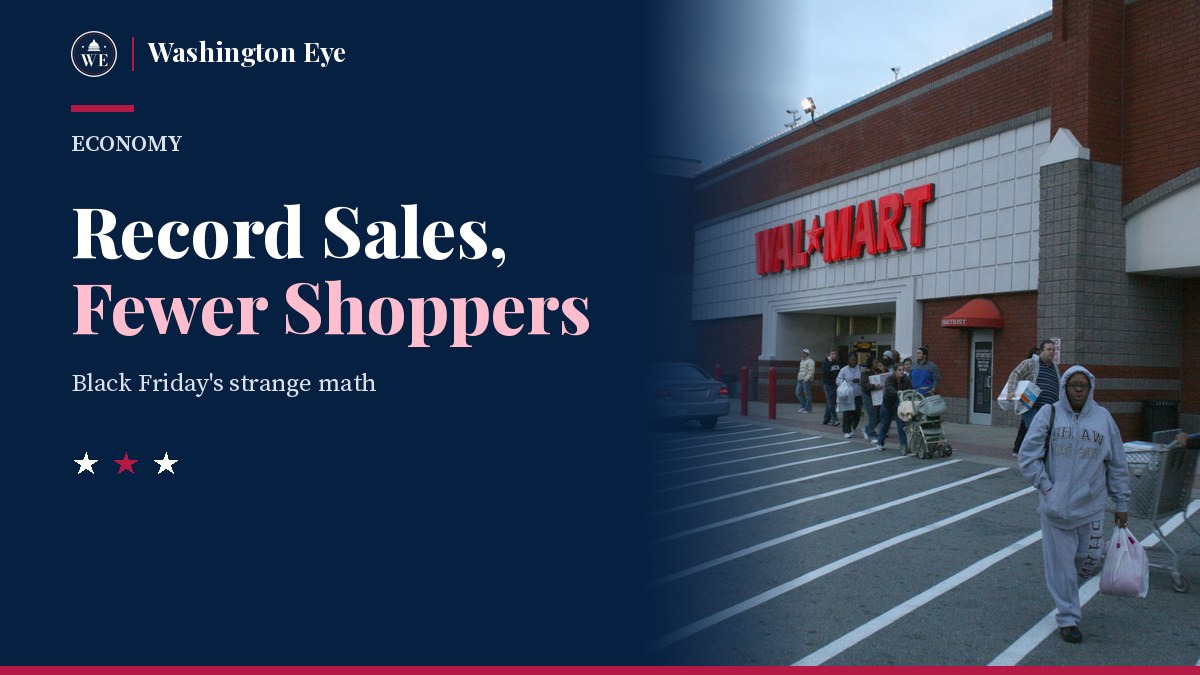
On paper, America is having a splendid holiday. Shoppers spent a record $7.1 billion online on Thanksgiving Day alone, according to Adobe Analytics figures reported on Friday, up 10.4 percent on last year and $200 million ahead of the company's own forecast. The National Retail Federation expects November and December retail sales to rise 4.2 percent to just above $1 trillion for the first time. Other forecasters are even sunnier, with EY Parthenon and the Mastercard Economics Institute both projecting growth of more than 5 percent.
Yet the same trade group expects fewer people to shop this weekend than last year. Its annual survey puts Thanksgiving weekend shoppers at 182.7 million, down from 186.9 million in 2025. Some 82 percent of consumers say they are taking steps to manage holiday costs. Toy prices are up 13.2 percent since January. Retail chief executives are describing customers who count every dollar. Record sales and fewer shoppers is a strange combination, and the explanation says a great deal about the American economy as it heads into 2027.
The short version is that a big share of the boom is price, not volume. Inflation is running at 3.8 percent, roughly a percentage point higher than in each of the past two holiday seasons. When the things in the basket cost more, the same basket produces a bigger number at the till. A 4 to 6 percent rise in nominal sales, the range most forecasts fall into, looks far less impressive once nearly four points of it are simply higher prices.
Forecasters disagree about how much of the gain is real. Oxford Economics, in an October outlook, projected a 4.2 percent rise in dollar terms but only 2.2 percent in volume after inflation, which it said would beat last year but trail a typical holiday season because higher energy prices have eaten into spending power. EY Parthenon is more upbeat. It forecasts a 5.2 percent nominal rise, the strongest since 2021, and argues that higher purchasing volumes will account for most of it, with real growth near 2.9 percent and prices up 2.3 percent on its own measure of retail goods. The gap between those two views is the whole debate in miniature: is the American shopper genuinely buying more, or paying more for roughly the same?
Some of the strongest numbers come from online spending, which is growing far faster than the season as a whole. Adobe says shoppers spent $82.5 billion online between November 1 and November 22, up 9.1 percent on the same period last year, and it still expects $12.9 billion on Black Friday and a record $15.1 billion on Cyber Monday. Bain projects that sales across the four days from Black Friday to Cyber Monday will top $85 billion, growing 8.75 percent, roughly double its forecast for the whole holiday period. EY Parthenon expects online sales to rise 10.5 percent this season.
That shift matters for reading the headlines. Online channels are where discounts are easiest to compare and where impulse spending happens on a phone between courses of dinner. Adobe had forecast that a record 63 percent of Thanksgiving online spending would come through mobile devices. Strong online figures can coexist with a thinner crowd at the mall, and with households that are spending more of their total budget in a few concentrated bursts when the deals are deepest.
The calendar has changed too. The retail federation's survey found that 60 percent of shoppers had started holiday buying by the beginning of November, up from 56 percent before the pandemic. Large retailers launched sales well ahead of Thanksgiving, pulling demand forward. "Holiday shopping continues to be pulled forward, but Thanksgiving weekend remains an important shopping event for consumers," said Allison Zeller, the federation's vice president of industry and consumer insights. Black Friday is still the most popular day of the weekend, with 126 million people planning to shop, and a separate Deloitte survey of 1,200 consumers in October found 87 percent planned to take part in the five days from Thanksgiving to Cyber Monday, the highest share in a decade. Participation, in other words, is broad. What has changed is how carefully people are spending once they show up.
Look beneath the totals and the stress is easy to find. The retail federation found that consumers managing costs are buying less expensive gifts, cutting back in other areas, buying for fewer people or waiting for the Thanksgiving weekend to do most of their shopping. Gift cards, once a default present, are planned by 39 percent of shoppers, the lowest level in the survey's more than 20 year history.
Felicia Cox, a 50 year old sales representative browsing at a discount clothing store in Los Angeles, told a wire service reporter that her budget would be roughly stable but that inflation had changed how she thinks. "I want to get more gifts that people will actually use or need," she said. "I feel like people aren't able to afford as much stuff."
Retailers are hearing the same thing. Target, Dollar Tree and Kohl's have all pointed to belt tightening on recent earnings calls. Kohl's chief executive Michael Bender this week described an "increasingly choiceful" consumer who is "looking to stretch every dollar." Mattel cut its annual forecast this month as shoppers balked at higher toy prices, a category hit hard because so many toys are made from plastic, a petroleum product whose costs have climbed with oil.
The pain is not evenly shared. A survey by the Kearney Consumer Institute found that middle and lower income shoppers, who have been trading down for months, were more likely than wealthy ones to spend less this season. "People like to spend during the holidays," even with a "persisting undercurrent of stress," said Katie Thomas, who leads the institute. Oxford Economics described the season as "deeply bifurcated", with high income consumers keeping a floor under spending thanks to this year's surge in stock prices.
That floor now looks shakier than it did when most forecasts were written. Holiday projections largely predated the stock market correction that followed this month's midterm elections, the turmoil at chipmaker Nvidia and mounting talk of an artificial intelligence bubble. UBS analysts warned in a note this week that the decline could weaken the wealth effect that has encouraged affluent shoppers to splurge on gadgets and accessories. If the top of the income ladder pulls back even modestly, the arithmetic of a season that leans on it changes quickly.
Household finances show why the cushion matters. According to EY Parthenon's analysis of government data, growth in real disposable income slowed from 2.0 percent at the start of 2026 to 1.3 percent in August, half the pace of spending growth, while the saving rate stood at 4.1 percent. Families are increasingly funding purchases from savings, wealth and credit rather than from rising paychecks. Adobe reported that online buy now, pay later spending reached $6.1 billion between November 1 and 22, up 6.5 percent on a year earlier. Oxford Economics noted that Federal Reserve rate increases are making credit card borrowing more expensive for anyone planning to put the holidays on plastic.
There is a political backdrop that no retailer mentions in a press release. Earlier this month voters handed Democrats sweeping victories in the midterms, punishing President Donald Trump over a war with Iran that has pushed fuel and living costs higher. Record diesel prices are raising shipping costs, and the toy industry has been fighting over tariffs in court. Learning Resources, an educational toy maker that was a plaintiff in the lawsuits that overturned the president's tariffs, says demand is roughly flat. "People can't shop until they have their turkey," its chief executive, Rick Woldenberg, said, adding that demand is hard to predict before Black Friday.
For the White House, the season is a test of whether the cost of living message that cost Republicans so dearly at the ballot box is starting to fade, or whether it will carry into the new year. A strong headline number will be claimed as proof of a resilient economy. A disappointing real figure, once inflation is stripped out, will be read as confirmation that households are still stretched. Both readings can be argued from the same data, which is why the composition of spending matters more than the total.
One new variable could scramble the usual pattern: artificial intelligence. The retail federation found that 59 percent of Thanksgiving weekend shoppers plan to use AI tools for holiday shopping, from product recommendations to scanning sites for the best price. An Adobe executive said in a post online that traffic to retail sites from AI powered sources rose 162 percent on Thanksgiving and converted 74 percent better than other traffic. Salesforce expects about $75.8 billion of global Cyber Week sales, roughly a fifth, to be influenced by AI and AI agents.
That cuts both ways. Shoppers armed with bargain hunting software can wait out retailers, and retailers armed with pricing algorithms can change prices far faster than before. Ryan Orabone, a consultant at Spaulding Ridge, suggested the deepest discounts could arrive closer to Christmas as both sides play a waiting game. "My advice to shoppers is to be patient," he said. "Don't jump on the first deal you see."
What should readers watch? First, the gap between nominal and real growth when the government's retail and price data for November and December arrive. A season that lands at 4 percent nominal with inflation near 3.8 percent would mean American households bought barely more than last year. Second, the mix. If online and discount channels keep surging while department stores and mid priced chains stagnate, the story is trading down, not a spending spree. Third, credit. A jump in buy now, pay later balances and card debt in January would show how much of this Christmas was borrowed from the spring.
Final holiday results often beat the forecasts made before Thanksgiving, and this season may yet surprise on the upside. The American consumer has defied gloomy predictions for years. But the most honest reading of this Black Friday is not that shoppers are flush. It is that they are still showing up, in slightly smaller numbers, with tighter budgets, sharper tools and a clear sense that every gift now costs more than it used to. Record sales built on higher prices and fewer shoppers are not a boom. They are a household budget under strain, dressed up in holiday lights.