
Most fights over judicial power come wrapped in a headline policy: abortion, immigration, birthright citizenship. The next one arrives inside a dispute over the arithmetic of surprise medical bills, and that is exactly why it deserves attention before it reaches oral argument. Buried in a petition the Justice Department filed on October 14 is a question that could change how every federal regulation, under every future president, is challenged in court.
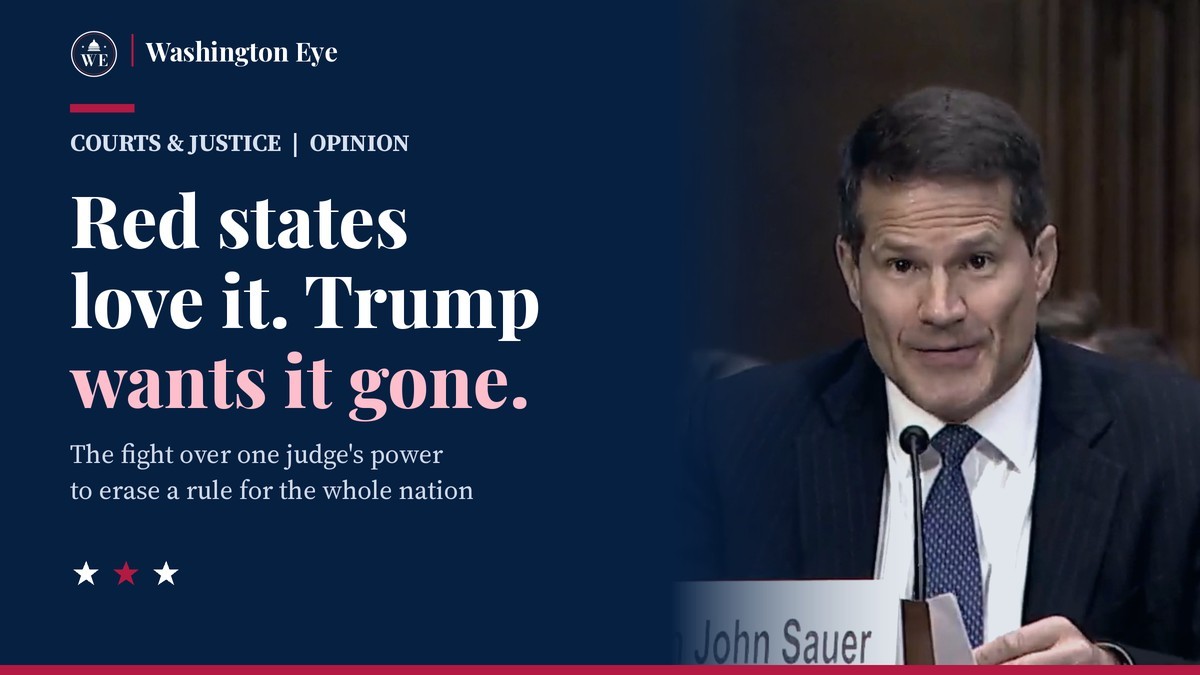
The case is Department of Health and Human Services v. Texas Medical Association, docketed at the Supreme Court as No. 26-491. The government is not asking the justices to save the rule at issue. It is not appealing the merits at all. Instead, Solicitor General D. John Sauer wants the Court to answer one question: when a judge finds an agency rule unlawful under the Administrative Procedure Act, may the judge wipe that rule off the books for everyone in the country, or only for the people who actually sued?
That remedy has a dull name, universal vacatur, and an enormous reach. The administration says it should end, or at least stop being the default. A group of Republican-led states, led by Texas, has already told a federal appeals court the opposite. Conservatives are therefore about to argue with each other over a power that each side has used against the other for a decade. On the merits, the administration has the better of the argument, and the right should say so even though it will cost red states a favourite weapon in 2029.
Start with the facts of the case. In late 2020, Congress passed the No Surprises Act, which President Trump signed in his first term, to stop patients from being hit with large bills when they unknowingly receive care from out-of-network providers. Federal agencies then wrote rules for calculating the benchmark payment, known as the qualifying payment amount, that shapes arbitration between insurers and providers. The Texas Medical Association, a hospital and several air ambulance companies sued in federal court in Texas, arguing the 2021 methodology tilted payments toward insurers.
They won in the district court. A three-judge panel of the Fifth Circuit partly reversed. Then the full Fifth Circuit, in an August 11 decision joined by nine judges, struck down several provisions of the rule and kept vacatur as its default remedy, brushing aside the government's warning that erasing the provisions could create practical problems while the agencies rewrote them. Judge James Ho, in a concurrence, signalled interest in revisiting the circuit's own precedent, comparing universal vacatur to the nationwide injunctions the Supreme Court had just curtailed.
That comparison is the heart of the matter. In June 2025, in Trump v. CASA, the Court ruled 6 to 3 that federal district courts lack the power to issue universal injunctions blocking a policy for everyone. Judges, the majority reasoned, can grant complete relief to the parties in front of them but cannot, as a rule, reach beyond them. The decision was a major win for the administration in the fight over its birthright citizenship order, though the justices later struck down that order itself on the merits. What CASA expressly did not decide was whether the APA's instruction to "set aside" unlawful agency action works differently.
The government's petition argues that it does not. Nothing in the "text, context, or history" of the 1946 statute, Sauer wrote, vests courts with a "new and far-reaching remedial power." Under the Fifth Circuit's approach, he told the justices, "at the behest of a handful of plaintiffs, those regulations are erased from the books as to everyone." The petition warns that the practice rewards forum shopping, forces the government to win in every court where it is sued, and gives a single district judge's order "the type of nationwide effect usually reserved for the precedents of the court of last resort."
Each of those points is correct, and conservatives made every one of them when the shoe was on the other foot. During the first Trump administration, rules on immigration, health care and the environment were routinely frozen nationwide by judges in a handful of districts that liberal litigants had learned to favour. During the Biden years, conservative litigants returned the favour, filing in single-judge divisions in Texas where they could predict the judge. Both habits made a mockery of the idea that the law is the same no matter which courthouse you walk into. The problem was never which side was winning. It was that one judge could govern the whole country.
Notably, this is not a partisan Republican position. The Biden administration made a similar request in 2023, in United States v. Texas, a case brought by Republican attorneys general from Texas and Louisiana over immigration enforcement priorities. The Court decided that case on other grounds. But Justice Neil Gorsuch, concurring, described universal vacatur as a "variation on th[at] theme" of nationwide relief, a line the government now quotes back to the Court. Two administrations of opposite parties, facing hostile courts, reached the same conclusion. That is usually a sign that an argument is about structure, not politics.
The states see it differently, and their case deserves a fair hearing. Fifteen Republican attorneys general, led by Texas, urged the Fifth Circuit to keep vacatur, calling the APA "a critical tool used by Amici States to curb federal overreach and incursions into state sovereignty by executive-branch agencies." Texas and Florida were among those warning the appeals court not to neuter the statute. Their logic is easy to follow. From 2021 to 2025, a single favourable ruling in Texas could stop a Biden rule in its tracks across all fifty states. Democrats will take control of Congress in January, and nobody in a red-state attorney general's office expects the White House to stay Republican forever.
Academics who defend the remedy make a more principled point. "You can't have a food-safety rule that applies only to some," Ronald Levin, a law professor at Washington University in St. Louis, said in an interview with a wire service. "You can't have an auto-safety manufacturing rule that applies only to some manufacturers." He argued judges should keep the tool even if they should not use it in every case. Aditya Bamzai of the University of Virginia, an administrative law scholar, put the political subtext plainly: whether you like the extra flexibility a Trump win would give the executive branch "can perhaps depend on whether you like or dislike a particular administration's policies."
Bamzai is right about the temptation, and that is precisely why conservatives should resist it. A legal philosophy that changes with the occupant of the Oval Office is not a philosophy. The right spent forty years arguing that courts should decide cases and controversies between real parties and leave governing to the elected branches. Universal vacatur turns a lawsuit by a medical association or an air ambulance company into a legislative veto exercised by whichever judge the plaintiffs could find. That should trouble a conservative just as much when the rule being erased is a Democratic one.
There are also better tools for the problems vacatur claims to solve. CASA left open class actions, which require plaintiffs to show that a group genuinely shares the same injury before a court grants relief to all of them. States can still sue for themselves and their residents. Appellate courts and the Supreme Court can still settle the law nationally, which is how a federal system is supposed to produce uniformity. And Congress, which wrote the APA, can always change it. If lawmakers want single judges to have nationwide power over agency rules, they can say so in plain text.
None of this means the administration has picked a perfect test case. Health policy analysts have pointed out that the rule here sets a methodology insurers apply across millions of claims, and it is hard to see how relief could be confined to the plaintiffs. The Texas Medical Association alone counts roughly 56,000 physician and student members. Would an insurer run one formula when a patient happens to see one of them and another formula for everyone else? Levin's food-safety example lands hardest in cases like this one, where the regulated activity is a single, interlocking system.
That is a fair objection to the remedy in this particular dispute, not to the principle. The petition itself argues, in the alternative, that even if the APA allows universal vacatur in some circumstances, it should never be the automatic default. That is the sensible middle ground. A court that believes only nationwide relief can protect the parties before it should have to explain why, on the record, rather than reaching for erasure as a reflex. The Fifth Circuit, the government notes, never explained why a narrower ruling would not do.
The timing matters too. A pending extension request would push the deadline for a response to December 14, and the justices are expected to decide early next year whether to take the case. A ruling could arrive in 2027, shaping the final two years of this administration and every one after it. The right should want that rule settled now, on neutral terms, rather than after a Democratic administration has spent four years watching conservative judges in Texas undo its agenda one courthouse at a time, and then responds in kind.
Republican attorneys general are not wrong that federal agencies overreach. They are wrong that the cure is to hand any single district judge a national eraser and hope the right judge holds it. Conservatives won the argument over universal injunctions by insisting that courts are not roving overseers of the executive branch. Consistency now means accepting the same answer for vacatur, even when it is inconvenient. If the principle only holds while a Republican sits in the White House, it was never a principle at all.