
For a week, the message from Washington was consistent and calm. The flights that stopped, the banks that froze and the classified network that went dark were, officials said, separate technical failures. Nobody had broken in. "Tell them to relax, everything is good. These are individual events," President Trump said on Wednesday when asked about Americans stockpiling food and water.
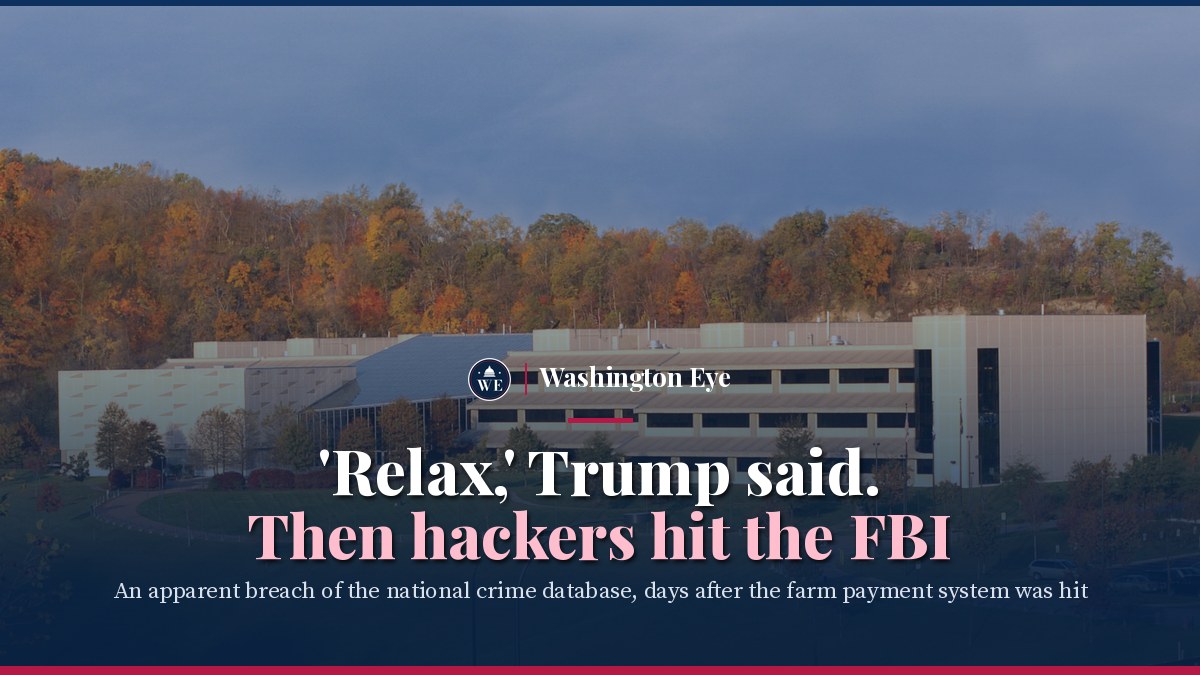
By Friday night, that story had a hole in it. The FBI is investigating an apparent breach of the National Crime Information Center, the nationwide database that police officers use every day to check for warrants and run background checks, according to two people briefed on the matter. A day earlier, the Department of Agriculture had told its own employees that a system it uses to pay farmers had been hit in a cyberattack. Neither agency has said who was responsible, and there is no public evidence that the two incidents are linked to each other or to the wider wave of outages. But they are the first reported intrusions by outside actors in a week when the government's central claim was that there were none.
The database every officer touches
The National Crime Information Center is not an obscure back office system. It connects federal, state and local law enforcement so that a patrol officer in one state can learn that the driver in front of them is wanted in another. It holds records on warrants, stolen property and missing persons, and it is run from the FBI's Criminal Justice Information Services Division in Clarksburg, West Virginia.
According to the two people briefed on the investigation, the intrusion was discovered in recent days and is the second breach of an FBI system in recent months. The bureau did not comment on Friday night.
A former FBI official who led investigations into cybercriminal groups explained why the incident matters beyond the usual worry about stolen data. "Every day, officers across the country rely on NCIC to identify wanted fugitives, check for outstanding warrants, and access information that can directly impact officer and public safety," the former official said. "My concern isn't simply whether hackers gained access to sensitive information, although that is an issue, but whether they could compromise the accuracy of the information that officers rely on."
That is the nightmare scenario for a system like this one. A leaked record is a privacy problem. An altered record, a warrant that disappears or one that suddenly appears next to the wrong name, is a public safety problem that plays out at the side of a road.
Second time since September
The bureau has been here before. In September, a hacking group known as ShinyHunters targeted sensitive personal data on FBI employees through the agency's jobs website. A Canadian cybersecurity researcher and author has since been arrested and charged in connection with that breach. Some FBI employees later complained that they were left in the dark about whether they had been affected. In 2023, hackers got into a computer system used by the FBI's New York field office in child sexual exploitation investigations.
The timing of the latest discovery is awkward for the bureau's leadership. On Thursday, after FBI officials had learned of the new incident according to the people briefed on it, Director Kash Patel went on a cable news programme to praise the bureau's cyber work. He spoke about Operation Winter Shield, an effort completed months ago that urged companies to update their systems, as though it were still under way. "Other administrations could have made these updates, but they didn't," he said. "We are staying ahead of the curve and making up for lost time."
The farm payment system
The Agriculture Department incident has been building quietly since Monday. Employees reported outages that day in the Farm Service Agency's loan software, in the Natural Resources Conservation Service program that releases payments to farmers, and in a service desk tool used to map conservation projects.
An internal email sent on Monday by Chris Rottler, acting assistant chief information officer for the department's Farm Production and Conservation Business Center, said its Cybersecurity and Privacy Operations Center had "uncovered a security incident". Staff had to "reset all database passwords in all environments," the email said, and that was "requiring us to reset all applications causing outages." A Tuesday email warned employees that systems that seemed to be back online had not been verified. "Proceed at your own risk," it said.
Two former department officials said hackers might use the payments system as a back door into more sensitive material. One noted that the department handles "a bunch of scary biologic issues" and warned that if an adversary or a competitor gained access to that information, "they could use our own research against us."
The department's public line has been reassuring. Richard Fordyce, the under secretary for farm production and conservation, confirmed this week that the event was a "cyberthreat" and not a "software update". He said: "There was no Personally Identifiable Information (PII). No data was lost because the systems that protect against cybersecurity threats worked." He went further, suggesting the episode might be "a good news story that people that were trying to do harm weren't able to do it because our systems work." He also allowed that "there could be multiple reasons why potentially systems aren't operating."
On Thursday, the Farm Service Agency's administrator, Bill Beam, described the problem more vaguely. "I have heard that there's some outages," he said. "I talked to our leader in the IT department, and you know they're working on it."
A deadline that will not move
For farmers, the practical cost lands on a calendar. The deadline to elect and enroll in the Agriculture Risk Coverage and Price Loss Coverage programs for the 2026 crop year is December 11. Mr. Beam said on Thursday that the date could not be pushed back. "We are not going to be able to move that deadline back," he said. Mr. Fordyce agreed, saying farmers who contact their local office before the deadline and are placed on a register will be treated as having signed up on time. Farmers who miss the window lose eligibility for payments in October 2027.
The breach also arrived the same week as an awkward report. On Thursday, the Government Accountability Office said the Agriculture Department and the Food and Drug Administration had not fully carried out the cybersecurity requirements for the food and agriculture sector that Congress set in the 2021 defense authorization law. The department disagreed with the watchdog's recommendations and asked that they be removed or redirected, and officials told the auditors it had no plans for further cyber exercises based on potential incidents in the sector. Mr. Fordyce had no comment on the report.
Agriculture Secretary Brooke Rollins has argued that the problem is old plumbing. In February she said the department had inherited "500 different custom-built systems and databases managed by over 1,000 different contractors." Mr. Fordyce now puts the number of separate systems at between 400 and 600, and says about half the department's databases and platforms have been moved onto a single data layer. That modernization may help in two years. It did not help this week.
What the administration said, and when
The new intrusions do not prove that the earlier outages were attacks. Federal officials traced the November 13 nationwide air traffic ground stop to a newly installed router in Arkansas that flooded a telecommunications network. People familiar with the National Security Agency's multi day classified network outage said it began during maintenance and showed no sign of a cyberattack. Senator Mark Warner of Virginia, the top Democrat on the Senate Intelligence Committee, said on Wednesday that the evidence showed the outages were not caused by cyberattacks, while warning that artificial intelligence could have played a role in the systems' vulnerabilities.
What has changed is the credibility of the blanket reassurance. At a House hearing on Wednesday, the Director of National Intelligence, Jay Clayton, said: "These are separate service outages associated with maintenance and technical changes. They are not a coordinated or state-sponsored attack." The FBI's deputy director, Christopher Raia, said there was "no indication whatsoever" of malicious cyber activity. Those statements were about outages, not breaches, and they may well prove accurate. But they were delivered while the Agriculture Department was already resetting every database password it had, and in the same week that the FBI discovered an apparent intruder in one of its most important systems.
On Thursday, the White House replaced its national cyber director, Sean Cairncross, with the Pentagon's chief information officer, Kirsten Davies, in an acting role. At his Friday news conference, Mr. Trump again described the outages as "all separate events" and blamed air traffic control failures on equipment "55 years old and older", saying his administration would seek $50 billion from Congress for a new system.
Why it matters
The distinction between an outage and a breach is real, and officials are right to insist on it. A router that floods a network is a maintenance failure. Someone inside a national crime database is a security failure. Treating them as the same thing would feed panic.
But the public is being asked to trust a government that, in the same week, fired its top cyber official, told citizens to relax, sent its FBI director on television to celebrate a finished operation, and described a breach of the farm payment system as possible good news. The two new incidents leave basic questions unanswered: who got in, what they could see, whether anything was changed, and how long they were there.
Those questions will not stay inside the executive branch for long. Democrats take control of both chambers of Congress on January 3 and have promised aggressive oversight of the administration. A breach of the database that every police department in the country relies on is the kind of issue that tends to unite both parties at a hearing. The administration would be wise to have its answers ready before the first subpoena arrives.