
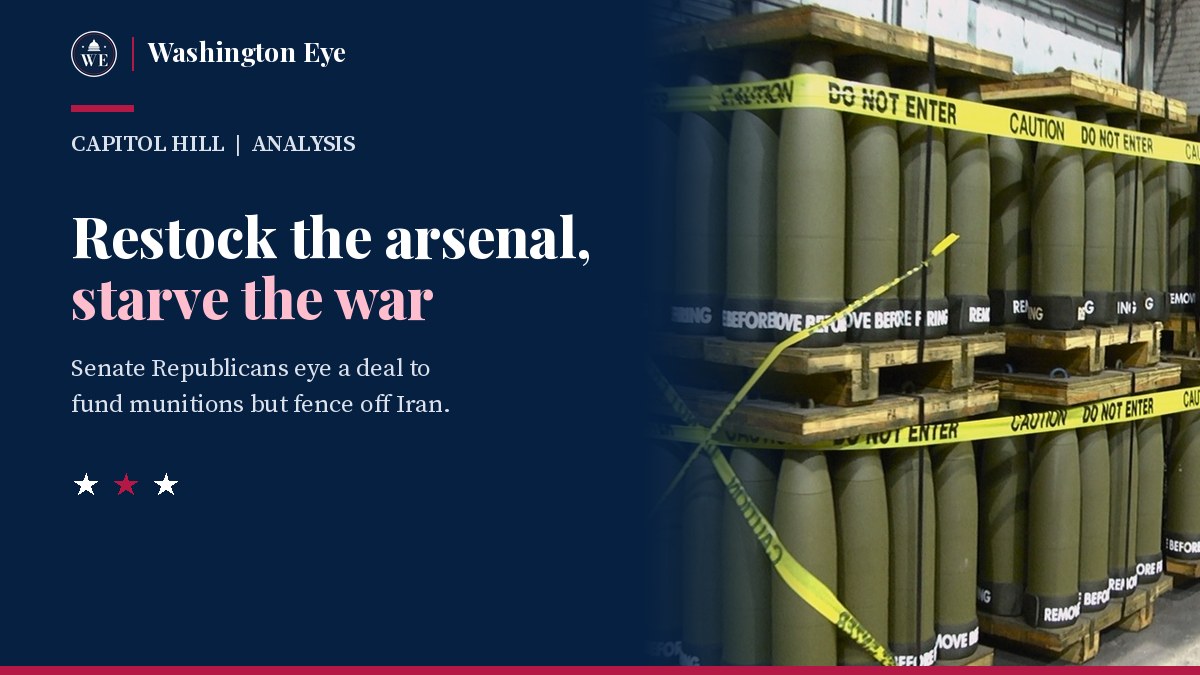
For nine months, Republicans in the Senate have treated the war with Iran as something to defend, or at least something to vote around. This week, with the government due to run out of money on 11 December, some of the most powerful of them began talking about something else: paying to refill the Pentagon's empty shelves while closing the tap on the war itself.
The shift is small in words and large in meaning. Senator Susan Collins of Maine, who chairs the Senate Appropriations Committee and leaves Congress in January after losing her reelection race, told reporters before the Thanksgiving recess that she was exploring language that would put fresh money into restocking depleted munitions while denying the administration funds specifically for continuing the Iran conflict. Senate Majority Leader John Thune, who only days earlier had dismissed Democratic demands as unrealistic, did not slam the door. "I think if you could fence off Iran and do some of the other stuff we need to do, I think that's a conversation we'd be interested in," he said.
Nobody has a deal. There are no formal bipartisan leadership talks, Congress is away for a week, and the White House wants the opposite outcome. But the outline of a bargain now exists, and it is one that would have been unthinkable in the Republican conference before the midterm elections on 3 November.
How the ground moved
The war began more than eight months ago without a vote in Congress, and it has never received one. Lawmakers have tried the usual tool repeatedly. On Thursday the Senate rejected the latest Iran war powers resolution by 48 votes to 51. Three Republicans, Ms Collins, Lisa Murkowski of Alaska and Rand Paul of Kentucky, voted with Democrats, while Democrat John Fetterman of Pennsylvania voted with Republicans. Two departing Republicans who have sometimes backed such measures, Thom Tillis of North Carolina and Bill Cassidy of Louisiana, voted no this time.
That measure was always symbolic. As a concurrent resolution it would never have reached the president's desk. What has changed is the venue. Democrats have concluded that war powers votes have run their course and that the only lever left is the power of the purse. "We've already tried tool after tool to get the president to rein in this conflict. Nine months in, defunding the war is the only way to force Trump to end it," said Senator Tammy Duckworth of Illinois, who has vowed to vote against any stopgap funding bill that lacks such language.
Senator Tim Kaine of Virginia says a group of Senate Democrats has finalised a draft. Its core, as reported, is simple: no money for offensive operations against Iran unless Congress authorises the war, with a clear exception for defending American forces under attack. Senator Michael Bennet of Colorado has gone further with his own amendment, barring any past or future funds from supporting combat by US personnel "in or over Iran, or in Iranian territorial waters" without specific authorisation. His office says the text is modelled on the language Congress passed in 1973 to end funding for the bombing of Cambodia.
Why Republicans are listening
Arithmetic explains most of it. Any government funding bill needs 60 votes in the Senate, so Republicans need at least seven Democrats. Several Democrats, including Ms Duckworth and Mr Kaine, say they will not supply votes for a bill that keeps paying for the war. Without them, the country heads towards a shutdown just before Christmas.
Mr Thune has made his fear plain. "I'm increasingly concerned that the Democrats may try to initiate another, a third government shutdown this year," he said last week. "And that would be a terrible outcome for the American people." Republicans know that the last shutdowns were painful, and that this one would come weeks after voters handed Democrats their largest House majority in more than three decades and control of the Senate from January.
The second reason is the Pentagon's own bill. The administration wants $350 billion in new defence money through budget reconciliation, the party line route that avoids a filibuster. That package includes about $48 billion for critical minerals, roughly $103 billion for low cost autonomous systems, artificial intelligence and counter drone systems, $47 billion for expanded munitions production and $17 billion for the Golden Dome missile defence system. It has stalled for weeks over how to pay for it.
After a long closed door meeting with Deputy Secretary of Defense Steve Feinberg, Senate Republicans chose to try the bipartisan route first, pursuing a $1.1 trillion defence appropriations bill that contains only $69 billion of the president's request. "I think the consensus of the conference is, you know, there are downsides to reconciliation," said Senator Ron Johnson of Wisconsin. Senator Roger Wicker of Mississippi, who chairs the Armed Services Committee, said that if a strong investment could be made through the normal process, "perhaps reconciliation could be avoided."
That choice gives Democrats leverage. If Republicans want munitions money through regular appropriations, they need Democratic votes, and Democrats now have a price.
The empty shelves
The munitions problem is real, and both parties say so. The war has burned through interceptors and precision weapons at a rate that has alarmed officials. The nominee to be the Navy's comptroller told the Armed Services Committee last week that, as of 13 November, the war had cost at least $48.3 billion, up from $47 billion a month earlier. That figure covers munitions, replacement equipment and operations, but not damage to American bases, which is likely to run into billions more.
Mr Tillis, a critic of the war who nonetheless voted against the resolution, put the Republican case to a reporter. Replenishing stockpiles such as Patriot missiles, he said, is "a legitimate funding request," and if Democrats refuse, "we have to use every device we can to do it."
Democrats concede the point. "We're in a really tough place," said Senator Chris Coons of Delaware. "I've been saying for months that the war with Iran has no support in my caucus. We are searching for responsible ways to bring it to an end, and a supplemental is a nonstarter, a reconciliation bill is a nonstarter, but I recognize we also need to find ways to invest in and support our troops and our security." Senator Peter Welch of Vermont summed up the dilemma more briefly: "The big obstacle is that we don't want to fund the war, we don't want to shut down, how do you solve that. That's the Gordian knot."
The Collins idea is an attempt to cut that knot. Restocking weapons is popular in both parties. Continuing an undeclared war is not. Separating the two in the text of a spending bill would let Republicans say they protected the troops and let Democrats say they kept their campaign promise.
The hard part
It is far easier to describe a fence than to build one. Munitions bought to refill stockpiles can be fired in any theatre. The line between defensive and offensive operations, which the Democratic draft relies on, is one that any administration will read generously, especially in a war where Iranian missiles and drones are still striking shipping and American positions in the Gulf. A US naval blockade of Iranian ports remains in place, and the president has said that Iranian vessels trying to breach it would be attacked and sunk. Is enforcing a blockade defence or offence? Lawyers on both sides will have views.
There is also the question of where the language goes. Ms Collins has said Democrats were tying their Iran demands to the new defence money the president wants rather than to the short term stopgap itself, and she has said she does not see a stopgap as the right place to change war policy. That suggests a two track deal: a clean continuing resolution to keep the lights on into the new year, and a separate defence package that carries both the munitions money and the restrictions.
Democrats are not united on timing either. Some want to force the issue now. Others, including Representative Rosa DeLauro, the top Democrat on the House Appropriations Committee, argue that "shutting the government down doesn't stop the war" and that the party should wait until it holds the gavels in January. The fight is tangled up with the Senate Democrats' own leadership vote on 1 December, in which Chuck Schumer faces a challenge from Chris Van Hollen, one of the senators who signed a statement saying any stopgap must restrict war funding.
And then there is the president. Mr Trump has pushed Republicans to pass his $350 billion package on party lines and has shown no interest in limits on his conduct of the war. He has said he is inclined to resume strikes on Iran after the New Year if talks fail. A Republican leadership that agrees to fence off the war would be defying the White House on its central foreign policy project, weeks before the party loses its majority.
What to watch
Three things will tell readers whether this is real. First, whether text appears. Senators talk about language all the time; a draft circulated between the Collins office and Democratic appropriators would be a different matter. Second, whether Mr Thune is willing to bring such a measure to the floor over White House objections, or whether he uses the conversation to buy time for reconciliation. Third, the House, where Representative Thomas Massie of Kentucky plans to force another war powers vote before the lame duck session ends, giving Republicans, in his words, "a chance to say whether they did or didn't get the message on Nov. 3."
For now, the important fact is that the question has changed. A month ago, the debate in the Senate was whether Congress should say anything at all about a war it never approved. Today, the chair of the committee that writes the checks is asking how to pay for the weapons without paying for the war. That is how Congress ended its funding of the bombing of Cambodia more than half a century ago. It is a sign of how far the ground has shifted that the comparison no longer sounds far fetched.