
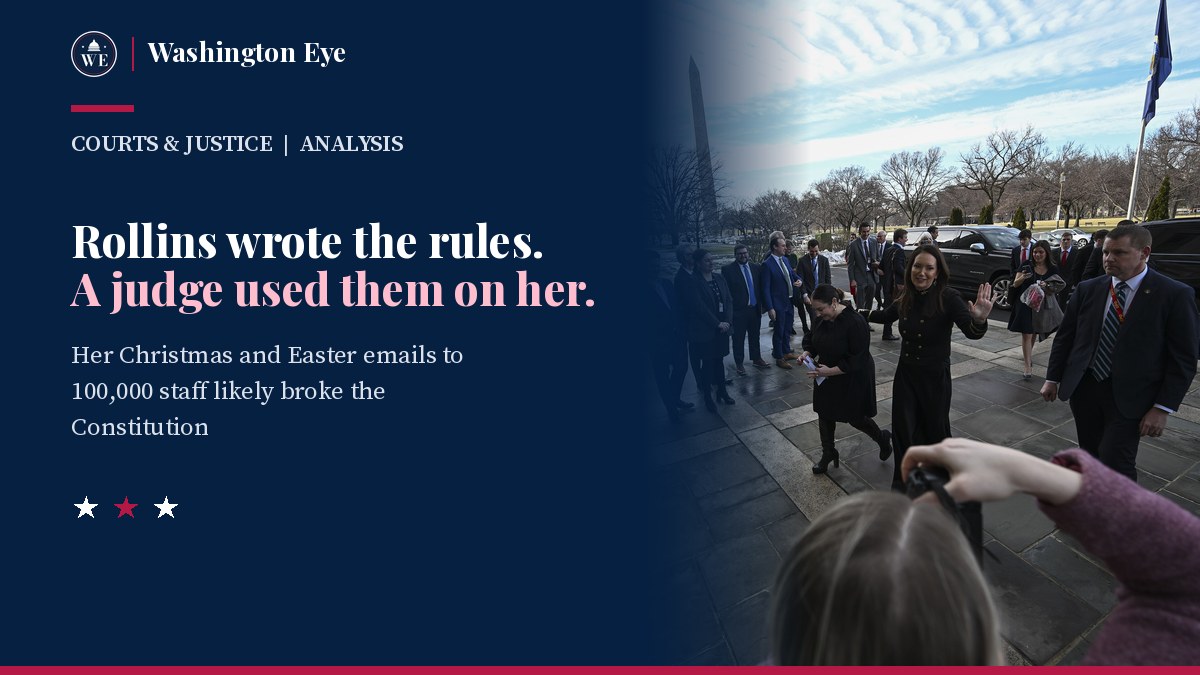
Last November, the Department of Agriculture issued a memo telling its staff how to talk about faith at work. Employees could share their beliefs with interested colleagues and invite co-workers to services. But there were limits. They "must stop if a colleague asks" them to stop. They "cannot use official authority to pressure subordinates." The memo carried the authority of the secretary, Brooke Rollins.
On Thursday, a federal judge in San Francisco turned that memo against the woman whose office issued it. In a 21 page order, US District Judge Trina L. Thompson found that two of Rollins's holiday emails to the department's roughly 100,000 employees, a Christmas video in December 2025 and an Easter message in April 2026, likely violated the First Amendment's ban on government establishment of religion. The limits she placed on the secretary were lifted, almost word for word, from the department's own guidance.
"Why should the Secretary be exempt from her own rules?" Thompson wrote. "The buck stops with Secretary Rollins."
The department called the ruling "a completely unprecedented attempt to muzzle a Cabinet Secretary" and said it was "evaluating all options including a prompt appeal." The fight now heads toward a larger question the Supreme Court has left open: when does a powerful official's religious speech stop being personal expression and start being government pressure?
What Rollins sent
According to the order, the messages began soon after Rollins took office in February 2025. Her Independence Day email in July 2025 closed with "May God continue to protect the United States of America and may His favor shine over all her land." Her Thanksgiving message that November credited the first Thanksgiving in part to "gratitude towards a loving God." The judge did not find either of those unlawful.
The two that crossed the line were more explicit. On 23 December 2025, Rollins emailed all staff a Christmas video in which she said "the spirit of generosity flows from the very first Christmas when God gave us the greatest gift possible, the gift of his Son and our Savior Jesus Christ, who came to free us from our sins and open the door to eternal life." On 5 April 2026, an email addressed to "All USDA Employees" opened: "Happy Easter, He is Risen indeed! Today we celebrate the greatest story ever told, the foundation of our faith, and the abiding hope of all mankind." It compared department staff to "the very first disciples to encounter our risen Lord" and urged them toward "the mission each of us has been called for" with "Paschal joy."
The plaintiffs are six department employees and the National Federation of Federal Employees, a union that represents about 110,000 federal workers, including more than 19,000 at the department. The individual workers identify as Jewish, Buddhist, Pagan, atheist, Humanist or nonreligious. In court filings, one said she no longer felt safe discussing a Buddhist holiday she celebrates. An atheist plaintiff said the messages left them feeling silenced, and a Pagan plaintiff described pressure to appear Christian to get ahead. Another plaintiff, Lanette Dietrich, said in a sworn declaration that she was told it was "not possible" to be removed from the distribution list and was warned she would "create trouble" for herself if she kept asking.
When the suit was filed in May, Rollins responded in a post online: "It's just another opportunity to remind everyone: He is Risen."
Why the judge called it coercion
The case turned on one word. Since its 2022 decision in Kennedy v. Bremerton School District, the case of the high school football coach who prayed at midfield, the Supreme Court has told lower courts to stop using older tests and to judge Establishment Clause claims by history and tradition, with coercion as the central concern. Kennedy won because, the justices said, his prayers were not "recited to a captive audience." But the Court has never spelled out exactly what counts as coercion.
Thompson built her answer on three factors: Rollins's position at the top of the department, her use of the official all staff email, and what the judge called the "alienating language" of the messages. The second point did most of the work. The government argued that employees could simply ignore the emails. The judge did not accept that. The same account, she noted, carries notices about reorganisation, relocations, shutdown planning and the deferred resignation programme, and holiday messages have sometimes included leave announcements. "To suggest that Plaintiffs may choose at their discretion which of the Secretary's emails to read and which to ignore defies logic," she wrote.
That, in her reading, made the workforce exactly the kind of captive audience the Kennedy majority said was missing on the football field. She also pointed to the pronouns. The Easter email's "we," "us" and "our" assumed every recipient shared the secretary's faith, and the absence of messages for other religions' holidays reinforced the point. The message, she wrote, cast the department's work "as a mission to serve her particular Christian views."
Thompson went out of her way to say what she was not doing. "This Court's judgment says nothing about the value of prayer or those who believe in its power," she wrote. She quoted the Supreme Court's warning that a "relentless and all-pervasive attempt to exclude religion from every aspect of public life could itself become inconsistent with the Constitution," and said she expressed "no view whatsoever" on what Rollins does in her personal capacity.
What the order actually forbids
Early headlines said Rollins had been barred from sending Christian messages. The binding language is narrower. The order requires her to follow the department memo when sending religious content: stop if asked, do not create a hostile workplace, do not use official authority to pressure subordinates. It also confirms she may discuss her beliefs with interested colleagues, explain why her faith matters to her and politely invite co-workers to services.
The sharper edge is in the remedy. Because the department gives employees no way to opt out of the secretary's emails, the judge said she must block messages like the two she found unlawful from reaching everyone, not just the seven plaintiffs. She tied that to the Supreme Court's 2025 ruling in Trump v. CASA, which curbed universal injunctions but allowed broader relief where it is the only way to give the plaintiffs complete protection. She compared it to a noise case: a court cannot stop loud music for one neighbour alone.
The government also won something. Thompson threw out the plaintiffs' claims under the Administrative Procedure Act, ruling that holiday emails are not final agency action. Only the constitutional claim goes forward. A case management conference is set for 17 December, with a joint statement due on 10 December.
The administration's own rulebook pulls the other way
The ruling lands awkwardly against the administration's wider push on religion in federal workplaces. In July 2025 the Office of Personnel Management told agencies that employees may try to persuade colleagues "of the correctness of their own religious views," provided the efforts are not harassing. That memo went further on one point that matters here: it said the constitutional rights of supervisors to have such conversations "should not be distinguished from non-supervisory employees."
Thompson's order rests on the opposite instinct. To her, rank is the whole problem. A rank and file worker who sends an unwanted all staff email urging colleagues to fast for Ramadan or attend a synagogue would likely breach the department's rules, she reasoned, and a cabinet secretary who reports directly to the president deserves "greater concern," not less.
Supporters of Rollins see the case the other way round. To them it is a judge policing the content of a cabinet member's holiday greetings, with no one forced to pray, attend anything or change their beliefs. The department's "muzzle" language reflects that view. Some legal scholars think the government has a real chance on appeal. Michael Helfand, a law professor at Pepperdine University, noted that the Supreme Court now treats coercion as the core of the Establishment Clause without saying what coercion means. "Saying emails are coercive will be tough," he said.
The plaintiffs' side reads the order as a warning shot. "Federal employees are public servants, not an audience for their bosses' personal religious beliefs," said Randy Erwin, the union's president. Rachel Laser, president of Americans United for Separation of Church and State, which represents the workers alongside Democracy Forward and a private firm, said the decision should tell the administration it "cannot misuse taxpayer resources to preach."
What to watch
The first test is the calendar. Christmas is five weeks away, and Rollins sent a religious Christmas video last year. The order names only the December and April messages as going too far and faults them for going "beyond mere holiday wishes," which leaves open how a plainer greeting would be judged. Any appeal would go to the Ninth Circuit, which could pause the order or leave it in place while it decides.
The bigger stakes run beyond one department. If the reasoning holds, it gives federal workers a template: an official inbox that staff are expected to read, a message that assumes a shared faith, and no way to opt out. If it falls, it would signal that the Kennedy framework leaves senior officials wide latitude to speak about faith through official channels, so long as no one is ordered to join in. Either way, the cleanest argument in the case may be the one the judge borrowed from the defendant. The department wrote the rules. The question for the appeals court is whether the person at the top has to follow them.