
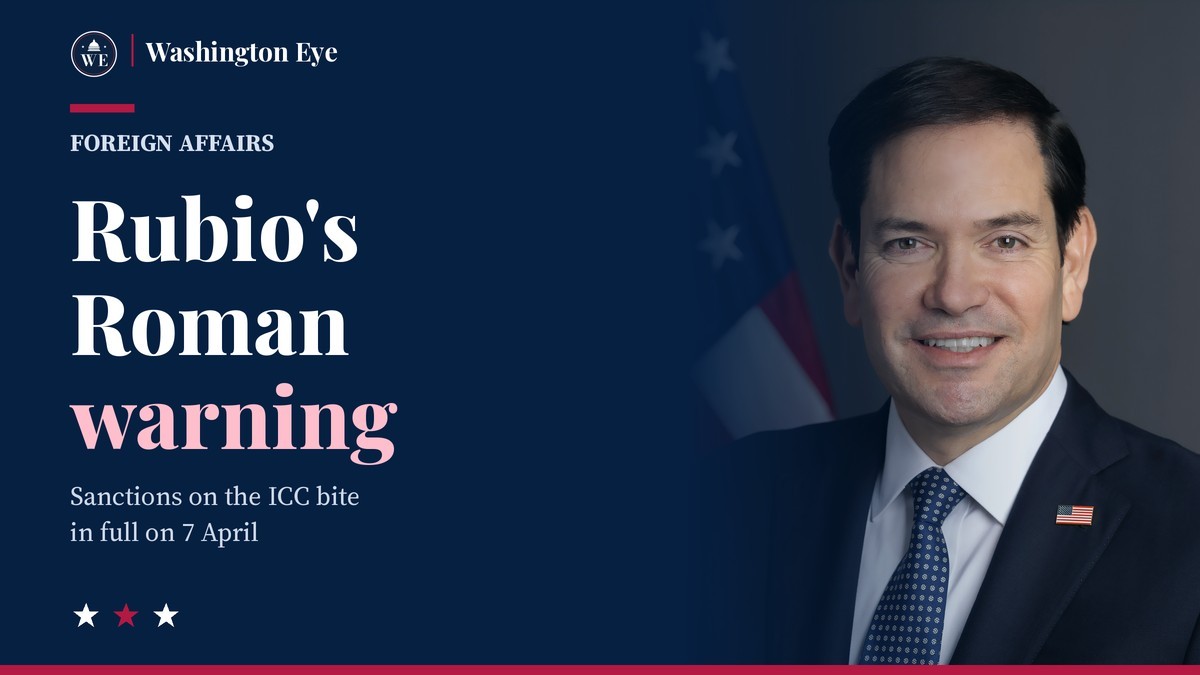
Marco Rubio reached back two thousand years for his punchline. Speaking to a packed ballroom of conservative lawyers in Washington on Friday evening, the secretary of state warned the International Criminal Court what would happen if it ever tried to enforce its rulings against Americans. The answer, he said, would probably be the one the Roman general Pompey gave to the people who cited their city's charters against his legions: "Stop quoting laws to men with swords."
The line drew laughter, and Rubio joked that it was not politically correct. But it was not a throwaway. It came one month after the Trump administration did something no American government had done before: it placed the court itself, not just its officials, on the Treasury's list of sanctioned entities. And it came with a clock attached. The licence that lets banks, landlords, software firms and insurers keep dealing with the court runs out at one minute past midnight, Eastern time, on 7 April 2027. Unless the court's supporters reach some arrangement with Washington before then, the institution in The Hague will have to find out how to run a global tribunal without access to the American financial and technology system.
That is the real story behind the speech. Rubio was not announcing a new policy on Friday. He was explaining, to a friendly audience and in the sharpest language he has used yet, why the administration intends to see the existing one through.
The occasion was the Barbara K. Olson Memorial Lecture at the Federalist Society's National Lawyers Convention, a fixture of the conservative legal calendar. It was Rubio's first major prepared speech since Republicans lost both chambers of Congress in the 3 November midterm elections, and he received a standing ovation.
His argument went well beyond one court. International law, he said, had been invoked against "nearly every major foreign policy decision" of the administration, from the strikes on suspected drug boats in the Caribbean and the eastern Pacific to the capture of Venezuela's then president, Nicolas Maduro. "For this global elite, international law is not a neutral body of rules," he said. It was, in his telling, "an instrument to advance their interest under the pretense of universal principles."
The court was his main target. "Americans have never agreed to submit to the ICC's authority," Rubio said, "but that court and its allies in the global bureaucracy have appointed themselves judge and jury and executioner of the international order." He described a tribunal accountable to no one yet "armed with the power to investigate, to prosecute, to persecute and to jail our citizens" under laws Americans neither consented to nor control. The United States, he added, would not "submit to the sterile vision of radical judges or soulless global bureaucrats."
He also used the speech to restate the purpose of the war the United States launched with Israel against Iran in February: to make sure Tehran never builds a nuclear weapon. He called the urgency greater because of what he described as the "expansionist mentality" of Iran's "radical Shia clerics." In a striking aside, he contrasted Iran with North Korea, whose leader Kim Jong Un has met President Donald Trump three times. "I'm not excusing the terrible things that have happened there," Rubio said, but Kim, in his view, "is not expansionist."
The legal machinery behind Friday's rhetoric is Executive Order 14203, which Trump signed on 6 February 2025. It declared a national emergency over the court's efforts to investigate or prosecute Americans and citizens of allies, including Israel, that have not accepted its jurisdiction. The first target was the court's chief prosecutor, Karim Khan. Over the following year the State Department added judges, deputy prosecutors and several Palestinian non-governmental organisations. By the department's own count, 17 people had been sanctioned under the order before October.
Then, on 9 October 2026, Rubio announced that the court itself was being designated. In plain terms, any property of the court that touches the United States is frozen, and Americans, along with any transaction passing through the United States, are barred from dealing with it unless a licence allows it. Penalties are steep: a civil fine of up to about $377,700 for a first violation, and for wilful violations up to 20 years in prison and a $1 million fine, according to an analysis by a London security institute.
The administration softened the immediate blow with four general licences covering ordinary operations and wind-down, information technology and cloud services, pensions, and matters involving detainees. The broadest of them, which covers things like member states' payments to the court, staff salaries and health insurance, rent and routine commercial services, is the one that expires on 7 April.
Rubio's October statement made the strategy explicit. "We have structured this action to provide an opportunity for States Parties to negotiate and present a solution to address our concerns," he wrote. The same statement was blunter elsewhere: "Either the ICC will end its threats, or we will end the ICC." If allies did not rein the court in, he wrote, the United States would keep working to dismantle it "brick by brick."
For a body that prosecutes genocide and war crimes, the court's vulnerabilities are surprisingly mundane. It has around 900 staff from about 100 countries, and it depends heavily on American technology. "We have been extremely dependent on US technology solutions," the acting chief prosecutor, Mame Mandiaye Niang, said in a recent interview, adding that the court was looking for alternatives that might not be as effective. Niang, himself under sanctions, has described being unable to book travel or hotels or carry out ordinary banking. Extending that treatment to the whole institution raises practical questions about paying staff, running investigations abroad, protecting witnesses and operating the court's detention centre.
The court has called the designation an "assault on the rule of law." Its defenders point out that it is designed as a court of last resort, stepping in only when a country is unwilling or unable to try a suspect itself. Its critics, including some who do not share Washington's hostility, note its thin record: 15 convictions and four acquittals since 2002, and a caseload long dominated by Africa. Its most prominent current defendant is Rodrigo Duterte, the former president of the Philippines.
The court has 125 member states, including every country in the European Union and every NATO member except the United States and Turkey. That is why the sanctions are as much a transatlantic quarrel as a legal one.
The Netherlands, which hosts the court, is bound by a 2008 headquarters agreement to protect its premises and staff and to keep its financial assets free from restrictions. Dutch Prime Minister Rob Jetten told the UN General Assembly in September that there could be only one response: "hands off the ICC." On the day the sanctions were announced, he said the Netherlands and Europe would defend the court "stone by stone," and warned that sweeping measures would "really affect relations between the U.S. and Europe."
The European Union called the sanctions "deeply regrettable" and said it was "ready to take any necessary measures to enable the court to carry out its work." The sharpest tool available is the bloc's blocking statute, which forbids European companies from complying with certain foreign sanctions. A European Commission spokesperson, Siobhan McGarry, said on 19 October that it "still remains on the table" but that no decision had been made, and that the Commission still hoped for "a more optimal outcome." Activating it would put European banks and tech firms in an awkward spot: obey Washington and break European law, or obey Brussels and risk American penalties.
Rubio's supporters argue that he is defending a position both American parties have held for a quarter of a century, and on that narrow point the record is on his side. The United States signed the Rome Statute that created the court but never ratified it. Israel, Russia, China and India are not members either. In 2002 Congress passed the American Service-Members' Protection Act, which authorises the president to use "all means necessary and appropriate" to free American or allied personnel held by the court. Its critics nicknamed it the Hague Invasion Act. Friday's reference to swords was, in that sense, a vivid restatement of a two-decade-old law.
The administration's specific grievances are the arrest warrant the court issued for Israeli Prime Minister Benjamin Netanyahu over the conduct of the Gaza war, and the court's long-running Afghanistan investigation, which could in theory reach American personnel. The court says that part of the Afghanistan inquiry has been "deprioritized," but Washington has not been reassured.
The court's backers answer with three arguments. First, the earlier bipartisan consensus was about refusing the court's jurisdiction over Americans, not about trying to bankrupt the institution for everyone else, including victims in cases that have nothing to do with the United States. Second, sanctions built for terrorist groups and hostile states are now aimed at a court whose members include nearly every close American ally. Third, treating international law mainly as a weapon wielded by elites makes it harder for Washington to invoke the same rules when it wants to, for example against Russian conduct in Ukraine or Chinese conduct at sea.
Analysts at a London security institute add that the fight lands on top of existing strains between the United States and Western Europe over trade, the war between Russia and Ukraine and the future of NATO.
The venue mattered too. The Federalist Society convention is a regular stop for Republicans with national ambitions, and Rubio is widely seen as a possible successor to Trump. He has firmly denied reports that he plans to leave his posts as secretary of state and national security adviser to prepare a 2028 presidential campaign. But a crowd-pleasing defence of American sovereignty, delivered days after his party's midterm defeat, will do nothing to quiet the speculation.
Democrats, who take control of both chambers in January, have little direct power over the sanctions, which rest on presidential emergency authority. They can hold hearings and ask questions, but undoing the designation would take a decision by the president himself.
Three things will decide whether 7 April becomes a real cliff. The first is whether member states open a serious negotiation with Washington, which is exactly what the administration says it wants and exactly what many European governments are reluctant to be seen doing. The second is whether Brussels activates its blocking statute, turning a fight between Washington and a court into a fight between Washington and the European Union. The third is whether the court can move its banking, software and insurance away from American providers fast enough to keep working.
Rubio's speech suggested the administration is in no hurry to blink. For the court and the governments that fund it, the next five months will show whether there is still room for lawyers in this argument, or whether, as Rubio put it, the swords have already been drawn.