
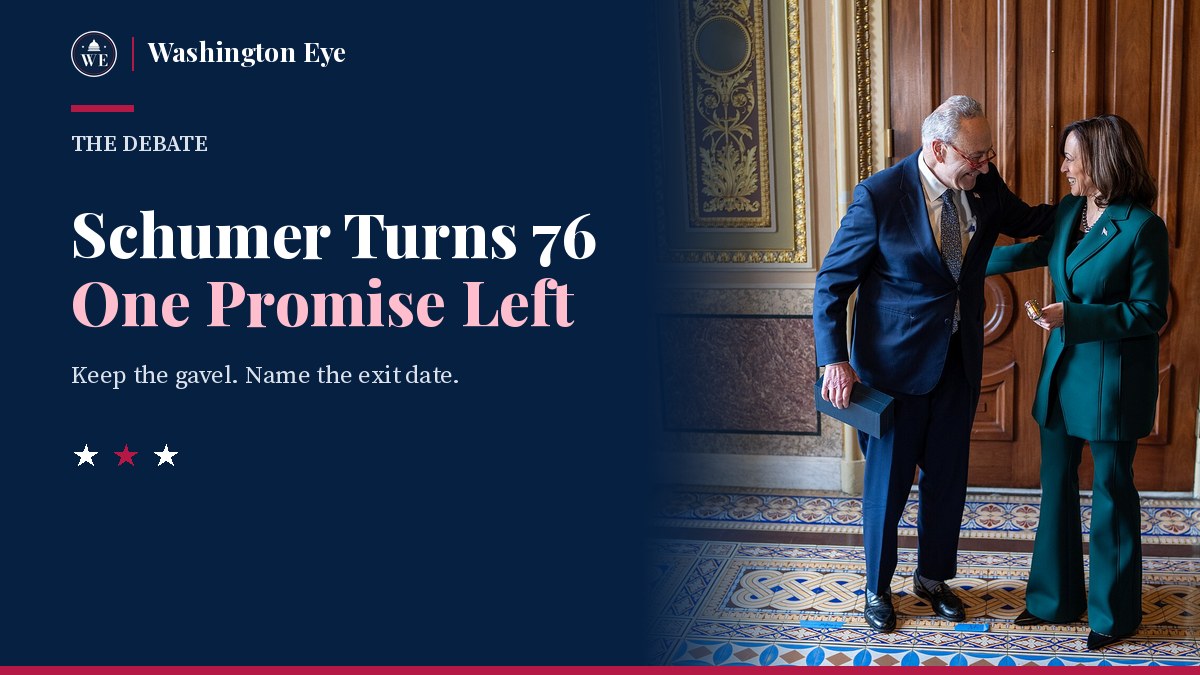
Chuck Schumer turns 76 today, and the present his colleagues seem to want most is a date. Not a dinner date. An end date.
Three weeks after leading Senate Democrats to one of their best midterm nights in a generation, the New York senator is fighting for his job. Democrats will hold 56 seats when the new Congress meets on January 3, after Mary Peltola's win in Alaska became the party's ninth Senate pickup of the cycle. In the House, the defeat of Representative Virginia Foxx in North Carolina pushed the Democratic majority to 258 seats. By any normal measure of political success, a leader who presides over a night like that gets a victory lap. Instead, Schumer has a challenger, a secret ballot on December 1 and a chorus of fellow Democrats telling him, politely and otherwise, that his time is nearly up.
Our view is simple. Democrats should keep Schumer as majority leader for the next two years, and Schumer should make that easy for them by promising, before the vote, that these two years will be his last at the top. That is the bargain that ends this fight without wrecking the party's first hundred days. It is also the bargain that Schumer, so far, refuses to offer.
The challenge nobody expected
Senator Chris Van Hollen of Maryland, 67, launched his bid for majority leader in mid-November, arguing that voters had demanded "a change from the status quo that isn't working for working people." "It's now on us to meet this moment, and to do that we need new leadership," he said. Senator Bernie Sanders of Vermont and Michigan's senator-elect, Abdul El-Sayed, quickly said they would back him. Senator Elissa Slotkin of Michigan joined Sanders in calling for new leadership, and a few other senators-elect have said they will not vote for Schumer.
Schumer's response was crisp. "I have the votes to continue serving as Democratic Leader," he said in a statement. "I welcome any discussion about the future of our caucus and the important work ahead." He had earlier predicted that he would face no challenger at all, which tells you something about how fast the mood has turned.
On Sunday, in a television interview, Van Hollen said his support stood at "north of 15" senators. That is well short of the 28 votes reported as needed to win, but he insisted he could get there. "If you look at our caucus, you can see a huge appetite for change," he said, adding that the Democratic Party is "on probation" with the public. "You don't earn people's trust by going back to business as usual." He also ruled out a run for president in 2028, win or lose, a move plainly meant to show that his bid is about the Senate and not about himself.
Why firing the winner is the wrong move
Start with the case for Schumer, because it is stronger than his critics admit. His allies argue that his leadership helped produce historic wins across the country, and the scoreboard backs them up. Nine pickups is not a fluke. Whatever voters were rejecting on November 3, it was not the Senate Democratic campaign.
A party that ousts its leader three weeks after a landslide also sends a strange message to the people who delivered it. Democrats are expected to unveil an ambitious agenda for the first 100 days in early December, once the leadership race is settled. Every day spent on a bruising internal contest is a day not spent on that agenda, and a secret ballot fight leaves scars that last long after the votes are counted. Van Hollen himself concedes he is the underdog. A drawn out war that he is likely to lose helps nobody except a Republican minority that would love to watch the new majority argue with itself.
There is also the practical problem of power. A majority leader controls the floor, negotiates with the White House and decides which fights the caucus picks. Doing that well against a president as combative as Donald Trump requires experience, relationships and a deep knowledge of Senate procedure. Schumer has all three. Van Hollen is a serious, respected senator, but he has never run a caucus.
Why the critics still have a point
And yet the critics are not wrong about the mood. Former Chicago mayor Rahm Emanuel, a friend of both men and a possible 2028 presidential candidate, put it bluntly on Sunday. Schumer, he said, should announce: "I'm going to secure the majority, I am not going to run for majority leader next cycle, and I'm going to make sure the other, the young voices and faces of this party grow." Asked whether that meant Schumer should still serve the next two years, Emanuel replied: "Yeah, just get it over with." His warning to both camps was sharper still: "This is not what people voted for. They voted to get their lives better, not yours." Emanuel has previously called for a mandatory retirement age of 75 for federal officials, including members of Congress. As of today, Schumer is past it.
Schumer's own silence is feeding the problem. He is up for re-election in 2028 and has declined to say whether he will run, telling one interviewer only that he is "focused on 2027 and delivering for the American people." New York Democratic operatives have said privately that they broadly assume he will not seek another term, and attention has already swirled around Representative Alexandria Ocasio-Cortez as a possible primary challenger. One operative claimed not to know "one person in New York politics" who thinks Schumer will run again. A former Schumer aide disagreed, saying he was "not convinced" his old boss would leave, especially after a good legislative year.
That uncertainty is the real cost. If Schumer wins on December 1 without saying anything about his future, the question does not go away. It follows him into every negotiation, every caucus lunch and every New York fundraiser through 2027. Senators who might want the job next will spend two years quietly campaigning for it. A veteran political columnist argued this weekend that Schumer's best exit is one he chooses himself, and we agree.
The Pelosi precedent
Democrats have been here before. At the end of 2018, after her party won back the House, Nancy Pelosi faced a rebellion from members who wanted a new generation in charge. She did not fight it to the last vote. She made a commitment not to stay in the Democratic leadership for more than four years, and that pledge helped her win the votes she needed to become Speaker again.
What followed is the best answer to the fear that a leader with an end date becomes a powerless lame duck. Pelosi's final term as Speaker produced the American Rescue Plan, the bipartisan infrastructure law and the Inflation Reduction Act. When the time came, after the 2022 election, she stepped aside, and the handover to a new team was orderly rather than bloody. Her deal did not weaken her. It freed her to govern.
Schumer could do the same thing this week. A simple statement would do: he will serve as majority leader in the coming Congress and will not seek the post again. It would take the heat out of the race, give wavering senators a reason to back him and give the party's younger members a clear path to compete openly for the next leadership election rather than plotting in the shadows.
What Van Hollen's camp should get in return
A deal like this should not be one sided. The challengers have raised real questions about how the Senate should work, and Schumer should answer them. Van Hollen called the filibuster "an anti-democratic provision," while acknowledging that "the job of the majority leader is to work with the caucus." He has suggested that Democrats agree in advance on standards for when Republican obstruction on issues such as political corruption and voting rights would justify changing the rules, and has floated a talking filibuster that would force opponents to hold the floor in person.
Those are reasonable ideas to debate inside a caucus that has just won a strong mandate. A two year leader who commits to open caucus votes on the rules, and on how the agenda is set, gives the change camp something more valuable than a symbolic leadership vote. It gives them a seat at the table.
Many senators are still keeping their counsel. "I'm thinking about just what's best for the caucus for this Congress. I'm not really thinking about what happens after that," said Senator Andy Kim of New Jersey, who has not publicly backed either man. Senator Peter Welch of Vermont said he had views he had shared with colleagues, but added: "That's a decision for Sen. Schumer."
It is. And it is the right decision to make before December 1, not after. Schumer has earned the chance to lead the majority he helped build. He has not earned an open ended lease on it, and neither has anyone else. A leader confident enough to win the vote should be confident enough to name the day he will hand over the keys. That would be the best birthday present he could give his party, and himself.