
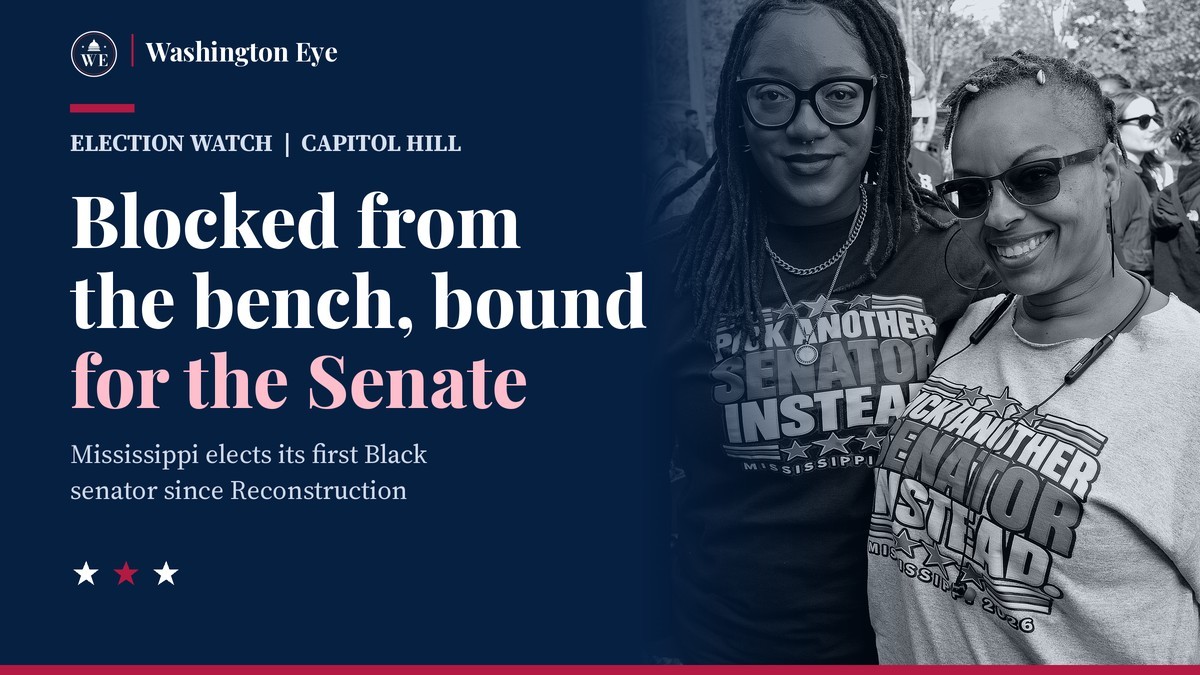
Three years ago, Cindy Hyde-Smith used one of the quietest powers a senator holds to stop Scott Colom's career in its tracks. When President Joe Biden nominated the north Mississippi prosecutor to a federal judgeship, she declined to return her "blue slip", the home-state sign-off that district court nominees need, and his nomination died without a hearing. Had it gone through, Mr. Colom would almost certainly be sitting on the federal bench today, appointed for life. Instead he ran against her. On Wednesday, he won.
A wire service declared Mr. Colom the winner on Wednesday evening, Washington time, eight days after Election Day and after county officials across the state had worked through thousands of absentee and affidavit ballots by hand. With 99 percent of precincts reporting, he led 49.2 percent to 48.7 percent. The latest published tallies gave him 472,188 votes to 467,603 for Ms. Hyde-Smith, a lead of roughly 4,600 votes, with the independent Ty Pinkins taking about 2 percent. The final update that settled the matter came from Jackson County, a Republican stronghold on the Gulf Coast, which reported more than 2,000 additional votes without narrowing the gap. The results remain uncertified ahead of a Friday deadline.
Ms. Hyde-Smith, 67, did not wait for certification. Her campaign said she telephoned Mr. Colom on Wednesday afternoon to concede, and she then posted a two-minute video. "While this is not the outcome we worked for or hoped for, I respect the decision of Mississippi voters," she said. "I want to congratulate Scott Colom and wish him well as he takes on the tremendous responsibility of representing our great state." Her campaign added that it had worked to ensure "every legally cast vote was counted".
The concession matters because the race had been heading toward a legal fight. Mississippi is the only state with no recount law, and lawyers for both campaigns arrived the day after the election. A clean concession closes that door and lets Mr. Colom begin transition work immediately.
The historical weight of the result is hard to overstate. Mr. Colom, 43, will be the first Democrat elected to the Senate from Mississippi since John Stennis won his final term in 1982. He will be the state's first Black senator since Reconstruction, when the state legislature chose Hiram Revels in 1870 and Blanche Bruce in 1875, and the first Black person ever popularly elected to statewide office in Mississippi. Ms. Hyde-Smith is the first sitting Mississippi senator to lose a re-election bid since the 1940s.
It happened in a state that President Donald Trump carried by 23 points two years ago, where Republicans hold every statewide office, and where most forecasters had rated the contest safe or likely Republican. Mississippi also has the largest Black population share of any state, about 38 percent, a fact Democrats have cited for decades as a reason to compete there and that has rarely translated into statewide wins.
Asked how it felt to be on the brink of that history, Mr. Colom said his concern was not to be the first but to make sure he would not "be the last". "I don't want anybody to say that I did anything to hurt the next person that has the talent, the work ethic, the ability to be able to reach for their dreams," he said.
Strip away the symbolism and the result is a story about turnout and a few counties. Mississippi Republican turnout fell by nearly 280,000 votes compared with 2024, according to an analysis by a conservative Mississippi news site, while the Democratic vote rose by only a little over 5,000. In other words, this was less a mass conversion than a collapse in Republican participation, combined with a Democratic base that held firm.
But there were conversions too, and they were striking. Mr. Colom won DeSoto County, a fast-growing and reliably Republican suburb of Memphis, by about seven points, according to state reporting. He flipped Lafayette County, home to the University of Mississippi, and Madison County, an affluent suburb of Jackson; both are majority-white and have swung between the parties in recent cycles. He also held down his losses in Harrison County on the coast, which has served as a Republican firewall for a decade.
The young vote was part of the story, and so was its fragility. More than 200 students at Jackson State University who believed they were registered, or who voted at the wrong precinct, saw their ballots rejected. "Ultimately, a tsunami of young people came out to vote and it got us to the finish line," Mr. Colom told local reporters, urging them to "fight to protect their vote". Derrick Johnson, the president of the NAACP, said Black voters had turned out "even in the face of efforts to remove voters from the rolls, attempts to intimidate voters and election officials, and bids to create fear around the electoral process".
Mr. Colom's campaign leaned hard on cost of living. His most widely shared advertisement used a clip of Ms. Hyde-Smith suggesting that voters unhappy about the price of beef could pick another protein; his supporters answered that they would rather pick another senator. He tied her to high gasoline and grocery prices, tariffs that have hurt Mississippi farmers, and the war with Iran, which polls showed was unpopular across the country. He has said he wants to end that war, restore health coverage for people who lost it, and abolish federal income tax for police officers, teachers and anyone earning under $75,000.
He also did something Mississippi Democrats rarely do: he embraced the national party. Former President Bill Clinton, former Vice President Kamala Harris, Representative Jim Clyburn, Senators Raphael Warnock, Cory Booker, Angela Alsobrooks and Lisa Blunt Rochester, and former Transportation Secretary Pete Buttigieg all campaigned with him, and former President Barack Obama appeared in an advertisement. Outside groups spent nearly $16 million backing him, according to one tally of disclosures, against about $2.4 million for Ms. Hyde-Smith, even though she outraised him directly by roughly $6 million to $4 million. The national Democratic Senate committee, by contrast, announced only a $500,000 investment six days before the election.
Ms. Hyde-Smith, a Brookhaven cattle farmer first appointed in 2018 to succeed Thad Cochran, ran a cautious campaign. She declined to debate Mr. Colom and rarely took extended questions from reporters. President Trump came to Corinth in late October and urged Mississippians to vote as if he were on the ballot. Her campaign attacked Mr. Colom as a puppet of national Democrats and of the billionaire George Soros, whose money backed a political committee that supported Mr. Colom's first run for district attorney in 2015.
The Democrat's campaign had its stumbles. Mississippi's Republican attorney general, Lynn Fitch, told him that one of his AI-generated videos appeared to violate the state's law against election deepfakes. His campaign also initially dismissed as fake a 2001 booking photograph released by the Hyde-Smith campaign; a conservative Mississippi news site then established that it was genuine, from an arrest at age 18 for contributing to the delinquency of a minor. None of it proved decisive.
Mr. Colom's victory is the eighth Republican-held Senate seat Democrats have flipped this year, bringing them to 55 seats. Alaska is still counting, with Democrat Mary Peltola ahead of Senator Dan Sullivan by about 4,000 votes and ranked-choice tabulation still to come. A Peltola win would mean a 56 to 44 chamber. The cushion matters: a majority leader with 55 or 56 votes can lose several moderates on a nomination or a spending bill and still prevail, which shapes everything from the war powers fight over Iran to the oversight battles the White House is already bracing for.
The new senator's first test comes quickly. Senate Democrats choose their leader on December 1, and Chuck Schumer faces an open challenge from members who want new leadership. Mr. Colom has said it gives him pause that Mr. Schumer and the incoming House speaker, Hakeem Jeffries, come from the same New York borough. Yet Mr. Schumer recruited him, called Mississippi his "white whale", and on Wednesday issued a joint statement with Senator Kirsten Gillibrand calling Mr. Colom "a seventh-generation Mississippian" who would be "a champion for Mississippi in Washington". Few expect the freshman to vote against the man who drew him into the race.
Mr. Colom has also said he wants seats on the Appropriations and Agriculture committees, the two panels that matter most to a poor, rural, farm-heavy state. Ms. Hyde-Smith sat on both. Mississippi's Republican governor, Tate Reeves, offered an early signal of how the state's establishment will deal with him, posting that he hoped "to collaborate" with the senator-elect on jobs, wages and schools.
For Democrats, Mississippi is now Exhibit A in an argument that the party can compete deep in Republican territory if it recruits local candidates, talks relentlessly about prices, and turns out Black voters in large numbers. Dan Pfeiffer, a former senior adviser to President Obama, said Mr. Colom had run "a model for Dems trying to flip very red states". Mike Espy, who lost to Ms. Hyde-Smith twice and handed his donor and voter lists to the Colom campaign, put it more simply: "This is Scott Colom's time, and his place is in the U.S. Senate." Bill Clinton offered the line many Democrats will repeat: "Blue Mississippi sure has a nice ring to it."
Republicans will draw a different and more uncomfortable lesson. A margin of about half a percentage point in a state Mr. Trump won by 23 points suggests that the party's problem this year was not that Mississippi has stopped being conservative but that conservative voters stayed home. That is fixable in a presidential year with Mr. Trump's name absent from the ballot and a different mood. It is also a warning: if a weak candidate, an unpopular war and high prices can cost Republicans a seat in Mississippi, few seats are truly safe.
The caveats are real. Mr. Colom won with a plurality, not a majority, which Mississippi law allows in federal general elections; Thad Cochran first won this same seat in 1978 with just over 45 percent in a three-way race. He has no legislative experience at any level. And he will face voters again in 2032 in a state where a Democrat has not won a full Senate term in more than four decades. Still, the man Ms. Hyde-Smith kept off the federal bench will be sworn into her seat in January, and the Senate's newest majority will be a little larger because of it.