
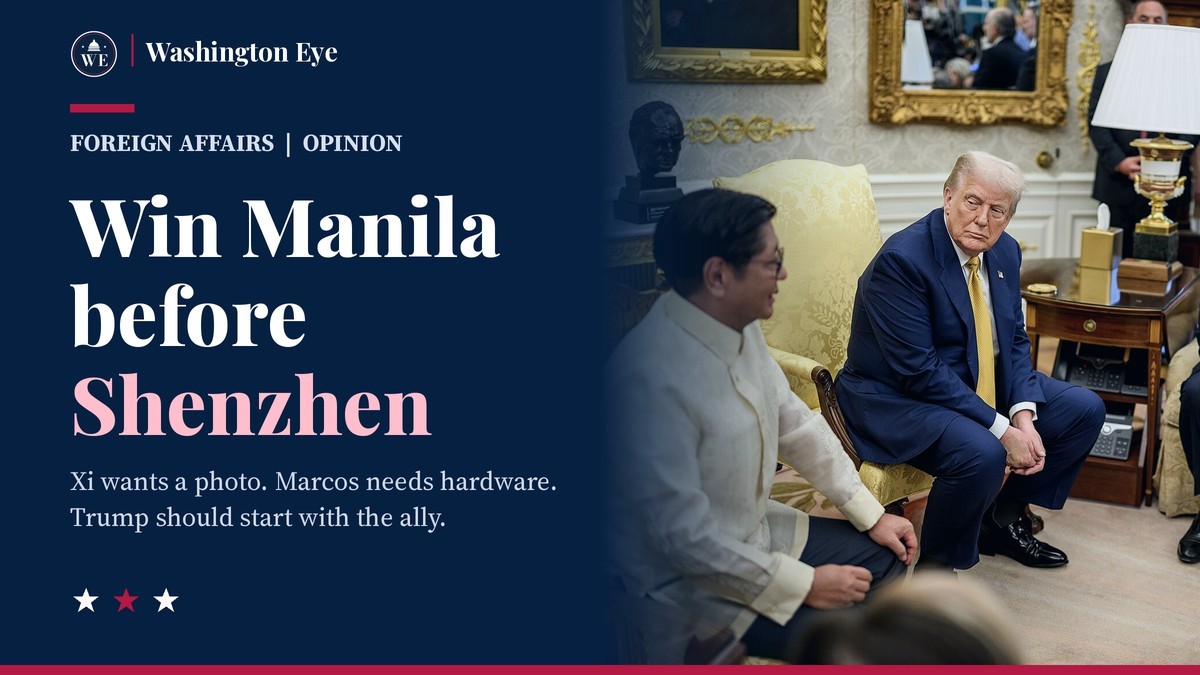
Every camera in Asia will be pointed at Shenzhen next week. If the choreography holds, President Donald Trump will sit down with Xi Jinping and Vladimir Putin on the sidelines of the Asia-Pacific Economic Cooperation summit on November 18 and 19, in what would be an extraordinary three-way meeting of the leaders of the world's three largest nuclear powers. Commentators have already reached for the word Yalta. The White House talks of denuclearisation. Beijing talks, carefully, of staying "in communication with relevant parties."
The more consequential stop comes first, and it will get a fraction of the attention. On November 17, according to the Philippine foreign ministry, Mr. Trump is expected in Manila for a special summit with the leaders of the Association of Southeast Asian Nations, as the Philippines closes its year in the bloc's chair and hands it to Singapore. A senior Philippine diplomat in charge of preparations said on Thursday that a one-on-one meeting with President Ferdinand Marcos Jr. is certain. "President Trump is coming so there will definitely be a bilateral engagement," said Dominic Imperial, who runs the ministry's ASEAN office.
That meeting is where this trip can actually be won. A photo with Mr. Xi and Mr. Putin is a hope. A stronger Philippines is something Washington can deliver in an afternoon.
Start with what Shenzhen is likely to produce. A major American newspaper reported this week that Beijing wants any trilateral to be a scripted affair, with each leader reading a prepared statement and little room for discussion, while the administration is pushing for a looser format. The same report quoted a Chinese official saying Beijing would not agree to take part in trilateral arms control talks. China's foreign ministry said last month that it would be "neither fair, reasonable nor realistic" to ask China to join such negotiations at this stage, because its arsenal is not at the level of America's or Russia's. Even after Secretary of State Marco Rubio's call with Foreign Minister Wang Yi on Wednesday, which the State Department said affirmed the value of leader-level talks on peace and denuclearisation, Beijing's own account of the call left those words out.
Seasoned China hands across the spectrum expect little. Ryan Hass, a China scholar at a Washington think tank, told a wire service that "the symbolism ... will account for a good portion of its substance," and that Mr. Xi and Mr. Putin will probably agree on broad principles without committing to follow-on actions. Kurt Campbell, who served as deputy secretary of state under President Joe Biden, called the meeting "very risky and deeply unpredictable for Xi," adding that Beijing would rather manage Washington and Moscow separately "and extract their own quid pro quo" from each. A China scholar writing this week predicted that, if it happens at all, the meeting will hew to the host's wishes and offer "more pomp and less substance."
None of that is a reason to skip Shenzhen. Talking to rivals is part of the job, and a president who wants to bring China into nuclear limits has to keep asking. It is a reason not to let the Shenzhen photo define the trip, and certainly not to pay for it with anything Manila needs.
Because the Philippines is where China's pressure is not hypothetical. In July, according to the Armed Forces of the Philippines, eight China Coast Guard personnel attacked Philippine Navy sailors at Second Thomas Shoal, the reef where the Philippines keeps the grounded warship BRP Sierra Madre as an outpost, leaving at least one Filipino with a bloodied head. Around the same time, Chinese ships turned water cannon on Philippine vessels near Scarborough Shoal. Mr. Rubio, who was in Manila at the time, said an American Coast Guard cutter in the area had helped "stand between the two sides" so the injured sailor could be evacuated.
His words then were the right ones. "We're a treaty ally," he said. "The United States and the Philippines have a treaty. And so we will live by that treaty." He added: "We're not going to abandon our allies." The 1951 Mutual Defense Treaty commits both countries to respond to an armed attack on either side's armed forces, public vessels or aircraft in the Pacific. Every Chinese probe at Second Thomas and Scarborough is, in part, a test of whether Washington means it.
The diplomatic track that was supposed to calm those waters has stalled. ASEAN set itself a 2026 deadline to finish a code of conduct with China for the South China Sea. The Philippines' year in the chair will end without one. Tang Siew Mun, a former head of a leading Singapore research centre on Southeast Asia, put it bluntly to a wire service: "The COC today, I think, has lost its purpose," he said, because facts on the water have changed as islands were militarised. When paper fails, deterrence rests on hardware, presence and resolve.
Here the Philippines' own numbers tell the story. Manila's proposed 2027 budget sets aside 50 billion pesos for its military modernisation programme, according to figures reported by a Philippine news site. The defence department told lawmakers in August that it needs almost 127 billion. Its overall request was cut by about 43 percent, and its capital outlay was slashed from nearly 240 billion pesos to under 33 billion. Defence Secretary Gilberto Teodoro has asked his Congress to scrap a 2012 modernisation law built on fixed 15-year cycles. "Which entity works on 15-year horizons in this day and age?" he asked in August.
Washington has already started to fill some of that gap, and the Manila stop is the moment to finish the job in public. When Defense Secretary Pete Hegseth met Mr. Teodoro in Cebu on October 28, the Pentagon said it would raise security cooperation funding to speed up the Philippine military's modernisation and improve coordination "along the First Island Chain," though it gave no figure and no timetable. The two men also agreed on what they called an "alliance command and control modernization sprint" to let the two militaries share information in real time. Congress, for its part, has authorised up to 500 million dollars a year in foreign military financing for the Philippines from 2026 to 2030, plus up to a billion dollars in direct loans, but appropriated at least 100 million dollars in grants for this fiscal year.
Mr. Teodoro has hinted that announcements are being held for the president's visit. "These are not cash grants, these are hard grants of equipment and capabilities so no cash is involved," he said earlier this month, describing the command and control initiative as "essential for our cyber and IT resilience." That is exactly the right model, and conservatives should cheer it. It is aid with a clear return: equipment that makes an ally harder to coerce, delivered to a partner that is trying to spend more on its own defence rather than less.
So what should Mr. Trump bring to Manila? First, numbers. The October promise of more money had no figure attached. Putting a dollar amount and a delivery schedule on it, standing next to Mr. Marcos, would turn a press release into a signal Beijing cannot miss. Second, a plain restatement that the treaty covers Philippine forces and coast guard vessels in the South China Sea, including at Second Thomas Shoal. Mr. Rubio has said as much; hearing it from the president, on Philippine soil, a day before he flies to China, would carry a weight no readout can match.
Third, a clear understanding that nothing Manila depends on is on the table in Shenzhen. Mr. Xi wants the optics of a historic summit without the risk of real conversation, according to people close to Beijing's decision-making cited by that major newspaper. Russia, by several accounts, wants to use the format to push its own terms on Ukraine. The worst outcome for American credibility in Asia would be a three-way communique full of warm language about stability, issued a day after a thin visit to an ally that has been taking water cannon blasts for Washington's principle of freedom of navigation.
There is a domestic case too. Mr. Trump arrives in Asia as a president who has just lost both chambers of Congress, with foreign policy one of the few arenas where he can still act largely on his own. Regional analysts say that does not make him a lame duck abroad. "He has two more years. He can do a lot of things," Mr. Tang said. Allies are watching to see what he does with them. Congress wrote the Philippine financing authority into a defence bill the president signed last December, and there is little sign the incoming Democratic majorities want to undo it.
Mr. Rubio has also been right to push wealthy allies to carry more of their own defence. The Philippines is not a wealthy ally, but it is a willing one. Its defence secretary is fighting his own legislature for a bigger modernisation budget, and the Senate president in Manila has backed him, citing conflicts in the Middle East and Eastern Europe. That is the kind of partner an America First foreign policy should reward: one that asks for equipment, not cash, and that sits on the front line Washington says it cares about most.
There will be protests in Manila; civil society groups have said so, and the government has declared special non-working days from November 16 to 18 for security and traffic. There will be pageantry in Shenzhen. The test of the trip is simpler than either. When Mr. Trump leaves Asia, will China's coast guard think twice before boarding a Philippine resupply boat at Second Thomas Shoal? A photo with Mr. Xi and Mr. Putin will not answer that question. What he signs in Manila might.