
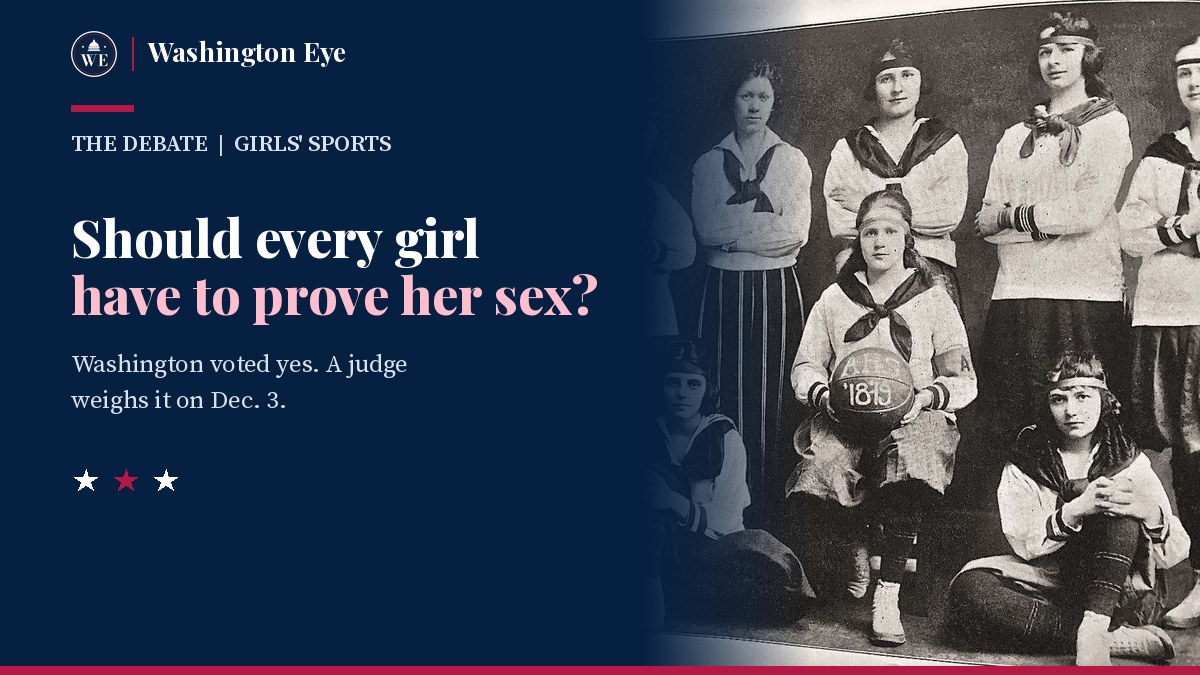
On December 3, at nine in the morning, a King County Superior Court judge will hear a request that could decide whether a law approved by more than 1.7 million Washington voters takes effect that same day or waits. The law is Initiative 638. It bars transgender girls from girls' school sports teams, and it asks every girl who wants to play on those teams to have a health care provider confirm her biological sex.
The first half of that sentence is the part most people argued about during the campaign. The second half is the part now driving the lawsuit, the doctors' objections and the scramble inside school athletic offices. It is also the part where the honest arguments on both sides are strongest, which is why we have set them out side by side below.
What voters approved
Initiative 638 passed on November 3 with 1,774,044 votes in favour and 1,396,656 against, about 56 percent to 44 percent, in the state's latest count. It was brought by Let's Go Washington, the conservative political committee founded by Redmond hedge fund manager Brian Heywood, who gave about $2.2 million to the campaign. It reached the ballot as an initiative to the Legislature, which declined to act on it during the 2026 session.
The result stood out because Washington voters rejected the committee's two other measures on the same ballot: a repeal of the state's tax on household income above $1 million, and a parental rights measure on school materials and sex education. Voters who were unwilling to follow the campaign on taxes or curriculum followed it on girls' sports.
The text applies only to girls' interscholastic teams. To play, a student must have a provider verify her sex "based on the student's reproductive anatomy, genetic makeup, or normal endogenously produced testosterone levels." Boys' teams have no matching requirement.
The state's school sports association has already begun to comply. It says girls in basketball, wrestling, flag football, bowling, gymnastics and competitive cheer will need a signed biological sex attestation from a provider by December 3. A girl who already has a valid sports physical will not need a new exam, only the new form. A girl without one may keep practising but cannot compete until it is filed. Spring and fall girls' sports follow. Schools may choose to collect attestations from boys too, but that is left to local districts. The association says deciding a student's sex is a medical question and deciding eligibility is a school question.
The fight in court
The lawsuit was filed on November 9 by the Washington Education Association, the statewide teachers' union, along with TransFamilies, a nonprofit that assists transgender youth, and parents of both transgender and non-transgender girls in Seattle Public Schools. On November 18 they asked Judge Maureen McKee for a preliminary injunction, and for interim relief keeping the old rules in place if she cannot rule before the law kicks in.
Their claims rest entirely on the state constitution: its Equal Rights Amendment, its privacy protections and its guarantee of equal education, plus an argument that the initiative changes existing anti-discrimination law without setting out the statutes it affects. That focus is not an accident. On June 30 the US Supreme Court ruled in West Virginia v. B.P.J. and Little v. Hecox that states "may determine eligibility for women's and girls' sports based on biological sex," as Justice Brett Kavanaugh wrote for the majority. The federal door is closed. Washington's own constitution is the door that remains.
The defence is unusual too. Attorney General Nick Brown, a Democrat whose office is litigating several transgender rights cases, appointed an outside firm, Bryan Cave Leighton Paisner, to defend the measure. "My personal views do not dictate what laws get defended or the strength of that defense," he said. Let's Go Washington is not convinced. "This is the law firm you would hire if you wanted to strike 638 down, not defend it," said its executive director, Darren Littell. A national group, Female Athletes United, represented by Alliance Defending Freedom, has asked to join the case, saying its members include Washington cross-country runners who raced this fall against a transgender athlete from Camas High School.
The federal government has also stepped in. On November 12 the Education Department's civil rights office opened a Title IX investigation into the Camas School District over that same athlete and complaints about how the district handled teammates' concerns. "Washingtonians sent a message," said Kimberly Richey, the assistant secretary for civil rights. The district says it will cooperate and notes that opening an investigation is not evidence of a violation.
The case for I-638
Supporters start with a point the highest court in the country has now endorsed. Sex-separated sports exist because of physical differences, and in the majority's words, "forcing female athletes to compete against males can create significant safety risks" in contact sports and "can undermine competitive fairness" in nearly all of them. Twenty-seven states had already drawn the same line, the opinion noted, as have the NCAA and the US and international Olympic committees. Washington was an outlier, and its own athletic association tried and failed three times in two years to change its gender identity rules, with two proposals winning majorities but falling short of the 60 percent needed.
Then comes the democratic argument. A clear majority voted for this, in a state that otherwise rejected the same committee's agenda. When the attorney general outsources the defence and a lawsuit seeks to freeze the law on the morning it begins, supporters see an establishment hoping a judge will undo what voters chose. Under the state constitution, lawmakers cannot amend an initiative within two years of its enactment without a two-thirds vote in both chambers. A court injunction would get there faster.
On the verification clause, supporters say critics have described a law that does not exist. The initiative does not order genital exams. "In most cases, it would just be a doctor relying on existing medical records to check that box, so we don't anticipate much of a change," Hallie Herzberg, a spokesperson for Let's Go Washington, said before the vote. Birth certificates were excluded, she noted, because they can be changed in Washington. And if every girl has to file the form, no individual girl is singled out or questioned on the basis of how she looks, which is the outcome critics of narrower rules have long feared. "There can be a solution in the trans sports arena," Mr Heywood said on election night, "but it shouldn't come at the cost of every girl that wants to compete."
The case against I-638
Opponents begin where the law is most specific. It names three methods, and all three are medical procedures that a routine sports physical does not include. Seven professional medical associations, led by the Washington State Medical Association, said this week that they support pausing the law. "Physicians need time and clear clinical guidance before being asked to implement something that is, in our medical judgment, not part of a routine sports physical exam," said Dr. Matt Hollon, the association's president. Their statement warned that an exam of "reproductive anatomy" could be external or internal and that the vague wording puts physicians "in an untenable position."
The records shortcut, they argue, works only for girls who have a regular doctor. Many students get sports physicals at urgent care centres or mass clinics in school gyms, from providers who have never seen them before. "Doctors don't want to put themselves at risk of signing a paper of someone they don't know," said Dr. Ken Gass, a retired pediatrician in Bellingham, who opposed the measure. The doctors' groups add that laboratory tests are expensive, unlikely to be covered by insurance because they are not medically necessary, and so would fall hardest on girls from lower income families, who might face a choice between paying for a blood test and accepting an intimate exam.
That leads to the legal core of the challenge. The law treats girls differently from boys: only girls must prove their sex to play. Washington's Equal Rights Amendment is broader than federal equal protection doctrine, and opponents say a rule that puts a medical burden on every girl, and on no boy, is exactly the kind of sex-based burden that amendment was written to forbid. Before the Supreme Court reversed it, a federal appeals court in the Idaho case had made a similar point about "invasive sex verification procedures" falling only on female athletes. The June ruling settled the federal question. It did not decide what Washington's constitution says.
Finally, there is timing. Winter seasons are already under way, and the change lands in the middle of them. Opponents ask what harm there would be in a short pause while a court looks at a law that, by its sponsors' own account, was meant to change little in the doctor's office.
Where the real argument lies
Strip away the slogans and the two sides disagree less about who should play than about how the state should check. The Supreme Court has said states may draw the line at biological sex. Washington voters drew it. What remains open is whether the state can enforce that line by putting a new medical step in front of every girl, and only girls, with three listed methods that doctors say they were never trained to use for this purpose.
Supporters have a fair point that the most alarming readings are not required by the text. Opponents have a fair point that a law should not depend on doctors quietly choosing the mildest interpretation. A narrower ruling, one that lets the participation rule stand while asking for a clearer verification standard, is possible, though neither side has asked for it in those terms.
Whatever Judge McKee decides on December 3, it is unlikely to be the last word. The case raises questions under the state constitution that the Washington Supreme Court has not answered, a federal investigation is running alongside it, and girls across the state will be filling in new forms before their next game. The question on the ballot was whether transgender girls should compete on girls' teams. The question now in court is what every girl must do to prove she belongs on one.