
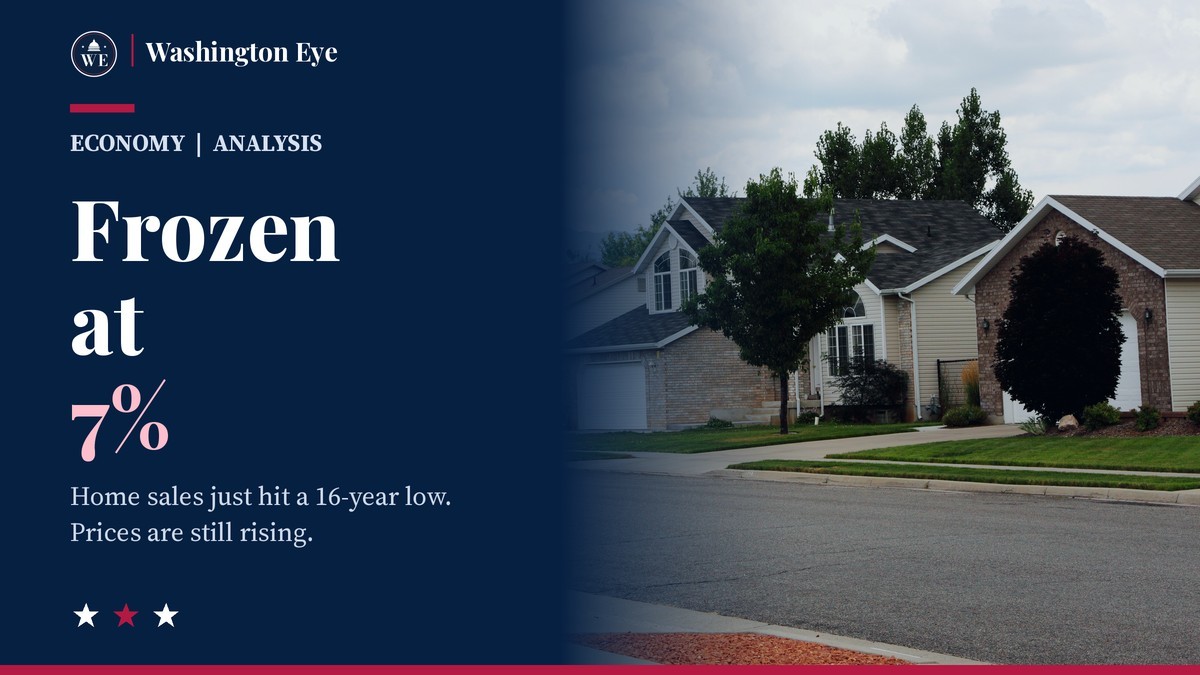
Americans bought previously owned homes in October at the slowest pace since the summer of 2010, when the country was still digging out of the worst housing crash in living memory. The National Association of Realtors said on Thursday that existing-home sales fell 5.5 percent from September to a seasonally adjusted annual rate of 3.75 million. That was 8.8 percent below the level of a year earlier and short of the 3.8 million pace economists had expected.
In 2010 a collapse in sales came with a collapse in prices. This time it has not. The median price of an existing home in October was $416,700, up 0.4 percent from a year earlier. By the trade group's count, it was the 40th consecutive month in which the median price was higher than in the same month a year before. Distressed sales, the foreclosures and short sales that flooded the market after 2008, made up just 2 percent of transactions.
That combination, almost nobody buying and almost nobody cutting, is the defining feature of the American housing market in late 2026. It is also a political problem for a president who promised to bring borrowing costs down and for a Democratic Congress that won both chambers this month largely on the cost of living.
The rate that broke the market
The proximate cause is not hard to find. The average 30-year fixed mortgage rate was 7.33 percent in October, according to Freddie Mac, up from 6.86 percent in September and 6.25 percent a year earlier. Rates breached 7 percent in late September and touched a three-year high of about 7.4 percent in early October.
"Home buying is difficult when mortgage rates have climbed to their highest levels since 2000, aside from a single month in 2023," said Lawrence Yun, the association's chief economist. "As a result, home sales fell to their lowest level since August 2010."
Rates have eased a little since. Freddie Mac's weekly survey put the 30-year average at 7.11 percent in the week to November 12, the fourth straight weekly decline and the lowest level in seven weeks. But that is still almost a full percentage point above the 6.24 percent of a year ago. On a $400,000 loan, a gap of that size adds about $230 to a monthly payment of principal and interest, before taxes and insurance.
It was not supposed to go this way. In January President Donald Trump directed Fannie Mae and Freddie Mac, the government-sponsored companies that underpin much of the mortgage market, to buy $200 billion of mortgage-backed securities to push rates down. For a while it seemed to work: rates dipped below 6 percent in February for the first time since 2022. The relief faded after the United States went to war with Iran. An oil price shock, renewed inflation fears, rising federal deficits and heavy borrowing to fund the boom in artificial intelligence investment have all pushed up the 10-year Treasury yield, which mortgage rates track.
Why prices are not falling
If buyers have pulled back so sharply, why are sellers not slashing prices? Part of the answer lies in who owns the homes. Mr Yun noted that the country's 88 million homeowners are "largely in a comfortable financial position due to sizable housing wealth accumulation." Most locked in far cheaper mortgages earlier in the decade. Few are forced to sell, and many would rather stay put than give up a loan at 3 or 4 percent for one above 7.
Supply is creeping up, but slowly. Total inventory was 1.59 million homes in October, 4.6 percent more than a year earlier, equal to 5.1 months of supply at the current sales pace. Economists usually treat four to six months as a balanced market, so the scales are tilting gently towards buyers rather than tipping. Homes are taking a little longer to sell: the median time on the market was 35 days, against 34 a year ago.
The national figure also hides real regional differences. In the West, sales were down 14.5 percent from a year earlier and the median price was flat at $624,300. In the South prices slipped 0.4 percent. The Northeast, the tightest market, still saw prices rise 3.2 percent. One bank's economists noted that price growth had slowed to a crawl and warned that if rates stay higher for longer, "home-price growth stalls or turns moderately negative."
Who is still buying
The buyers who remain are increasingly those who do not need a mortgage at all. Cash sales accounted for 29 percent of transactions in October. Individual investors and second-home buyers made up 20 percent, up from 16 percent a year earlier. First-time buyers, the group most exposed to high rates because they have no equity to roll over, fell to 29 percent of sales from 32 percent in October 2025.
The affordability gap is stark. The trade group's affordability index fell to 100.7 from 107.3 a year earlier, with declines in every region. One research firm estimates that a household now needs an income of about $115,600 to afford the typical cost of housing, 75 percent more than the $66,200 required five years ago.
The squeeze is spreading to builders. One of the country's largest homebuilders reported a 9 percent drop in third-quarter closings. "The rapid increase in interest rates has stretched affordability even further, made selling an existing home even harder, and has pushed even more consumers to the sidelines," its chief executive, Ryan Marshall, said in October. A homebuilder sentiment survey sank to a 14-year low in September, and pending home sales, which usually lead closings by a month or two, hit a record low in data going back to 2001.
The Fed is not coming to the rescue
Buyers hoping the Federal Reserve will ride to the rescue are likely to be disappointed. The central bank raised its benchmark rate by a quarter point in September, to a range of 3.75 to 4 percent, and its officials spent the past week signalling that more is coming. Consumer prices rose 0.4 percent in October and core prices 0.3 percent, both above forecasts. Producer prices were up 6.5 percent on the year, the most since November 2022.
"Inflation is rising," Austan Goolsbee, president of the Chicago Fed, said in a television interview on Friday. "It's proved far more persistent than we predicted at the beginning from the supply shocks, and now we're adding this old-fashioned demand overheating coming from the AI data center buildout." Governor Christopher Waller said in a speech this week that he was leaning towards supporting a quarter-point rise at the December meeting, and that "more robust action" might be needed if inflation came in substantially higher than he expected. Futures markets now fully price a December increase, with some chance of a half point.
Fed hikes do not move mortgage rates one for one; those follow long-term Treasury yields, which reflect expectations about inflation and deficits as well as policy. But a central bank that is still tightening is a central bank that is not cutting, and that keeps a floor under borrowing costs. One real estate economist summed up the near-term outlook bluntly: high rates, the usual autumn slowdown and election-season caution are "likely to keep home sales near long-time lows for the next few months."
A test for divided government
Housing now lands on the desk of a divided Washington. Democrats will control the House and Senate from January; Mr Trump keeps the White House and the agencies. The White House insists the president is "laser-focused on making housing more affordable," pointing to an executive order barring large Wall Street firms from buying single-family homes, the $200 billion bond purchase, and a deregulation drive. Last month Mr Trump signed another order aimed at easing mortgage insurance and refinancing costs.
Critics note that some proposals, such as a 50-year mortgage or portable mortgages that homeowners could carry to a new property, never materialised. Builders' groups say tariffs have raised construction costs and that deportations have slowed projects that rely on immigrant labour. And the one major housing law of the term, the bipartisan ROAD to Housing Act passed this summer, became law without the president's signature; he called it "a big yawn" and "of minor importance."
Industry lobbyists see an opening anyway. "Voters made it clear that affordability is a central concern, and housing is the biggest line item in most family budgets," said Isaac Boltansky, head of public policy at the lender Pennymac, who is pushing for a "ROAD to Housing 2.0" package. Mortgage bankers want lower insurance premiums on government-backed loans and cheaper closing costs. Others point to the tax on capital gains, which can discourage long-time owners from selling.
None of that will move the market quickly. Zoning and permitting, the biggest levers on supply, sit mostly with states and cities, and the biggest lever on demand, the cost of money, sits with a central bank that is fighting inflation. Mr Yun sees one reason for hope: with jobs still growing steadily, he said, "there could be sizable pent-up demand if mortgage rates decline."
Until they do, the market will stay where it is: plenty of owners who do not need to sell, a thinning pool of buyers who cannot afford to, and prices that refuse to give way. For the first-time buyer, that is not a crash. In some ways it is worse: a door that simply stays shut.