
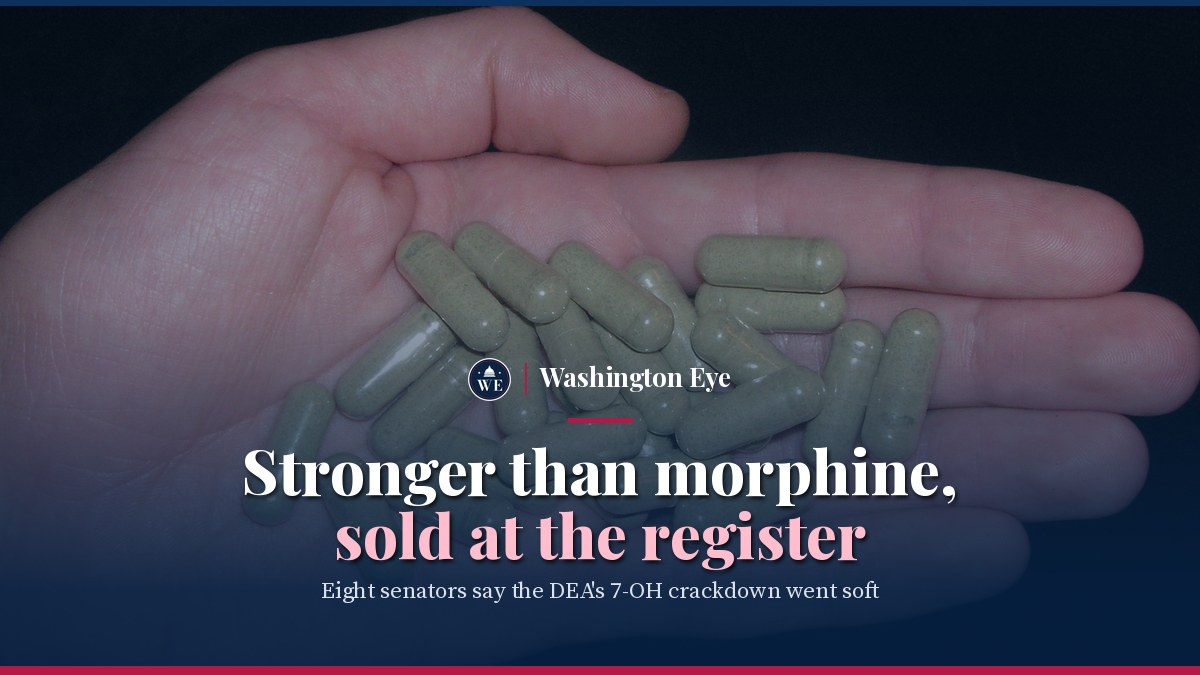
Brian had been off opioids for six years when he found the thing that pulled him back. It was not in an alley. It was a kratom product at a gas station, "literally right next to the register," he told a public radio reporter this month, packaged like an energy shot. Within minutes of taking it, he said, he felt "exactly" the way he used to feel on opioids. Later a smoke shop clerk offered him a sample of something stronger: small tablets of 7-OH. "Once I found these little tiny tablets, that I had to take one and it felt like I had taken an Oxycontin, you know, that was it," he said. "It was game over." At the height of his use he was taking 1,200 milligrams of 7-OH a day and spending about $150 to do it.
7-OH, short for 7-hydroxymitragynine, is found in tiny amounts in the leaf of the kratom tree. Sellers concentrate it, or boost it chemically, into tablets, gummies, tonics and even chocolate. Federal health officials first recommended controlling it in July 2025, and the government has been promising since to pull the strongest products off American shelves. As of this writing, it still has not. And when the order finally comes, it will be weaker than the one first proposed.
Eight Republican senators led by Chuck Grassley of Iowa, chairman of the Senate Judiciary Committee, say that is a mistake. We agree. Washington should stop drifting, publish the order, and restore the tougher standard it walked away from in October.
How a crackdown got softer
The timeline matters, because it shows a government that knew what it wanted and then blinked. In early July the Drug Enforcement Administration announced it intended to place 7-OH in Schedule I, the most restrictive tier of federal drug law, alongside heroin and LSD. The trigger was a threshold: kratom leaf with more than 0.05 percent 7-OH by dry weight, or processed pills, extracts and edibles above 0.05 percent or carrying more than one milligram of 7-OH per product.
On August 26 the agency went further and temporarily placed three semi-synthetic relatives in Schedule I: mitragynine pseudoindoxyl, known as MP, and two compounds called MGM-15 and MGM-16. The same day the American Kratom Association, the industry's best-known advocacy group, filed a federal lawsuit against the DEA, arguing that natural kratom products with trace amounts of MP could be swept up.
Then the government changed course. On October 8 the Department of Health and Human Services sent the DEA a new recommendation, and on October 14 the DEA withdrew its July notice and published a new one. Under it, 7-OH and MP together would be Schedule I only above one milligram per gram for solids or one milligram per millilitre for liquids, or where a product carries less than 100 times as much mitragynine, the leaf's main alkaloid, as it does 7-OH and MP. The order could be published on or after November 13. It takes effect the day it appears in the Federal Register, with no grace period, and runs for two years with a possible one-year extension.
November 13 has come and gone. At the time of writing, no temporary order had appeared in the Federal Register. Every day of delay is another day concentrated 7-OH stays legal under federal law.
What the senators are asking
Grassley wrote to the DEA and the Food and Drug Administration with Susan Collins of Maine, Rick Scott of Florida, Mike Crapo of Idaho, Bill Cassidy of Louisiana, Jerry Moran of Kansas, Shelley Moore Capito of West Virginia and Jim Risch of Idaho. Their complaint is simple: the October rewrite doubled the threshold first set for 7-OH and took MP out of Schedule I at low levels, which in their words would let both chemicals sit in over-the-counter products "at levels higher than those found naturally in the kratom plant."
"Kratom is a drug in any form with addictive properties, and we believe this combined threshold level for 7-OH and MP set by DEA is inappropriately high and unsound," the senators wrote. "If the administration's goal is to remove all unsafe products from the shelves, particularly synthetic or enhanced kratom products, this order misses the mark."
They want three things: the scientific and medical evaluations behind the higher limit, an explanation of how a looser threshold protects families better than a tighter one, and a decision to put any product containing MP back in Schedule I. Those are not radical demands. They are the questions any serious regulator should be able to answer before it eases a standard on a substance it has already called dangerous.
Notice, too, what the DEA itself conceded. In the October notice the agency wrote that neither it nor HHS has made a finding that these substances are safe to use below the new threshold. The higher line was drawn to keep certain products on the market, not because anyone showed that the products under it are harmless.
Why this is not a war on a leaf
The fairest objection to a crackdown comes from people who say kratom has helped them. It deserves a hearing. A Delaware mother, Angela Wilson, told the same reporter she takes 32 to 40 milligrams of 7-OH a day for pain from endometriosis and for depression, that it has been "truly life-changing," and that losing it without health insurance would be "devastating." Researchers at the National Institute on Drug Abuse say kratom compounds warrant further study as possible treatments for opioid use disorder. Some users point out that overdose deaths are falling: a health policy research group counted more than 79,000 opioid deaths in 2023 and about 54,000 in 2024.
But none of that argues for leaving concentrated 7-OH on gas station counters. Federal officials have said repeatedly that they are not targeting traditional leaf kratom. The fight is over enhanced products that look and act very little like a plant. The senators cite federal estimates that 7-OH is 13 times more potent than morphine and that MP is 20 times more potent. The DEA says state health authorities have linked 7-OH products and concentrated extracts to dependence, addiction, acute psychosis, slowed breathing, cardiac arrest and death.
The people who treat addiction are seeing it. A study of data from 53 US poison control centres found that calls related to kratom rose about 1,200 percent between 2015 and 2025, and recorded 233 deaths associated with kratom in that decade. Most of those deaths involved other substances too, but 62 percent of the calls involved kratom alone. "I certainly have a growing list of patients in addiction clinics who are addicted to this, and in withdrawal, that we're having to manage," said Chris Holstege, an emergency medicine professor at the University of Virginia and one of the study's authors. He also asked the obvious question about the shops springing up near his campus: "What else are they advertising this product for?"
David Epstein, a senior investigator at the National Institute on Drug Abuse, said his ongoing research suggests the risk of addiction is higher with 7-OH than with whole leaf kratom. Some users, he said, "couldn't make it through the night. They had to get up in the middle of the night to take more." Tyler, a 38-year-old who used kratom leaf to quit opioids, moved to 7-OH tablets in early 2025 and ended up in a rapid detox programme in Michigan. "It's just too addictive and too accessible," he said.
The states moved first
Conservatives usually prefer to let states lead, and on this issue they have. The DEA's own July notice listed nine states that had prohibited 7-OH: Alabama, Arkansas, Florida, Indiana, Kentucky, Louisiana, Ohio, Vermont and Wisconsin. Ohio's pharmacy board now bans kratom extracts and synthetic compounds outright while leaving natural leaf legal.
Florida's experience is the warning. The state limited 7-OH last year with an emergency rule that outlawed products over 0.04 percent concentrate, and new products appeared that skirted it. In June it tightened again, with a limit of one milligram per gram or millilitre and a rule that any product must contain at least 100 times more mitragynine than 7-OH. That is almost exactly the standard the DEA now proposes for the whole country.
To be fair to federal officials, that ratio test has teeth. A pill made mostly of 7-OH with little mitragynine would fail it at any strength, which targets precisely the enriched tablets that hooked Brian and Tyler. But Florida had to rewrite its rules once already because sellers found the gaps, and the federal limit is still double the line the DEA itself drew in July. A national market that sells across state lines and online cannot be policed by a patchwork of nine bans and a few dozen labelling laws. That is the one job Washington has to do itself.
What should happen now
First, the DEA should publish the temporary order without further delay. A notice that sits unenforced is a gift to the people selling these products. Second, the agencies should answer Grassley's letter in public and release the evidence behind the higher threshold. If the science supports one milligram per gram, show it. If it does not, go back to the July line. Third, MP, a compound the senators say is 20 times stronger than morphine, should be controlled in any amount in enhanced products, as the August order already did.
None of this requires banning the leaf or punishing people who use it to stay off fentanyl. It requires treating a concentrated opioid-like compound as what it is. A product that can put a man in detox should not be sold beside the register like an energy drink. Washington knew that in July. It should remember it now.