
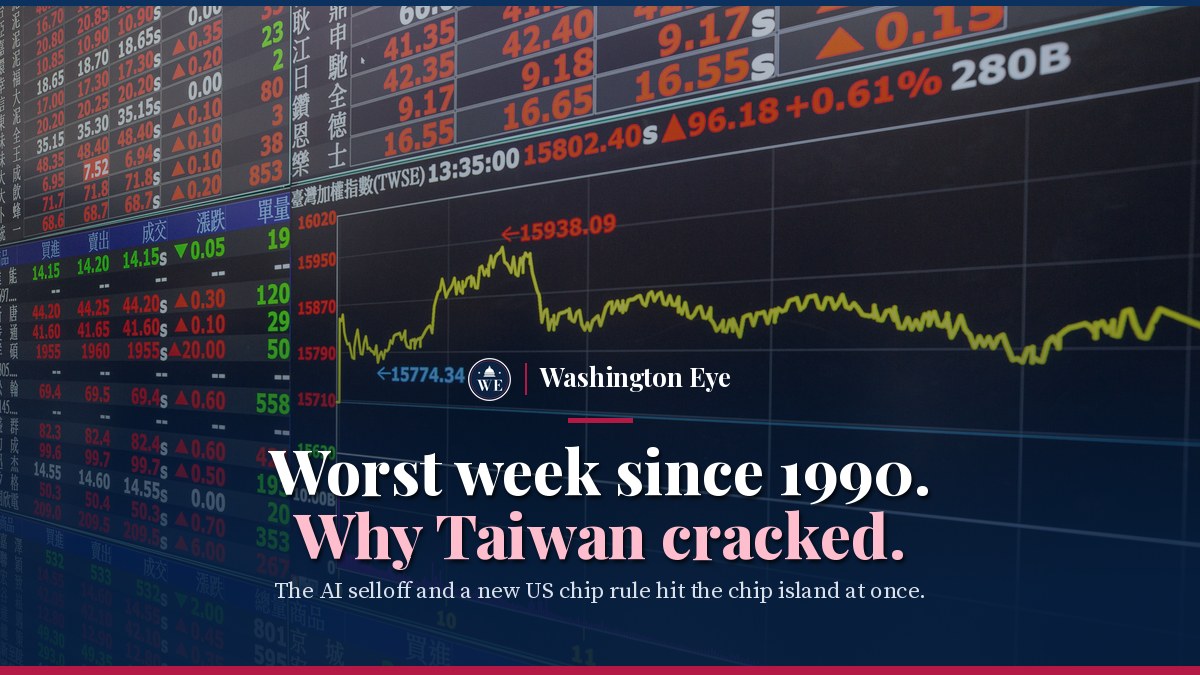
On Friday afternoon in Taipei the selling simply did not stop. Taiwan's benchmark stock index, the Taiex, fell 2,393.60 points, or 6.23 percent, to close at 36,033.29. That capped a week in which the index lost 7,641.83 points, or 17.5 percent, the steepest five day rout since 1990. Since its record high on October 6, the market has lost nearly 28 percent, about $1.12 trillion in value.
Taiwan is not just another emerging market. It is the place where most of the world's most advanced chips are made, and for two years it has been one of the purest bets on artificial intelligence anywhere. When that bet unwinds, the effects travel quickly: to Seoul and Tokyo, to Wall Street, and to the retirement accounts of millions of Americans who hold chipmakers through index funds. Here is a plain guide to what happened, why Taiwan was hit hardest, and what comes next.
How bad was the week, really?
Very bad by any modern yardstick. The only weekly fall steeper in Taiwan's history came in August 1990, when the index sank 21.8 percent in the final stretch of a speculative bubble that had already cut the market by more than 80 percent from its February peak. Friday's 2,393 point drop was the third largest one day point fall on record, exceeded only by a slide on July 17 and by Monday's 2,635 point drop earlier this same week.
The damage was concentrated in the companies that made Taiwan rich. Taiwan Semiconductor Manufacturing Co., the contract chipmaker that builds processors for most of the world's leading AI designers, fell 4.8 percent on Friday and 15.8 percent over the week. ASE Technology, which packages and tests chips, dropped 9.3 percent on the day and about 25 percent on the week. United Microelectronics fell 9 percent on Friday and more than 23 percent since Monday. MediaTek lost 9.9 percent in a single session.
It is worth keeping one number in mind for perspective. Even after this week, the Taiex is still up about 24 percent for the year. That tells you how far and how fast it had climbed before the fall began.
Why did Taiwan fall further than everyone else?
Because almost everything listed in Taipei is, in one way or another, an AI stock. Technology makes up more than 70 percent of the index. When investors around the world began to doubt that the vast sums being spent and borrowed on data centres would earn a return, there was nowhere in Taiwan's market to hide.
Several worries landed at once. The first was political. Analysts in Taipei pointed to the American midterm elections, in which Democrats swept Congress and local opposition to giant new data centres became a campaign issue. Fan Chen hung, general manager of Capital Investment Management, said the results highlighted growing resistance to data centre expansion in the United States, which could slow future construction. Fewer American data centres means fewer orders for the servers, chips and cooling systems that Taiwanese companies supply.
The second was Nvidia. Jensen Huang's sudden departure as chief executive of the chipmaker, together with uncertainty over roughly $530 billion in AI financing deals tied to the company, has weighed heavily on a market whose biggest firms depend on Nvidia's orders. Nvidia's shares fell 13.8 percent in New York on Friday alone, even after a quarterly report that one American fund manager described as possibly "one of the greatest quarters in corporate earnings history."
The third was the stock market debut of Anthropic, the maker of the Claude chatbot. Many investors had hoped its record listing would act as a vote of confidence in the industry. Instead the shares faded after a strong open, closing their first day 17.1 percent above the $83 offer price and then falling 9.1 percent on their second day. "The listing of Anthropic failing to lift the market sentiment is the main hit on AI across Asia," said Steven Leung, an executive director at the brokerage UOB Kay Hian.
What does a rule from Washington have to do with it?
Quite a lot, and it is the part of the story most likely to be missed. On November 16 the Commerce Department's Bureau of Industry and Security released an interim final rule titled "Addressing Remote Access to Advanced Semiconductors." It took effect on November 19, the day before Taiwan's worst session of the week.
The headline target is overseas data centres that rent large amounts of computing power to companies headquartered in China and other countries of concern. Data centres, foreign foundries and chip exporters must now carry out what the rule calls robust due diligence on their customers, including any hidden Chinese ownership or control. The rule also adds a new licence requirement for advanced chips sent to five countries the department says carry a higher than normal risk of diversion: Indonesia, Malaysia, Singapore, Thailand and Brazil. Shipments to companies headquartered in the United States are exempt if reporting requirements are met.
A less publicised provision hits Taiwan directly. Under existing controls, chips made on 16 or 14 nanometre processes or anything more advanced are presumed to be controlled AI processors, but foundries could overcome that presumption by certifying that a chip had a low transistor count. According to a client alert from an American law firm, that escape route is now closed for chip designers headquartered in China and other restricted countries, so foundries and packaging houses need a US licence to ship their chips. Reports this week said TSMC suspended orders using 16 nanometre and more advanced processes for some Chinese designers, leaving them largely reliant on older 28 and 40 nanometre technology.
Sixteen nanometres was cutting edge in 2015, when it went into phones of that generation. Eleven years later it has become a line that Chinese customers of Taiwanese factories cannot cross without Washington's permission, a direct hit to future sales.
Did Taiwan's government try to stop the slide?
Yes, twice over, and so far without much success. On November 6, after the index had fallen 20.55 percent from this year's high of 49,968, the National Financial Stabilization Fund held its 131st extraordinary committee meeting and authorised its executive secretary to deploy the fund's resources to support the market. The fund, worth NT$500 billion or about $15 billion, has intervened roughly ten times since 2000.
Regulators also moved against short sellers. The Financial Supervisory Commission first restricted short selling on November 6, including a ban on shorting stocks that had fallen at least 3.5 percent the previous day. On Thursday it went further, capping intraday short sale orders of borrowed shares at 1 percent of a stock's average daily volume over the previous 30 days, down from a 3 percent limit set earlier this month.
The market rallied briefly after the first intervention, then resumed its fall. Analysts say the curbs treat a symptom rather than the cause. "Limiting short selling activity does not eliminate underlying bearish sentiment or selling pressure from investors reducing existing long exposure," said Matthew Unterman, head of research at S3 Partners. The bigger force, several fund managers said, is ordinary investors who borrowed to buy stocks and are now being forced to sell as prices fall. "At this point, margin loan balance is still too high in Taiwan and that needs to come down more," said Xin Yao Ng, a fund manager at Aberdeen.
Is this only a Taiwan problem?
No. Taiwan was the epicentre, but the shock spread across Asia and beyond. South Korea's Kospi fell 5.2 percent on Friday, with Samsung Electronics down 7 percent, and Japan's Nikkei 225 lost 5.1 percent. A broad index of emerging Asian stocks fell nearly 9 percent over the week, its worst since March 2020.
Korea offers an instructive contrast. Its market was more than 46 percent below its June record by November 10, yet Seoul has so far declined to use its own stabilisation fund. "The fund is designed for highly urgent, temporary and exceptional circumstances," Lee Eog weon, chairman of Korea's Financial Services Commission, said last week. President Lee Jae Myung had warned in October that direct government intervention in share prices was "undesirable."
In New York, the S&P 500 fell 3.70 percent on Friday to 6,910.42, its seventh straight decline and its longest losing streak since February 2020. Both the S&P 500 and the Dow Jones Industrial Average are now more than 10 percent below their record closes, the formal definition of a correction. The Nasdaq Composite dropped 5.28 percent and is now down for the year.
Why should American readers care about a market in Taipei?
Because the AI boom that powered American stocks this year runs through Taiwan's factories. When foreign funds dump Taiwanese chipmakers, they are also expressing a view about the American companies that buy those chips and the American data centres that house them. Desh Peramunetilleke, head of quantitative strategy at Jefferies, downgraded Taiwan to neutral and Korea to underweight on Friday, warning that "a moderation in AI investment could trigger EM earnings downgrades, led by Korea and Taiwan." He noted that AI still accounts for about 46 percent of the main emerging markets index, leaving those markets "increasingly hostage to the AI cycle."
There is also an awkward policy question for Washington. The new export rule is designed to keep advanced computing out of Chinese hands, a goal with support in both parties. But it lands on an ally whose economy and security depend on its chip industry, at a moment when that industry's share prices are collapsing. The tighter the controls, the more of the cost falls on partners such as Taiwan, Singapore and Malaysia.
Finally, the selloff is colliding with interest rates. Markets are pricing an almost certain quarter point rate rise by the Federal Reserve in December, and Fed Governor Lisa Cook said this week that the central bank's policy rate is not yet high enough to deal with inflation. Higher borrowing costs make expensive, debt funded AI projects harder to justify, which feeds straight back into the doubts hitting Taiwan.
What should we watch next?
Three things. First, margin debt in Taiwan. Several fund managers say the selling will not ease until borrowed positions are cleared out. Second, whether TSMC and other foundries win US licences quickly enough to resume some China bound shipments, or whether the 16 nanometre line becomes a lasting wall. Third, next week's American inflation data, which will shape whether the Fed's December move is a single step or the start of a longer squeeze.
Not everyone is gloomy. Huang Yi ting, chairman of First Capital Management, said fear had made the market impossible to judge on fundamentals but predicted a rebound once panic subsides, arguing that demand for computing power will keep data centres rising and that Taiwan's place in the supply chain would be difficult to replace. Others warn the bottom may not be in sight. A sales desk note from Goldman Sachs put it bluntly: "if anything learned from 2026 momentum, that is the highs can go higher, so now the lows may go lower."
In 1990 it took eight months for Taiwan's bubble to fully deflate. This time the market is trying to price two things at once: how much the world will really spend on artificial intelligence, and how much of that spending Washington will let Taiwan's factories sell to China. Neither question will be answered in a week.